Everything Just Went Dark — In a Language You Don't Speak
Your spouse collapsed in your Copenhagen apartment. Your father died in a hospital in Aarhus. Your mother passed away while visiting family in Jutland. Within hours, the Danish CPR system has already deactivated their digital identity — and yours is collateral damage.
Their bank accounts are frozen. Your joint accounts are frozen. Their e-Boks digital mailbox — where every utility bill, insurance document, and government notice lives — is permanently blocked. Every power of attorney you ever signed is now legally void. And you have eight days to bury, cremate, or arrange international transport of the body before Denmark's burial deadline expires.
You call the embassy expecting help. They give you a list of funeral directors and tell you they cannot investigate the death, cannot translate documents, cannot pay for anything, and cannot act as your legal representative. You are on your own in a system that was designed to run automatically — for Danish speakers with a MitID login and a CPR number.
The Two-System Collision
Denmark's death administration is one of the most digitized in the world. For a Danish citizen, the transition from life to death triggers an automated cascade across the civil registry, the tax authority, the pension system, and the banking sector. Everything happens in days, not months.
But this automated efficiency creates a wall for anyone who lacks native language fluency, a CPR number, or MitID credentials. Where a Danish citizen's family navigates a streamlined digital process, you face manual submissions, paper forms, and phone calls to offices that may not have English-speaking staff — all while statutory clocks are already running.
This guide is the translation layer between Denmark's automated system and your reality as an English speaker. It sequences every administrative step into one chronological manual — from the first phone call through final estate settlement.
The CPR Cascade
When the physician registers the death in the CPR system, three things happen simultaneously that catch every foreign family off guard. Bank accounts freeze — sole and joint — leaving a surviving spouse unable to pay rent, funeral costs, or daily expenses. Digital mailboxes lock permanently, severing access to insurance statements, utility bills, and tax correspondence. And every power of attorney becomes void, meaning any arrangement you made for emergencies no longer works. The guide walks through each freeze in sequence: what triggers it, how long it lasts, and the exact steps to regain access through the probate court certificate.
The Five Estate Pathways
Danish probate is not one process — it is five. The smallest estates (under DKK 55,000 net) can be released directly to whoever paid the funeral costs, with no court fee and no formal probate. A surviving spouse with joint children can assume the entire estate undivided. Larger estates go through private division at DKK 1,500, and estates where heirs miss the 15-month filing deadline get a court-appointed executor at an average cost of DKK 54,000. The guide maps each pathway with the exact thresholds, court fees, and filing deadlines — so you know which one applies to your situation before you hire a lawyer you may not need.
The Mortuary Passport Protocol
Repatriating remains from Denmark requires five specific documents submitted in physical form to the Patient Safety Authority: the medical death certificate, the parish registration confirmation, a signed transport request, a zinc coffin soldering certificate, and an embalming certificate. Miss one document and the application is rejected. Get the embalming done before the parish registration is confirmed and the timeline collapses. The guide provides the exact sequence, the forms, and the contacts — including the MFA Apostille webshop that most families discover only after they have already mailed uncertified documents to a foreign court.
What You Get
- The Complete Emergency Guide — 17 chapters covering the first 24 hours, death registration, the CPR cascade, bank account unfreezing, probate court pathways, estate tax obligations, repatriation logistics, tenancy liquidation, pension claims, the funeral benefit application, and the professional services decision matrix
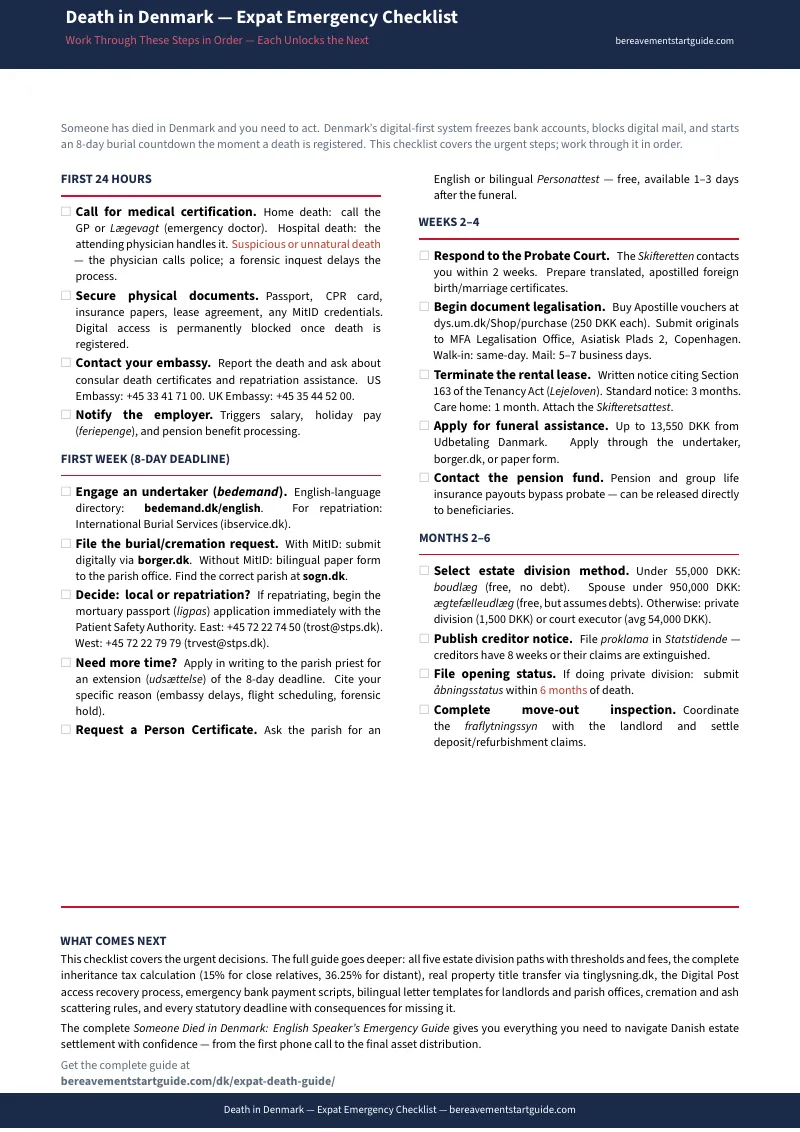
- Emergency Checklist — 20 action items across four time phases (first 24 hours, first week, first month, first six months) so nothing falls through the cracks while you are managing grief and bureaucracy simultaneously
- Professional Necessity Matrix — a decision framework showing exactly when you need a lawyer, a funeral director, a notary, or a tax advisor — and when you are paying for services you can handle yourself
- Estate Pathway Decision Tree — the five probate pathways mapped against your estate's value, family structure, and solvency status, with the court fees and deadlines for each
- Repatriation Document Checklist — the five documents required for a mortuary passport, in the exact submission order, with contact details for the Patient Safety Authority and the MFA Apostille webshop
- Bank Identity Requirements Reference — the accepted ID types for Danish banks, the Power of Attorney exception that lets one representative handle everything, and the digital upload limits for online estate management
- Estate Tax Calculator Reference — the 2025 and 2026 thresholds, rates for close relatives (15%) versus distant beneficiaries (36.25%), and the funeral benefit asset test
- Timeline Planner — every statutory deadline from the 8-day burial requirement through the 15-month final estate statement, mapped on a single printable timeline
Who This Is For
- Expats living in Denmark whose spouse, parent, or family member has died — who may hold a CPR number and MitID but have never navigated the legal system or probate courts in Danish
- Family members managing remotely from the US, UK, Canada, Australia, or anywhere else — who have no CPR number, no MitID, and no access to Danish digital systems
- Tourists and temporary visitors' families dealing with an unexpected death during travel or short-term business in Denmark — facing immediate repatriation pressure with no local infrastructure
- Executors and administrators who need to navigate frozen bank accounts, probate court filings, and estate tax obligations across two legal systems
- Pre-planners with family living in Denmark who want to understand the process before a crisis hits
Why Free Information Falls Short
The embassy gives you a list of funeral directors. The probate court website is in Danish. Borger.dk — Denmark's central government portal — has an English section, but it covers the basics for residents, not the crisis-level detail an English speaker needs when navigating repatriation, estate tax, and cross-border inheritance. Expat forums share anecdotes, but many describe pre-2016 translation rules that are now obsolete.
The information exists. It is scattered across the parish registry, the CPR system, the probate court, the Patient Safety Authority, the Ministry of Foreign Affairs, Udbetaling Danmark, the Danish Tenancy Act, and the banking sector's AML compliance requirements. Piecing it together while grieving takes dozens of hours across multiple Danish-language government portals. One missing Apostille, one overlooked filing deadline, one identity document not collected from a distant heir — and the entire process stalls.
— Less Than One Hour of a Danish Lawyer's Time
A court-appointed executor costs an average of DKK 54,000. A missed Apostille means a return trip to Copenhagen or weeks of postal delays. An overlooked identity requirement from one heir freezes every bank account for another month. If the guide prevents one missed deadline, one unnecessary professional appointment, or one rejected document submission, it has paid for itself before you finish the first chapter.
Every purchase includes a money-back guarantee, no time limit. If the guide does not give you the clarity and structure you need to navigate this crisis, email us for a full refund.
The free Emergency Checklist covers the 20 most critical actions across four time phases — the ones with hard deadlines and immediate financial consequences. The full guide covers every chapter in depth: the CPR cascade, bank account unfreezing procedures, all five probate pathways, repatriation logistics, estate tax calculations, tenancy liquidation, and the detailed timeline that keeps Danish bureaucracy moving while you focus on your family.