
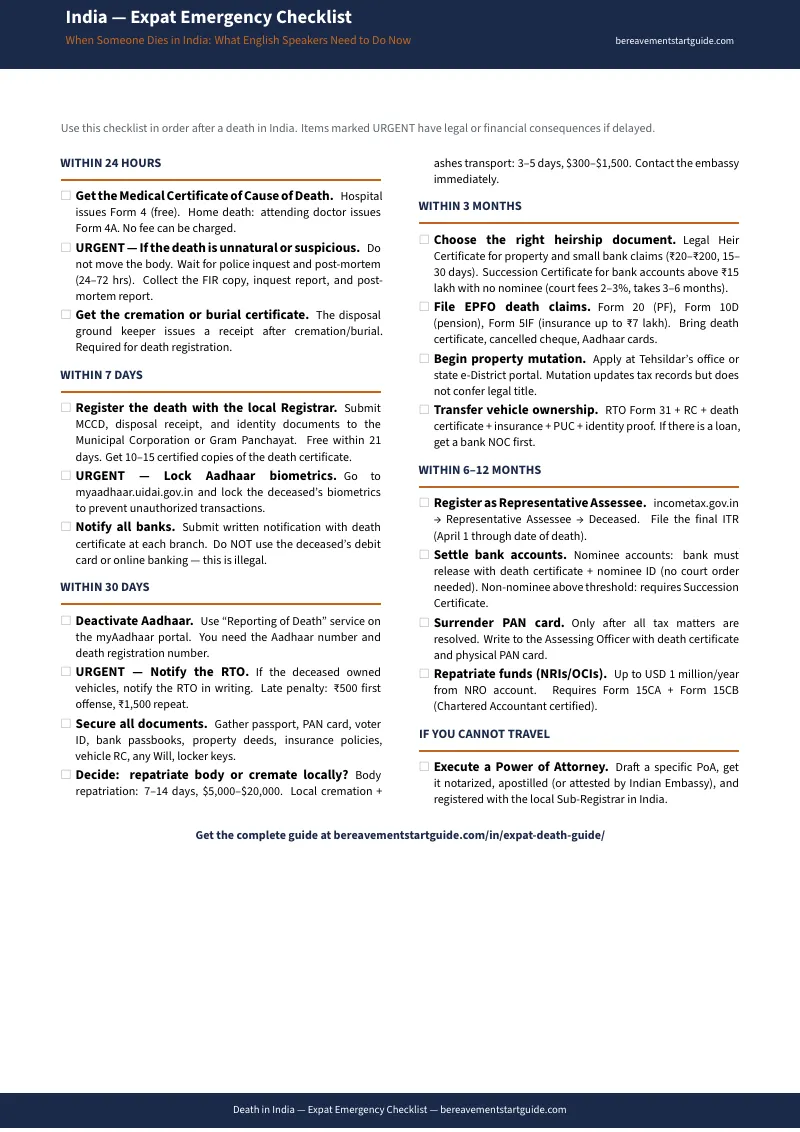
Someone You Love Just Died in India. You Have 21 Days Before the System Punishes You for Waiting.
The death certificate window closes in three weeks. Banks freeze accounts the moment they learn. Relatives with proximity can file mutation claims while you're still booking a flight. And every municipal officer you'll deal with speaks in a language of forms, stamps, and processes designed for locals who already know the system.
You don't. And you can't afford to learn by trial and error — not when every misstep costs months, thousands of dollars, or permanent loss of property rights.
The India Bereavement Command System
This isn't a pamphlet of sympathy and vague advice. It's a sequenced operational playbook built for English speakers who need to protect assets, move paperwork, and get results from Indian bureaucracy — whether you're sitting in New York, London, Sydney, or Dubai.
The guide maps every decision point in order: what to do in the first 48 hours, which certificate unlocks which asset, how to stop relatives from filing claims on your behalf, and exactly how to get money out of India legally.
It covers the December 2025 probate abolition that most Indian lawyers haven't caught up with yet — and gives you the exact gazette references to counter any local officer who still demands probate. It covers the post-July 2024 tax rules that changed how NRIs pay capital gains on inherited property. And it covers the FEMA repatriation process that lets you move up to USD 1 million per year out of NRO accounts with the right paperwork.
What's Inside
- The Day 1–14 Emergency Protocol — hospital release, death registration, police inquest (if needed), and consular transit procedures for both body repatriation and ash transport
- The Certificate Decision Map — a clear flowchart showing whether you need a Legal Heir Certificate (15–30 days, minimal cost) or a Succession Certificate (3–6 months, 2–7% of estate value) based on your specific asset mix
- Bank Claim Scripts and Templates — nominee fast-track procedures, indemnity bond drafts on non-judicial stamp paper, and escalation language for when branch managers illegally demand court orders
- The Property Mutation Roadmap — state-specific steps to update land registry records before someone else does, including the Unregistered Will Protocol with witness affidavit templates
- Remote Execution Playbook — how to settle 90% of the estate from your home country using FEMA-compliant Power of Attorney, e-District portals, DigiLocker, and consulate authentication
- The NRI Tax and Repatriation Guide — post-July 2024 LTCG rules (12.5% flat, no indexation for NRIs), Form 15CA/15CB walk-through, and the USD 1M/year repatriation pipeline
- Religious Succession Laws Decoded — Hindu Succession Act class shares, Muslim personal law, Indian Succession Act for Christians and Parsis — all in plain English with worked examples
- The Document Master Checklist — every form, certificate, ID, and stamp paper you'll need, organized by task and deadline
Who This Is For
- NRI and OCI cardholders whose parent just died in India and assets are at risk
- Expats and tourists dealing with a travel companion's death on Indian soil
- Family members abroad trying to manage an estate without flying to India for months
- Anyone facing a bank, registrar, or housing society that's stonewalling their legitimate claim
Why Free Information Won't Cut It
The forums are full of people who tried to piece this together from Reddit threads and government portals. Here's what happens:
- They apply for the wrong certificate and lose three months
- They use their father's ATM card to "just withdraw the money" and trigger a fraud investigation
- They skip property mutation and discover a year later that a local relative filed encroachment claims
- They send money abroad without Form 15CB and get flagged by FEMA compliance
- They accept a tout's offer to "expedite" things for ₹50,000 when the official fee is ₹500
Every one of those mistakes costs more than this guide — in money, in time, or in assets you'll never recover.
The Indian system isn't broken. It's complex, layered, and designed for people who already know the shortcuts. This guide is the shortcut for everyone else.
Updated for 2025–2026
This isn't recycled advice from 2019. The guide reflects:
- The December 2025 Repealing and Amending Act (probate abolition)
- Post-July 2024 capital gains rules for NRIs (12.5% flat, no indexation)
- Current e-District portal procedures and DigiLocker integration
- Latest RBI Banking Ombudsman escalation routes
- EPFO death claim digitization (2025 update)
— Less Than One Hour of a Cross-Border Lawyer's Time
A single consultation with an NRI estate lawyer runs ₹5,000–₹15,000. A full-service firm charges lakhs. A succession certificate alone costs 2–7% of the total estate value in court fees.
This guide won't replace a lawyer for complex litigation. But for the 80% of administrative estate work that doesn't require court — death registration, bank claims, property mutation, tax filings, repatriation paperwork — it tells you exactly what to do, in what order, with the exact forms and scripts you need.
Download the free checklist to see how this works. Ready for the full system? Get everything above and never wonder "what do I do next?" again.
Frequently Asked Questions
What if the rules change after I buy?
We update the guide when the rules change. Email us any time, even years later, and we'll send you the current edition free.