The Phone Call That Changes Everything
Someone you love has died in Peru. Within hours, every bank account under their name is frozen. The body may be held at the Instituto de Medicina Legal pending a prosecutor's clearance you did not request. Government offices — RENIEC, SUNARP, the notary, the municipality — each control one piece of what needs to happen next, but none of them explain the other's piece. And all of it is in Spanish, under a civil-law system that works nothing like what you know from home.
You are left searching for answers in a language you may not speak, hoping you do not accidentally trigger a jurisdictional rejection that forces you to restart the entire succession process from scratch.
The Peruvian Estate Navigator
The Someone Died in Peru: English Speaker's Emergency Guide is the consolidated reference that RENIEC, SUNARP, your embassy, and the banks will never give you — because each one only explains their fragment. This guide maps the connections between all of them, in plain English, from the first emergency call to the final SUNARP property transfer.
Every Peruvian legal term is translated and explained the first time it appears. Every government form is named so you can find it. Every deadline is flagged so you do not miss it.
What's Inside
Emergency First 24 Hours
Who to call when someone dies in Peru, what triggers mandatory Fiscalía involvement and an autopsy at the Instituto de Medicina Legal, and how to secure the remains before decisions are made without your input. You will know exactly what happens at the hospital, at the morgue, and at the prosecutor's office — and what you can and cannot control.
Death Registration — The Exact Sequence
The path from medical death certificate to certified acta de defunción at RENIEC, including why translating any document before the final RENIEC certificate is issued wastes your money — the translation becomes legally void when the official certificate replaces the preliminary one.
Repatriation — Permits, Costs, and Logistics
The TUPA N° 170 sanitary transfer permit process: the S/ 90.20 fee paid at Banco de la Nación, the virtual filing through Mesa de Partes, and the 2-business-day turnaround. Casket air freight requirements (embalming, airtight coffin, air cargo coordination) versus the simpler rules for cremated ashes as carry-on baggage. Every document you need, in the order you need it.
Two Paths Through Succession — Decoded Without Jargon
The notarial route (sucesión intestada notarial, 30–45 business days, S/ 1,000–3,000) versus the judicial route (12 months to years, mandatory lawyer, S/ 2,000–5,000+). The guide explains who qualifies for the faster notarial path — all adult heirs in agreement, no disputes — and what pushes you into the judicial track. Including the mandatory newspaper publication in El Peruano, the 15-day opposition window, and the final SUNARP registration.
The Forced Heirship Map
Peru reserves two-thirds of every estate for forced heirs (surviving spouse and children), regardless of what any foreign will says. Before that division, the Sociedad de Gananciales splits marital property 50/50. And if the deceased lived with an unregistered partner? The cohabitation trap (Unión de Hecho) means that partner has zero automatic rights unless they registered the relationship at SUNARP during the couple's lifetime — or win a post-mortem judicial claim proving two years of continuous cohabitation. The guide walks through every scenario with real calculations.
Frozen Accounts and Financial Recovery
How to use the free SBS Herederos Informados service to discover every bank account, insurance policy, pension balance, and consumer debt the deceased held nationally — delivered within 11–12 business days. Then the exact document package each bank requires to unfreeze funds, including the critical detail that your SUNARP literal copy must be less than 15 calendar days old or the bank will reject it.
Property Transfers at SUNARP
The last-domicile jurisdiction rule that catches foreign heirs every time — file in the wrong province and SUNARP issues a tacha sustantiva that forces you to restart from zero. The 10-year squatter claim deadline (prescripción adquisitiva) that can cost you the property entirely if you delay registration. And the S/ 46.00 per-property transfer fee for the second registration step that most guides do not mention.
Tax and Debt — The Reassuring Truth
Peru charges 0% inheritance tax — no estate tax, no gift tax, no wealth tax, regardless of the estate's value or the heirs' nationality. The municipal transfer tax (Alcabala) is also exempt for death transfers. Heirs are protected by limited liability under Article 661 — you respond for debts only up to the value of the inherited assets, never with your own money. Plus the post-March 2025 seguro de desgravamen update on mortgage insurance.
Remote Management — Powers of Attorney
Three consular power of attorney options for heirs who cannot travel to Peru: Poder por Escritura Pública ($45+ USD, broadest scope, covers real estate and court), Poder fuera de Registro ($25 USD, administrative tasks, one-year limit), and Carta Poder ($20 USD, three-month limit, utility cancellations only). The guide matches each one to the specific tasks you need done.
Who This Is For
- Expats in Peru who have lost a spouse, parent, or partner and are facing the bureaucracy alone
- Family members overseas who have just learned about a death in Peru and need to act from the US, UK, Canada, or Australia
- Tourists and temporary residents dealing with an unexpected death during a trip
- Corporate HR teams managing an employee death in Peru and needing a compliant, immediate protocol
- Cross-border estate lawyers and trust officers who need a Peru-specific operational reference
Why This Exists
Peru's government agencies are thorough within their own domains. But each one publishes guidance for its piece only — RENIEC for death certificates, SUNARP for property registration, SBS for financial discovery, MINSA for sanitary permits. None of them explain how their processes depend on each other. And none of them publish instructions in English.
Free online information is scattered across embassy pages, expat forums, and funeral home websites — each covering a fragment, many outdated, some dangerously wrong about jurisdiction rules or forced heirship calculations. Following the wrong advice in a civil-law system can trigger irreversible property forfeiture.
The alternative is hiring a Peruvian estate lawyer at S/ 200–500 per hour for work you could direct yourself with the right sequence and the right questions.
What You Get
- The Complete Guide — 15 chapters covering emergency response through final asset distribution, with every Peruvian form named and every deadline flagged
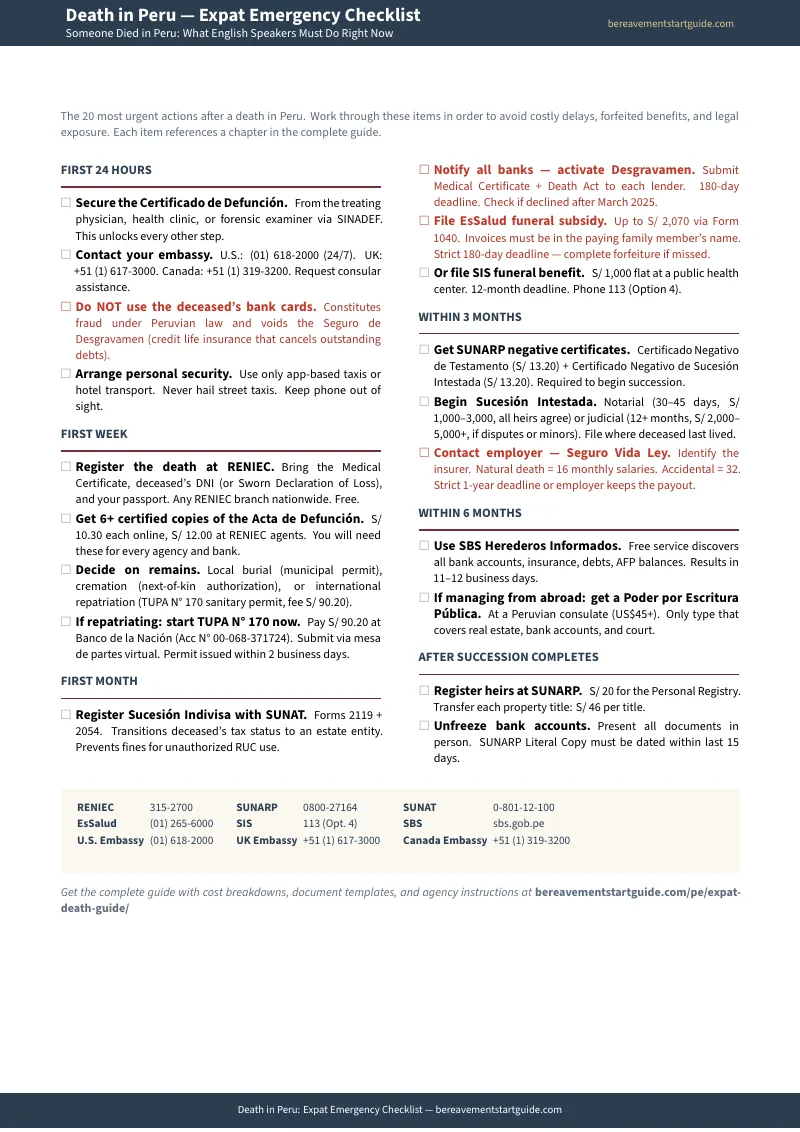
- Emergency Checklist — a printable step-by-step covering the critical first actions
- 8 Standalone Printable Tools — cost reference sheet, agency contact directory, document checklist, consular power of attorney comparison, succession path decision guide, common mistakes reference, bank account unfreezing worksheet, and repatriation permit checklist
— less than one hour of a Peruvian estate lawyer's time.
100% Satisfaction Guarantee
If the guide does not give you a clear path through Peruvian estate settlement, email hello@bereavementstartguide.com for a full refund. No time limit, no questions.
Start With the Free Checklist
Download the Death in Peru — Expat Emergency Checklist to see the format, then decide if the full guide is right for your situation.
Frequently Asked Questions
What if the rules change after I buy?
We update the guide when the rules change. Email us any time, even years later, and we'll send you the current edition free.