
The bank accounts are already frozen. The visa clock is already running. Here's the playbook nobody gave you.
Someone close to you has died in Saudi Arabia. Within hours of the hospital pronouncement, the Saudi Central Bank (SAMA) sent an automated signal to every commercial bank in the Kingdom. Every account, every joint account, every safe deposit box tied to that person's Iqama — locked. Your debit cards stopped working. Your standing orders failed. Your Power of Attorney was instantly canceled.
And that's just the financial side. The sponsor system now controls whether the remains can leave the country. The Passport Office won't issue an exit visa until traffic fines are cleared, vehicles are transferred, and the Labour Office confirms that End-of-Service Benefits have been settled. The embassy can register the death and issue a No Objection Certificate, but they cannot pay repatriation costs, represent you in court, or navigate the Arabic-language ministries on your behalf.
You're not looking for sympathy right now. You're looking for the sequence — which office triggers which, what to file before what, and how to keep your family afloat while every system around you says "wait."
The Saudi Clearance Pipeline — mapped, sequenced, and translated
Free resources give you pieces. The British Embassy's bereavement pack lists phone numbers. The US Embassy fact sheet describes general consular services. Expat forums share stories from 2019 that don't account for the Personal Status Law of 2022 or the Civil Transactions Law of 2023. None of them show you the full pipeline — the exact sequential clearance process that connects the hospital to the airport cargo terminal.
This guide maps the entire Saudi clearance pipeline from the moment of death to the final exit visa, in the order the Kingdom's bureaucracy actually requires. Every step references the specific ministry, the specific document, and the specific dependency that must be cleared before the next step can begin.
What's inside
- 72-hour emergency protocol — the first three days are the most critical. This chapter tells you exactly who to call, what to secure, and which documents to photocopy before the sponsor system activates. Miss this window and you lose leverage you can't get back.
- The SAMA freeze survival system — the automated bank freeze catches every expat family off guard. This section explains the freeze mechanism, the joint-account suspension trap (Saudi Arabia has no right of survivorship), and the legal routes to access funds through the Sharia court while the estate is locked. It covers the exact documents banks require to release funds to verified heirs.
- The four-envelope clearance process — the police-to-airport pipeline that most guides skip entirely. After the consular NOC is attested by the Ministry of Foreign Affairs, the City Principality issues four sealed envelopes addressed to the mortuary, the Passport Office, the airport cargo office, and customs. This chapter walks you through each envelope, what it authorizes, and what happens if one gets rejected.
- Sponsor dependency navigation — under Saudi labor law, the sponsor (kafeel) is legally responsible for all administrative procedures and repatriation costs. When the sponsor cooperates, the process moves. When the sponsor stalls, goes bankrupt, or disappears, you need an escalation path. This chapter covers Ministry of Human Resources complaints, court-ordered coordination transfers, and GOSI insurance claims.
- Repatriation logistics — embalming timelines at approved government facilities, zinc-lined coffin specifications for international cargo, the 6-to-12-hour airport delivery window, and airline cargo booking procedures. Includes a cost comparison between government facilities and private funeral homes (which typically charge three to five times more for the same service).
- Local burial protocols — cremation is prohibited. Non-Muslim burials are restricted to designated cemeteries in five cities. Muslim burials follow the rapid Islamic timeline. This chapter explains the options, the inter-city transport restrictions, and the permits required for each route.
- Sharia inheritance and the one-third rule — the faraid system of mandatory inheritance shares applies to all assets held in Saudi Arabia, regardless of the deceased's nationality or religion. You can direct a maximum of one-third through a will (wasiyyah). The remaining two-thirds follows fixed ratios. This chapter explains the shares, the religious bar on cross-faith inheritance, and how to structure both local and offshore holdings.
- Iqama and dependent visa crisis — when the primary sponsor dies, dependents face a countdown to find a new sponsor or exit the country. This chapter covers the transfer procedures, the grace period timeline, and guardianship risks for minor children (under default Sharia rules, custody does not automatically transfer to the mother).
- EOSB calculator and labor law settlement — the employer owes End-of-Service Benefits, accrued leave, and any outstanding salary. This chapter explains how to calculate the correct amount, what the Labour Office requires before issuing clearance, and how to dispute underpayment.
- Document legalization pipeline — Saudi death certificates, court orders, and inheritance certificates all require MOFA attestation before they're recognized abroad. This chapter maps the attestation sequence and explains how to avoid the name-discrepancy trap that sends files back to the Civil Affairs Head Office in Riyadh for weeks of correction.
- Ready-to-use templates — sponsor notification letters, bank account release requests, Labour Office correspondence, and ministry communications. Each template includes the English text with Arabic translation guidance and notes on which ministry office accepts which format.
10 printable PDFs — print what you need, when you need it
The full guide plus 8 standalone worksheets, reference cards, and templates you can print individually and bring to the bank, the ministry, or the embassy:
- Emergency contacts and agency directory — every phone number, portal, and embassy on one printable sheet, plus a communication tracker
- Settlement timeline — the complete phases from day 1 through month 6, with common delays and how to avoid them
- EOSB calculator worksheet — fill in salary and years of service to calculate exactly what the employer owes
- SAMA bank freeze action plan — step-by-step plan for navigating the freeze and releasing funds
- Document legalization checklist — track every document through the apostille or legalization pipeline
- Sponsor notification letters — three ready-to-send templates: death notification, bank release request, and MHRSD complaint
- Sharia inheritance quick reference — the faraid shares, the one-third rule, and the heirship certificate process at a glance
- Exit sequence checklist — the four-phase closing order that must be followed exactly, with a tracking log
Who this guide is for
- Expat spouses and dependents in Saudi Arabia whose partner or family member has just died — you need the sequence, not sympathy
- Family members abroad coordinating repatriation from the UK, US, India, Philippines, or anywhere else — you need to know what you can do remotely and what requires boots on the ground
- Corporate HR and global mobility managers handling a deceased employee's final affairs — you need a standard operating procedure that protects the company from Ministry fines and labor disputes
- Long-term expats planning ahead who recognize the conflict between Sharia forced heirship and their personal wishes — you need the asset structuring strategies before a crisis forces your family into a system designed for a different legal tradition
Why not piece it together for free?
You could. The FCDO bereavement pack covers the basics. Embassy fact sheets list emergency numbers. Reddit threads share experiences from people who went through it years ago.
But here's what free resources don't give you: the sequence. Saudi bereavement administration is a strictly sequential pipeline — an error or omission at any step stalls the entire process. The embassy can't tell you that the Passport Office won't issue the exit visa until traffic fines are cleared and vehicles are transferred. The embassy can't explain that the Labour Office clearance must happen before the Passport Office will even open your file. No forum thread maps the four-envelope system because most expats go through this once and never write it down comprehensively.
This guide exists so you don't have to reconstruct the pipeline under grief, sleep deprivation, and a ticking visa clock.
The free checklist or the full guide — your choice
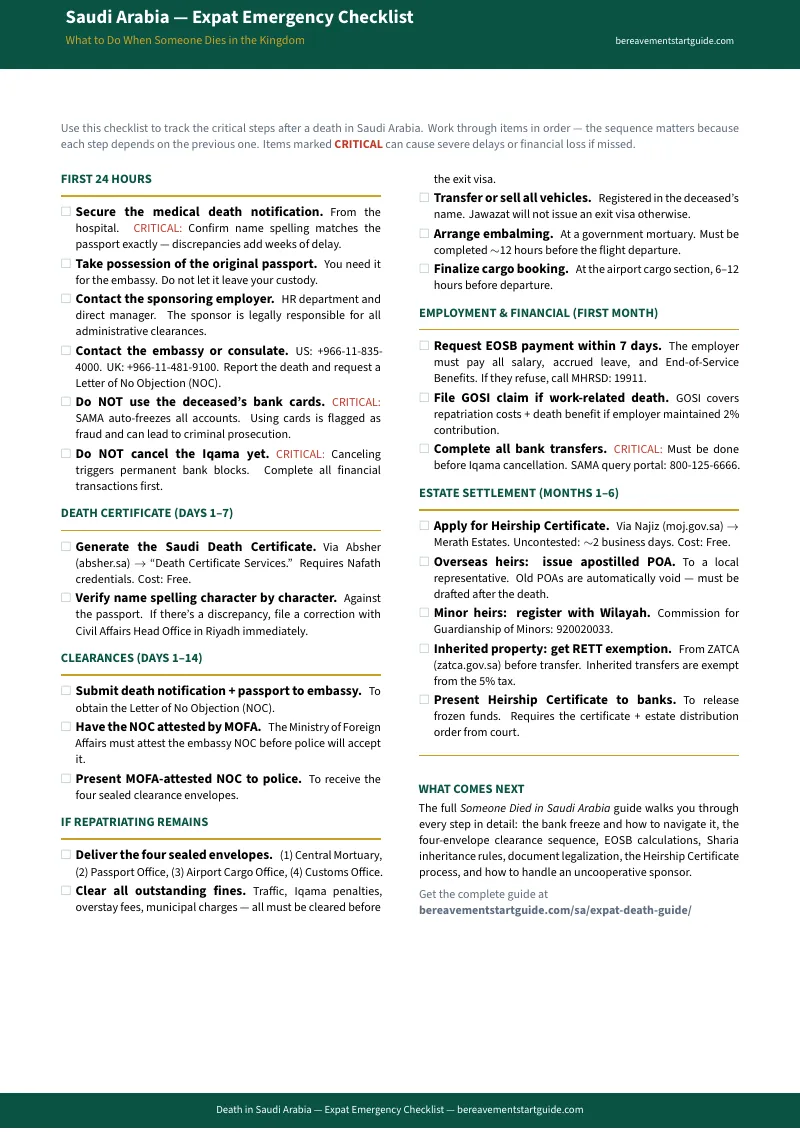
The free Death in Saudi Arabia — Expat Emergency Checklist gives you the critical first steps: the calls to make, the documents to secure, the deadlines that matter most. It's enough to get through the first 48 hours without making an irreversible mistake.
The full guide goes deeper — the complete clearance pipeline, the SAMA freeze workarounds, the Sharia inheritance framework, the sponsor escalation paths, and every template you need to communicate with Saudi ministries in a system that doesn't operate in English.
— less than one hour of a Saudi-licensed lawyer's consultation fee. One-time purchase, instant download, no subscription.
Frequently Asked Questions
What if the rules change after I buy?
We update the guide when the rules change. Email us any time, even years later, and we'll send you the current edition free.