— The Indiana Execution System That Turns a Free Form Into a Legally Bulletproof Directive
Indiana hospitals give you a blank advance directive PDF. Indiana law gives you the right to fill it in yourself. Neither one tells you that your document has two different sets of witness rules — and picking the wrong witness for the wrong section voids the entire thing.
Under Senate Enrolled Act 204, Indiana consolidated three separate documents into a single advance directive. The old healthcare power of attorney, the healthcare representative appointment, and the living will declaration are now one form. That simplification was supposed to make things easier. Instead, it created a new failure mode: families download a pre-2023 template from a hospital website, fill in all three sections, get their neighbor and sister to witness it — and discover at the ICU that the living will section is invalid because the sister is a potential heir.
The form was never the hard part. Execution is the hard part.
The Indiana Advance Directive & Living Will Kit is a complete execution system — not a blank form, but the 18-chapter operational guide that walks you through every Indiana-specific rule, every witness exclusion, every signing procedure, and every coordination step between your legal directive and the clinical orders that EMTs actually follow.
What the Free Hospital PDF Doesn't Cover
- The dual witness trap. Your Healthcare Representative section requires two adult witnesses with moderate restrictions. Your Living Will Declaration section enforces far stricter exclusions — no parent, spouse, child, heir, named HCR, or anyone financially responsible for your care. The kit provides both checklists side by side so you screen witnesses once and get both sections right.
- Remote signing under SEA 204. Indiana now allows advance directives to be signed electronically over live video with a notary or two witnesses. Paper counterparts must be assembled into a single file within 10 business days. No hospital PDF mentions this option or explains the procedural requirements. The kit includes the full remote execution checklist.
- POST and DNR coordination. Your advance directive is a legal planning document. EMTs are not required to find it or follow it during an emergency. A POST (Physician Orders for Scope of Treatment) form is a clinical order your physician signs — EMTs must follow it immediately. A DNR has its own separate requirements. The kit explains when you need all three, how to initiate the POST conversation, and how to ensure your clinical orders match your legal instructions.
- The pregnancy exception. Indiana law makes your living will automatically inoperable during pregnancy — no exception, no override clause, no workaround. If you are pregnant and lose capacity, your living will instructions will not be followed. The kit explains the restriction so you and your Healthcare Representative understand the gap.
- Transfer-on-Death deed traps. A TOD deed bypasses probate — but it is completely void if not recorded before death. Both spouses must sign if the home is held as tenants by the entirety. Recording by only one joint tenant severs the joint tenancy entirely. The kit covers every recording requirement, the auditor endorsement step, and predeceased beneficiary lapse rules.
- Medicaid estate recovery under the new 9-month window. Indiana is an expanded-estate state. The FSSA can pursue recovery claims against homes transferred via TOD deed, joint accounts, and revocable trusts. Effective July 2026, the state's filing window expanded from 120 days to 9 months. The kit covers every survivorship block, the caregiver child exemption, and the strict 90-day hardship waiver deadline.
What's Inside the Kit — 7 Printable PDFs
- 18-chapter Indiana-specific guide (guide.pdf) — SEA 204 requirements, Healthcare Representative appointment, living will instructions, POST/DNR coordination, psychiatric directives, remote execution, witness rules, TOD deeds, $100,000 small-estate threshold, Medicaid recovery, organ donation, revocation procedures, probate process, tax rules, and a complete action sequence
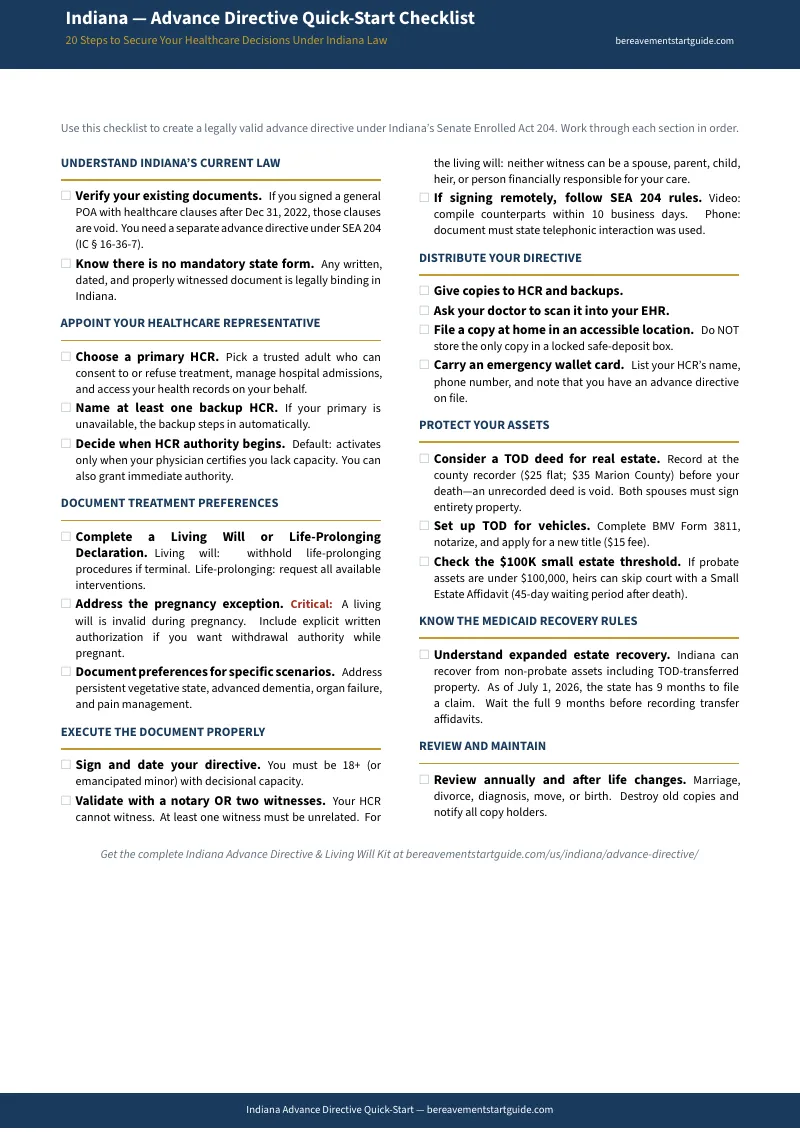
- 20-item quick-start checklist (checklist.pdf) — printable reference covering the entire process from values clarification through copy distribution, with page references back to the full guide
- Dual witness eligibility checklists (witness-eligibility-checklists.pdf) — standard section vs. living will section, side by side, with a fill-in section to record and verify your planned witnesses
- Remote execution checklist (remote-execution-checklist.pdf) — every SEA 204 procedural requirement for video/teleconference signing, including the 10-business-day assembly deadline
- POST & DNR coordination guide (post-dnr-coordination.pdf) — document comparison table, when you need clinical orders, and step-by-step instructions for getting a POST form
- TOD deed execution guide (tod-deed-guide.pdf) — recording requirements, auditor endorsement, tenancy rules, predeceased beneficiary provisions, and vehicle TOD designation
- Medicaid recovery protection guide (medicaid-recovery-guide.pdf) — the expanded 9-month timeline, what MERP can and cannot reach, mandatory exemptions, and the strict 90-day hardship waiver deadline
Who This Kit Is For
The adult child helping an aging parent. You need your parent's wishes documented before a diagnosis makes capacity an issue — and you need the witness rules explained clearly so you do not accidentally bring the wrong family members to the signing.
The person facing surgery. Your pre-admission paperwork asks about advance directives. You need a valid directive completed before your procedure — not a template from a national website that still uses the pre-2023 three-document format.
The unmarried partner. Under Indiana's default hierarchy, your partner's parents and siblings make medical decisions before you do. An advance directive with an HCR designation is the only document that puts you first.
The homeowner coordinating estate planning. You want to avoid probate using a TOD deed and the $100,000 small-estate threshold — and you need to understand how Medicaid recovery could reach the house even after a TOD transfer.
Why Not the Free Form?
Hospital PDFs and state agency forms are free and technically functional. They give you blanks to fill in. They do not tell you that the living will section requires different witnesses than the healthcare representative section. They do not cover remote signing under SEA 204. They do not explain POST/DNR coordination. They do not mention that a TOD deed is void if not recorded before death. And they do not address the Medicaid recovery rules that can reach the family home even through a probate-avoidance transfer.
National platforms like LegalZoom, Rocket Lawyer, and eForms charge a monthly subscription for multi-state templates with Indiana's name inserted. They do not cover the dual witness exclusion rules, the remote execution procedures, the $100,000 small-estate threshold, or the expanded 9-month Medicaid recovery window.
An Indianapolis elder law attorney handles all of this — for $200–$400 per hour and $1,500+ for a comprehensive plan. Indiana law says you can execute your own advance directive without an attorney. The kit gives you the execution system to do it correctly.
Your Family's Medical Decisions Are Already Assigned
Indiana's statutory hierarchy is in effect right now. If you lose the ability to communicate tomorrow, someone on a list you did not write will make decisions about your ventilator, your feeding tube, and your pain medication. The kit costs — less than one hour of an elder law attorney's time — and gives you the complete Indiana-specific system to override that default list, execute your directive correctly on the first attempt, coordinate with clinical orders, and protect your home from probate and Medicaid recovery.
Not ready for the full kit? Download the free Indiana Advance Directive Quick-Start Checklist — a printable one-page reference with the critical steps, witness eligibility rules, and distribution targets.
Frequently Asked Questions
What if the rules change after I buy?
We update the guide when the rules change. Email us any time, even years later, and we'll send you the current edition free.