Your Family Is Counting on You — and the Lamay Starts Tonight
When someone dies in a Filipino Catholic family, the planning pressure is immediate and relentless. The lamay — the multi-day overnight wake with open casket, continuous prayer, and communal food — often begins within hours. The parish needs to schedule a Requiem Mass, but availability depends on the day, the priest, and whether your family can produce the right paperwork. The LCRO requires death registration within 30 days or you face a delayed registration process with affidavits and negative certifications. Your lola insists nobody sweep the floor. Your tita wants to know when the pasiyam starts. Your cousin in Saudi Arabia is wiring money and asking if the casket has been chosen yet.
The parish hands you a readings list. The funeral home hands you a pricing sheet. Neither one tells you how to run a multi-night lamay at home, how to claim SSS funeral benefits as an unmarried partner, how to coordinate a body repatriation from the Middle East, or how to handle the conversation when a well-meaning elder insists on folk customs that sit uneasily beside what the priest has told you to do.
The Filipino Funeral Coordinator — Everything Between the Parish and the Parlor That Nobody Else Covers
The Catholic Funeral — Philippines guide is a step-by-step planning companion that bridges the gap between what the parish priest handles and what the funeral director handles — covering the cultural, logistical, financial, and emotional decisions that fall entirely on the family coordinator.
It walks you through every stage of the traditional mourning sequence, from the first hour after death through the lamay, the Requiem Mass, the libing, the nine-night pasiyam novena, the 40th-day memorial, and the first-anniversary babang luksa. Every chapter gives you concrete actions: fill-in worksheets, word-for-word scripts, vendor screening questions, and timeline templates — not general advice, but tools you can use while you're making phone calls, coordinating with the parish office, and keeping the family together.
What's Inside
- First-48-Hours Crisis Checklist — the exact sequence of calls, decisions, and paperwork from the moment of death through funeral parlor selection, so nothing falls through the cracks while you're grieving and sleep-deprived
- Lamay Hosting System — room setup, food and drink rotation schedules for multi-night wakes, prayer leader assignments, overnight vigil coordination, abuloy ledger template, and visitor flow management
- Complete Pasiyam Planner — nine-night prayer schedules, rosary guide, home altar setup, family role assignments, food coordination across all nine evenings, and guidance on the 40th-day and babang luksa milestones
- Requiem Mass Navigation — how to schedule with the parish, which Scripture readings to choose, approved hymn selections including Tanging Yaman and Hindi Kita Malilimutan, how to clarify arancel expectations under the new voluntary stewardship model, and how to handle GKK membership requirements
- Pamahiin Decision Framework — every major folk custom (no sweeping, broken rosary, pagpag, no red clothing, lifting children over the casket, the palayok throw) presented alongside the Church's position and practical compromises families have used — so you can make informed choices without blindsiding traditional relatives
- SSS, GSIS, OWWA & DMW Benefits Walkthrough — contribution thresholds, documentation checklists, step-by-step claim procedures, and specific guidance for common-law partners filing funeral benefit claims through notarized waivers and joint affidavits
- Civil Registration Roadmap — LCRO death registration under RA 3753, the burial permit process, medical certification for unattended deaths, and the complete delayed registration procedure when the 30-day window is missed
- Cross-Border Repatriation Checklist — full-body repatriation paperwork (consular mortuary certificate, hermetic sealing, quarantine clearance), cremains transport with airline-specific rules, and OWWA/DMW assistance pathways for OFW families
- Vendor Screening Questions — exactly what to ask funeral parlors, chapel rental providers, caterers, and cemetery or columbarium operators before signing anything — with realistic price ranges from entry-level to premium so you know what you're comparing
- Regional Variation Boxes — Ilocano leaf-wash cleansing rites, Visayan prayer customs, Tagalog mourning practices, and provincial variations flagged clearly so you can confirm the local form with your own family elders
Who This Guide Is For
- Adult children planning a parent's funeral while managing their own grief and the expectations of extended family — including the lola who remembers how it was done fifty years ago and the siblings who disagree about cremation
- Surviving spouses navigating benefit claims, vendor decisions, and parish paperwork under emotional pressure — with clear, large-print checklists designed for someone who can barely focus
- OFW families coordinating a funeral or body repatriation across time zones, international paperwork, and the emotional weight of distance — whether the death happened abroad or at home while they were overseas
- Interfaith or non-practicing relatives who need to understand Catholic funeral requirements and Filipino mourning customs without prior liturgical knowledge — including phonetic Mass responses and respectful ways to participate
- Lay prayer leaders and mananabtan preparing to lead pasiyam devotions, graveside prayers, or wake rosaries with confidence and the right prayer texts
Why Free Resources Fall Short
Parish websites publish approved readings and liturgical requirements — but they don't cover the lamay, the pasiyam, or the pamahiin customs that your family expects you to navigate, because those fall outside the liturgy. Funeral home websites explain their packages and pricing — but they don't help you run a multi-night home wake, mediate a cremation disagreement with traditional elders, or claim SSS benefits as a common-law partner.
Government portals list LCRO requirements and SSS filing procedures — but they offer zero guidance on the cultural, spiritual, or emotional dimensions of what you're going through. Reddit threads give fragments of personal experience from different provinces — but advice varies wildly by region, some of it contradicts current Vatican guidelines, and none of it is organized into a sequence you can follow at 2 AM when the family is waiting for you to lead the rosary.
This guide integrates all four dimensions — canon law, civil procedure, folk tradition, and family dynamics — into one structured companion you can actually use during a crisis.
Satisfaction Guarantee
If the guide doesn't help you plan a more organized, less stressful funeral for your family, email us and we will refund your purchase. No forms, no time limit, no questions.
Get Started Now
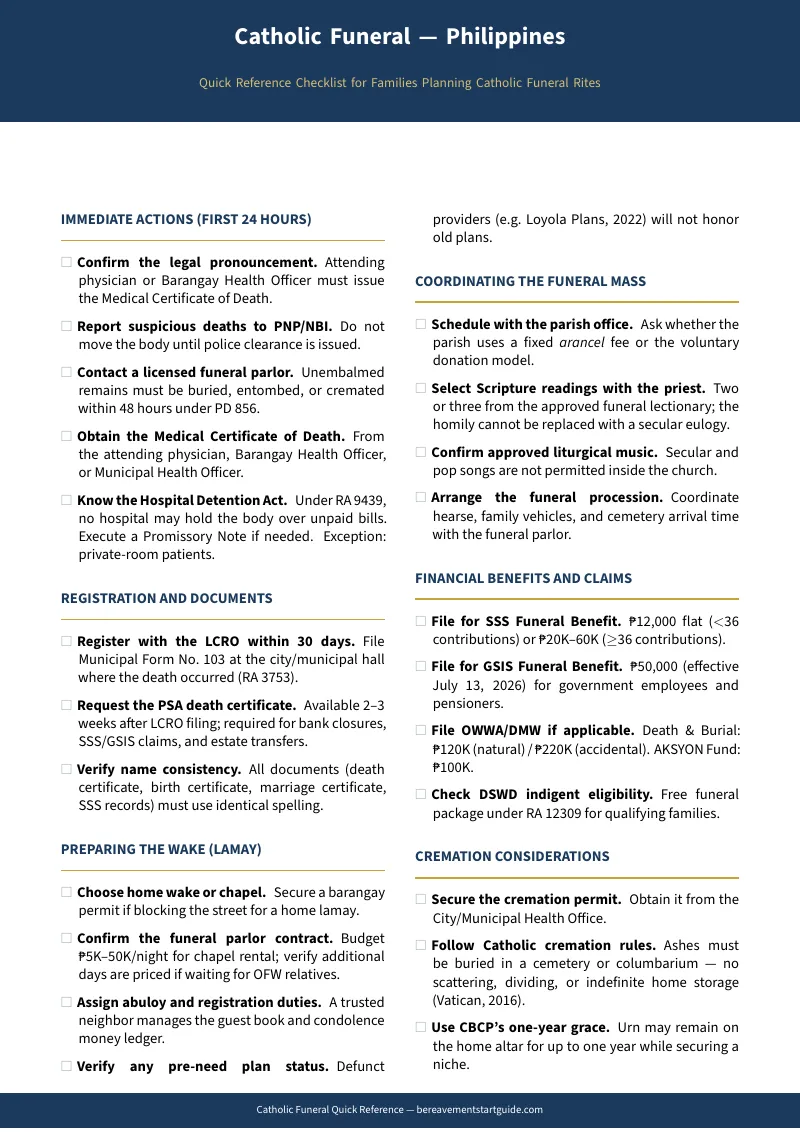
Download the free checklist to see the 29-item planning overview. When you're ready for the complete guide with step-by-step lamay hosting instructions, the full pasiyam planner, SSS benefit claim walkthrough, repatriation checklists, pamahiin decision framework, and all eight printable worksheets — get the full toolkit for and start planning with confidence.
Frequently Asked Questions
What if the rules change after I buy?
We update the guide when the rules change. Email us any time, even years later, and we'll send you the current edition free.