Your Indiana Estate Plan Has a Gap — and You Probably Don't Know Where It Is
You've done the responsible thing. You've thought about getting a will drafted, maybe looked into a trust, possibly even downloaded a free template. But somewhere between Indiana's common law property rules, the Transfer-on-Death deed requirements, and the Medicaid recovery rules that changed in July 2026, you're stuck. Not because you can't fill in a form — because you can't tell which forms you actually need, in what order, filed where.
That gap between "I have a template" and "my family is actually protected" is where estate plans fail. A will that wasn't witnessed correctly is void. A TOD deed that wasn't recorded before death transfers nothing. A POD bank account that you thought was safe from Medicaid recovery isn't — because Indiana is an expanded-estate state.
The Indiana Filing Roadmap
The Indiana Basic Estate Planning Kit is not another stack of blank forms. It is a step-by-step filing roadmap that connects every document in your estate plan to the specific Indiana statute that governs it, the office where you file it, and the deadline you cannot miss.
National platforms give you a will template and wish you luck. Court websites give you a blank affidavit with no context. This kit shows you how your will, your TOD deed, your healthcare directive, your vehicle title designation, and your beneficiary forms coordinate into a single plan — and what happens to your family if any one piece is missing or filed incorrectly.
What's Inside
- Will drafting walkthrough — every requirement under IC § 29-1-5-3 laid out step by step, including the self-proving affidavit language that lets your heirs skip witness testimony in probate court. Plus the counterpart will trap that national sites never mention — and that can void your document if you try to sign remotely without attorney supervision.
- Transfer-on-Death deed guide — how to prepare, execute, and record a TOD deed with your County Recorder. Covers the joint ownership traps that trip up most DIY planners: a TOD deed on a tenancy-by-the-entirety property is void unless both spouses sign, and a TOD deed on a joint tenancy severs the survivorship right and creates a tenancy in common.
- The $100,000 small estate shortcut — Indiana raised the small estate threshold in 2022. If your probate estate falls below $100,000, your heirs can bypass court entirely with a Small Estate Affidavit after a 45-day wait. The kit covers both the personal property affidavit and the separate devolution affidavit for real estate transfers — which has no value cap but requires a 7-month waiting period.
- Medicaid estate recovery explained — Indiana's expanded-estate rule means FSSA can pursue recovery against TOD deeds, POD accounts, and revocable trusts. The kit covers the new 9-month recovery window (effective July 1, 2026), the 90-day hardship waiver deadline, and exactly when a basic plan is sufficient versus when you need an elder-law attorney.
- Blended family protections — the second-spouse elective share rules under IC § 29-1-3-1, the intestacy distribution formula that gives a second spouse only 25% of real estate value, and how to structure your plan so your biological children and your current spouse are both protected.
- Vehicle and bank account transfers — BMV Form 3811 for Transfer-on-Death vehicle titles (transfers in 5 days, not 45), Payable-on-Death bank designations, and how these non-probate instruments must coordinate with your central will.
- Healthcare directives — Indiana Healthcare Representative appointment, living will under IC § 16-36-4, and HIPAA authorization — with the specific statutory language Indiana requires.
- County filing directory — recorder offices, BMV locations, and FSSA contact information for every step that requires a physical filing.
Standalone Worksheets and References
In addition to the 12-chapter guide, the kit includes 6 standalone printable PDFs you can use at your desk, at the county recorder's office, or at your financial advisor's:
- Estate Asset Inventory Worksheet — classify every asset by title type and calculate your probate exposure
- Beneficiary Coordination Worksheet — review every account's primary and contingent beneficiaries in one place
- TOD Deed Recording Checklist — step-by-step from title verification through county auditor endorsement to recording
- Key Deadlines Reference — every Indiana estate planning and probate deadline on one printable page
- Essential Forms Directory — every form number, issuing agency, and fee in a single reference card
- When to Hire a Professional — know when a basic kit is enough and when you need an attorney, CPA, or elder-law specialist
Who This Kit Is For
- Indiana homeowners who want to keep their home out of probate without paying $1,000–$3,500 for an attorney to draft a trust
- Parents of minor children who need a legally valid guardian nomination in writing — because without one, the court decides
- Families approaching retirement who need to understand Medicaid's 60-month look-back period and the expanded-estate recovery rules before it's too late to plan
- Blended families navigating the second-spouse distribution rules that can accidentally disinherit biological children
- Anyone who's been through Indiana probate as an executor and wants to spare their own family the paperwork, court dates, and delays
Why Not Free Templates?
Free will generators like FreeWill produce a basic document but leave you at the signature line. They don't include Indiana-specific TOD deed templates, don't explain the County Auditor endorsement process, and don't tell you that your POD bank accounts are exposed to Medicaid recovery under Indiana's expanded-estate definition.
Court websites give you the blank Small Estate Affidavit (Form 54985) but don't explain how the $100,000 threshold is calculated, what "gross probate estate" excludes, or how the 45-day waiting period interacts with the separate 7-month devolution affidavit for real estate.
An estate planning attorney will connect all these pieces — for $1,000 to $3,500. This kit gives you the same structural understanding at a fraction of the cost, and tells you exactly which situations require professional help so you don't waste money on services you don't need or skip protections you do.
Satisfaction Guarantee
If the kit doesn't give you a clear, actionable roadmap for your Indiana estate plan, email us and we'll make it right. No complicated process, no time limit.
Get the Free Checklist or the Full Kit
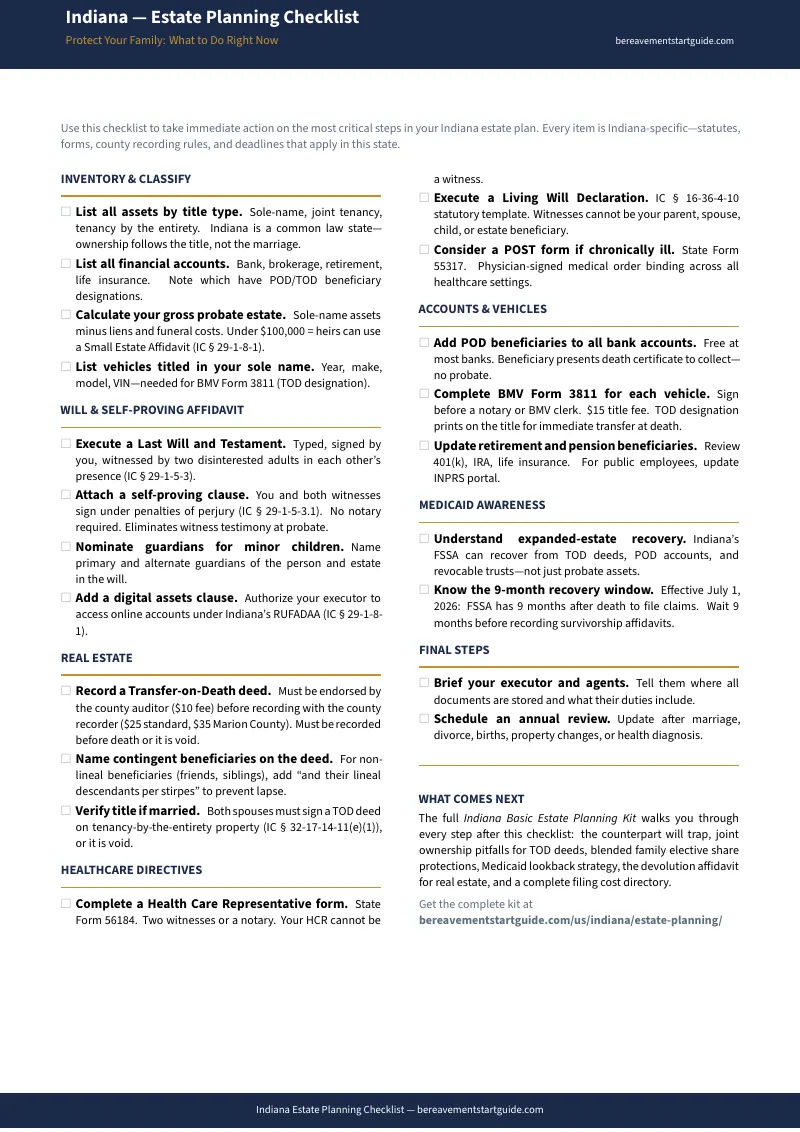
Download the free one-page estate planning checklist to see what your plan needs to cover. Ready for the complete step-by-step roadmap? Get the full Indiana Basic Estate Planning Kit — , one-time purchase, instant download.
Frequently Asked Questions
What if the rules change after I buy?
We update the guide when the rules change. Email us any time, even years later, and we'll send you the current edition free.