Iowa's Advance Directive Laws Are Clear. The Forms You're Finding Aren't.
The Iowa State Bar publishes Form 123. UnityPoint and MercyOne hand out blank PDFs during intake. LegalZoom runs you through a generic questionnaire built for all 50 states. Every one of these options leaves you with the same problem: a document you're not sure you executed correctly, covering medical decisions you're not sure it actually addresses.
Iowa's advance directive statutes are specific. Your witnesses can't include your healthcare agent, any healthcare provider, or their employees. At least one witness must be unrelated to you. If you miss a single exclusion, the document is void — and no one discovers the mistake until you're in a hospital bed unable to fix it.
And that blank form says nothing about the legal context surrounding your healthcare decisions. Iowa doesn't recognize Transfer-on-Death deeds for real estate. The abstract of title system means a documentation gap can freeze a property sale for months. Medicaid estate recovery under § 249A.53 can reach into joint tenancies and living trusts. Your healthcare proxy needs to coordinate with all of this — a form that only covers medical checkboxes leaves the rest to chance.
The Iowa Advance Directive Compliance System
This isn't a blank form. It's a guided compliance system that walks you through every Iowa-specific requirement — from choosing the right healthcare agent, to executing the documents with valid witnesses, to coordinating your medical directives with your property and Medicaid exposure.
You get the statutory forms, the execution checklist, the proxy selection guide, and the property coordination section — everything you need to get this done correctly in one sitting, without a billable hour.
What's Inside
- Iowa's combined Form 123, pre-formatted — The Chapter 144B Durable Power of Attorney for Health Care and Chapter 144A Living Will in one document. Structured so you can execute it with either two qualified witnesses or a notary public — your choice, with clear instructions for both paths.
- Witness eligibility checklist — Iowa's exclusion rules are stricter than most states. This checklist walks you through every disqualification before signing day, so you don't discover months later that your directive is invalid because a nurse or a cousin signed as witness.
- Healthcare proxy selection guide — How to choose your attorney-in-fact under Chapter 144B, what decisions they can and can't make, when their authority activates, and why Iowa's bar association warns against naming co-agents. Includes the hard conversations most families avoid — what happens if your first choice can't serve, and how to brief your proxy on your actual wishes rather than leaving them to guess.
- IPOST and DNR comparison — Iowa uses its own system (IPOST, not POLST) under Chapter 144D. The guide explains who qualifies, how an IPOST differs from an Out-of-Hospital DNR order, and how both interact with your living will — because most families don't realize these are separate documents with different legal authority.
- Organ donation and final disposition forms — Templates to document your preferences and name a representative, coordinated with your advance directive so there's no conflict between your healthcare proxy and family members.
- Revocation form with notification checklist — A standalone printable form. If your wishes change, a revocation isn't complete until your attending physician records it in your medical record. This form includes the notification steps most people skip — the ones that prevent an outdated directive from surfacing during an emergency.
- Storage and distribution plan — A standalone printable form with a distribution log, home storage rules, a cut-out wallet card, and a clear protocol for who gets the original (your physician), who gets copies (your agent, your family), and where the IPOST goes (the refrigerator door, not a safe deposit box that no one can access at 2 a.m.).
- Iowa property coordination section — How your healthcare decisions connect to Iowa's unique property rules. No TOD deeds means your home goes through probate unless you plan ahead. The abstract of title system punishes documentation gaps. The new $100,000 small-estate affidavit threshold (HF 2660, effective July 2026) only covers personal property — real estate still requires formal probate. This section shows you how to align your advance directive with your property planning so nothing falls through.
- Medicaid estate recovery overview — If you or your parent received Medicaid long-term care after age 55, Iowa will pursue recovery from the estate — including joint tenancies, life estates, and trusts. Covers the 30-day hardship waiver window, the income and asset limits, and the exemptions that delay (but don't eliminate) the state's claim.
Who This Is For
- Adults who want their healthcare wishes documented correctly — not with a generic template that ignores Iowa's witness exclusions, but with state-specific forms executed according to Chapters 144A and 144B.
- Adult children helping aging parents — A Durable Power of Attorney for Health Care must be executed while your parent still has legal capacity. Once a dementia diagnosis or cognitive decline advances past the threshold, you can't create this document — the only alternative is a costly, public court guardianship.
- Blended families navigating competing interests — Iowa's default statutory hierarchy hands medical decision-making authority to the spouse first, then a majority of adult children. In a blended family, that can mean a stepparent or step-siblings making healthcare decisions the patient would never choose. A Chapter 144B proxy designation is the only way to override the default.
- Homeowners coordinating healthcare and property planning — Your advance directive doesn't exist in a vacuum. If your home is your primary asset and Iowa doesn't allow TOD deeds, your healthcare proxy needs to understand how medical decisions intersect with property transfer rules.
Why a Free Form Isn't Enough
The Iowa State Bar and hospital systems provide blank forms. They don't provide instructions on Iowa's strict witness eligibility rules, guidance on choosing and briefing a healthcare proxy, explanations of how a living will interacts with an IPOST or DNR, or any coordination with property planning and Medicaid exposure.
National platforms like LegalZoom use one-size-fits-all templates. They don't distinguish between Iowa's IPOST and the generic POLST used elsewhere. They don't mention that Iowa lacks TOD deeds or that the abstract of title system creates risks that other states don't have. They charge a monthly subscription for something you should only need to set up once.
An estate planning attorney in Iowa charges $350 or more per billable hour. For standard advance directives — which Iowa law explicitly allows you to execute yourself using statutory forms — that's an unnecessary expense for most families.
This kit gives you the guided process that sits between a blank form and a $1,000+ attorney bill. One payment. No subscription. Iowa-specific from the first page to the last.
Satisfaction Guarantee
If the kit doesn't give you what you need to complete your Iowa advance directive with confidence, email us and we'll make it right.
Get Started Today
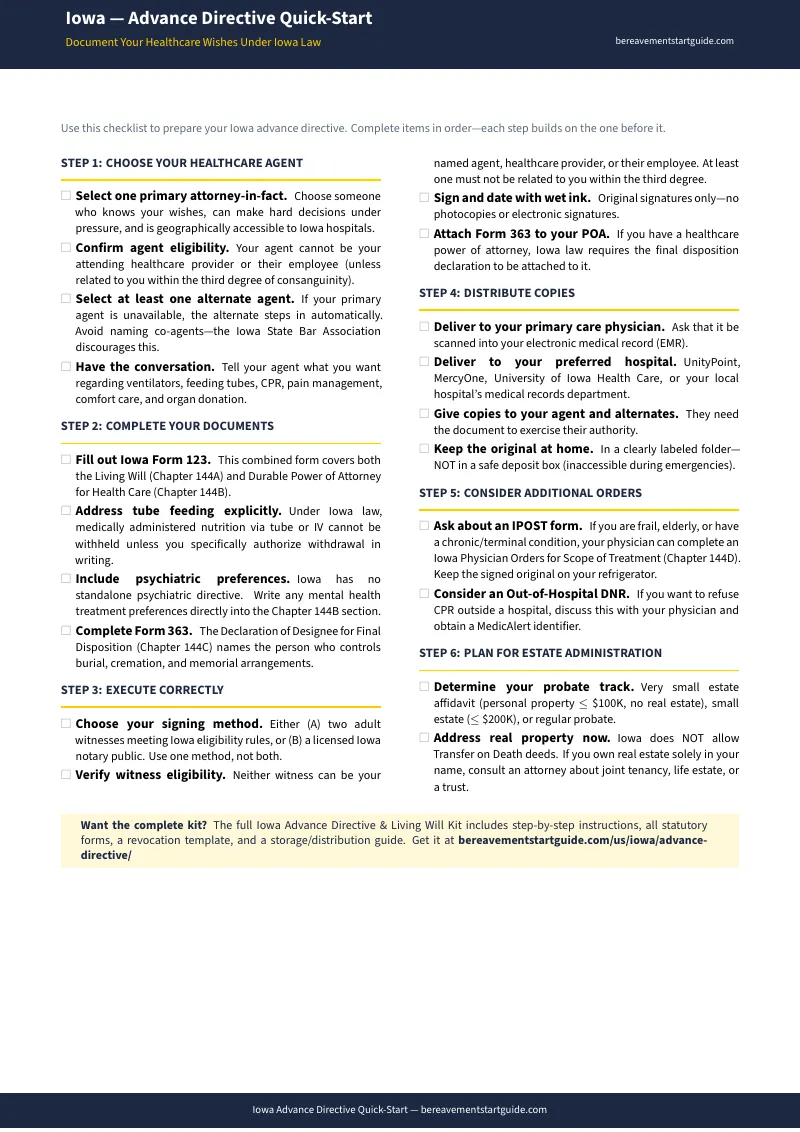
Download the free Iowa Advance Directive Quick-Start checklist to see the key steps at a glance. When you're ready for the complete system — statutory forms, execution guide, proxy selection, property coordination, Medicaid overview — get the full Iowa Advance Directive & Living Will Kit for .
Frequently Asked Questions
What if the rules change after I buy?
We update the guide when the rules change. Email us any time, even years later, and we'll send you the current edition free.