
Iowa Has Rules That Catch Everyone Off Guard
No transfer-on-death deeds — the Iowa Court of Appeals voided one in King v. Smith, and three separate bills to legalize them have died in the Senate. No title insurance — Iowa is one of the only states that bans it, relying instead on a paper Abstract of Title system where any estate planning error becomes a permanent cloud that blocks your heirs from selling. An expanded Medicaid estate recovery program that reaches beyond probate to seize joint tenancy property, revocable trust assets, and annuities. And a spousal elective share that overrides your will if you are in a blended family and forgot to get a boldface, notarized waiver signed.
These are not obscure edge cases. They are the default rules that apply to every family in the state. And most people discover them only after something goes wrong — after a deed is recorded with language the courts have already voided, after the Department of Health and Human Services files a Medicaid lien against assets that were supposed to be protected, or after a surviving step-spouse invokes their statutory right to one-third of everything the will tried to leave to children from a prior marriage.
The Iowa Estate Coordination System
Free will templates give you a document. Attorney blogs give you information. This kit gives you a system — one that coordinates your will, your powers of attorney, your beneficiary designations, your property titles, and your digital accounts into a plan that actually works under Iowa law.
The difference matters because your will controls only a fraction of your estate. Life insurance, retirement accounts, POD bank accounts, and jointly held property all pass outside your will — directly to the person named on the account. If those designations contradict your will, the designations win. Every time. The kit walks you through the coordination step by step, so nothing falls through the gap between your documents and your accounts.
What You Get
The Complete Guide (12 Chapters)
- Will execution requirements — Iowa's two-witness rule under Iowa Code § 633.279, the self-proving affidavit that eliminates witness testimony at probate, the three-day safe harbor, remote signing options, and how out-of-state wills are treated
- Guardian nominations — Iowa Minor Guardianship Proceedings Act, how the court evaluates best interests, successor guardian planning, and why naming a guardian only in a will is not enough
- Trusts vs. wills — when a revocable living trust is worth the cost in Iowa, how the Uniform Trust Code governs administration, the Estate of Melby trust trap, and a cost comparison framework
- Real property and the abstract system — why Iowa bans title insurance, how an estate planning error creates a permanent abstract defect, joint tenancy with right of survivorship mechanics, the King v. Smith TOD deed ruling, and how to verify your current deed titling
- Blended family protections — the spousal elective share formula under Iowa Code § 633.238, the homestead occupancy election, the 12-month spousal support allowance, prenuptial and postnuptial waiver mechanics, and how to protect both your spouse and your biological children
- Powers of attorney and healthcare directives — durable financial POA, healthcare POA, the Iowa living will, and the automatic revocation that activates at divorce under Iowa Code § 633B.5
- Medicaid estate recovery — Iowa's expanded estate definition under Iowa Code § 249A.53(2), why revocable trusts do not protect assets, the Estate of Melby ruling, the undue hardship waiver, and the 30-day response window
- Digital assets under Iowa RUFADAA — the three-tier access hierarchy, how to authorize email access in your will, and the digital asset inventory
- Post-divorce estate overhaul — automatic revocation statutes for ex-spouses (Iowa Code § 633.271 and § 633A.3107), POA termination, and beneficiary designation audits
- Moving to Iowa from another state — out-of-state executor restrictions, how Iowa recognizes foreign wills, common law vs. community property coordination, and title abstract requirements for new purchases
- Document checklist — every form, filing, and designation you need, organized by document type with specific Iowa requirements for each
- When to hire a professional — what the kit handles completely and what genuinely requires an Iowa attorney, with typical fee ranges so you know what to expect
The Estate Planning Checklist
A 20-item printable checklist that tracks every document, every account, every beneficiary designation, and every legal formality across your entire plan. Use it as your project manager — check off each step as you complete it, and you will know exactly where you stand.
8 Standalone Worksheets and Reference Sheets
- Beneficiary Audit Worksheet — verify every asset (real estate, financial accounts, retirement, vehicles) passes to the right person
- Property Deed Worksheet — verify your title, decode vesting language, choose a probate-avoidance strategy
- Digital Asset Inventory — RUFADAA-compliant worksheet for cataloging online accounts and authorizing fiduciary access
- Medicaid Recovery Reference — Iowa's expanded estate definition, the 30-day hardship waiver deadline, and payment priority
- Blended Family Reference — the spousal elective share formula, waiver mechanics, and protection strategies
- Post-Divorce Estate Checklist — what Iowa law automatically revokes and what you must update manually
- Iowa Forms Directory — every official form referenced in the guide with issuing agency and statutory authority
- Relocator Checklist — estate plan updates when moving to Iowa from another state
Who This Is For
- First-time homeowners who just realized their house will go through probate — and that Iowa does not allow transfer-on-death deeds to avoid it
- New parents who need guardian nominations and have no estate plan at all
- Married couples who assume everything passes to the surviving spouse — and have not checked whether their retirement account beneficiary designations agree with their will
- Blended families navigating the spousal elective share statute and the risk of accidental disinheritance of children from a prior marriage
- Adult children helping aging parents get powers of attorney in place before a health crisis — especially families facing potential Medicaid long-term care
- Anyone who moved to Iowa and needs to understand how the abstract of title system, TOD deed ban, and Iowa-specific execution requirements affect their existing plan
- Anyone who has been putting this off because the attorney quoted $750 to $1,500 and the free templates did not explain any of the Iowa-specific rules that actually matter
Why Not Free Templates?
The Iowa Judicial Branch and Iowa State Bar provide free forms for powers of attorney and living wills. They do not offer free will templates, trust forms, or any guidance on coordinating beneficiary designations with your estate plan. Non-profit "estate planning kits" from organizations like UnityPoint are lead-generation tools for charitable bequests — they do not provide document templates or Iowa-specific legal analysis.
A free will template does not tell you that Iowa bans transfer-on-death deeds — and that three legislative attempts to change this have failed. It does not warn you that Iowa's Medicaid estate recovery program uses an expanded definition of "estate" that reaches joint tenancy property and revocable trusts. It does not explain that adding your child to your house deed creates a permanent entry in the Abstract of Title that exposes the property to their creditors, their divorce proceedings, and their bankruptcy.
The gap between "having a will" and "having an estate plan that works under Iowa law" is where families lose money, lose time, and lose access to their own assets. This kit closes that gap.
A Fraction of What You Would Pay an Attorney
A basic will package from an Iowa attorney runs $750 to $1,500. Living trust packages start at $2,000 and climb from there. LegalZoom charges $99 to $349 upfront plus $199 per year to keep editing. Quicken WillMaker costs $80 to $150 to install and does not explain Iowa's abstract of title system or its ban on transfer-on-death deeds. This kit costs — a one-time purchase with no subscription, no recurring fees, and no upsells.
For straightforward estates, the kit handles everything. For complex situations — significant agricultural holdings, Medicaid spend-down strategies, contested blended-family dynamics — it organizes your entire financial picture before your first attorney meeting, saving you billable hours and ensuring you walk in knowing exactly what to ask.
Satisfaction guarantee: If the kit does not give you a clear, actionable path to completing your Iowa estate plan, email hello@bereavementstartguide.com for a full refund. No questions, no hassle.
Start Your Estate Plan This Weekend
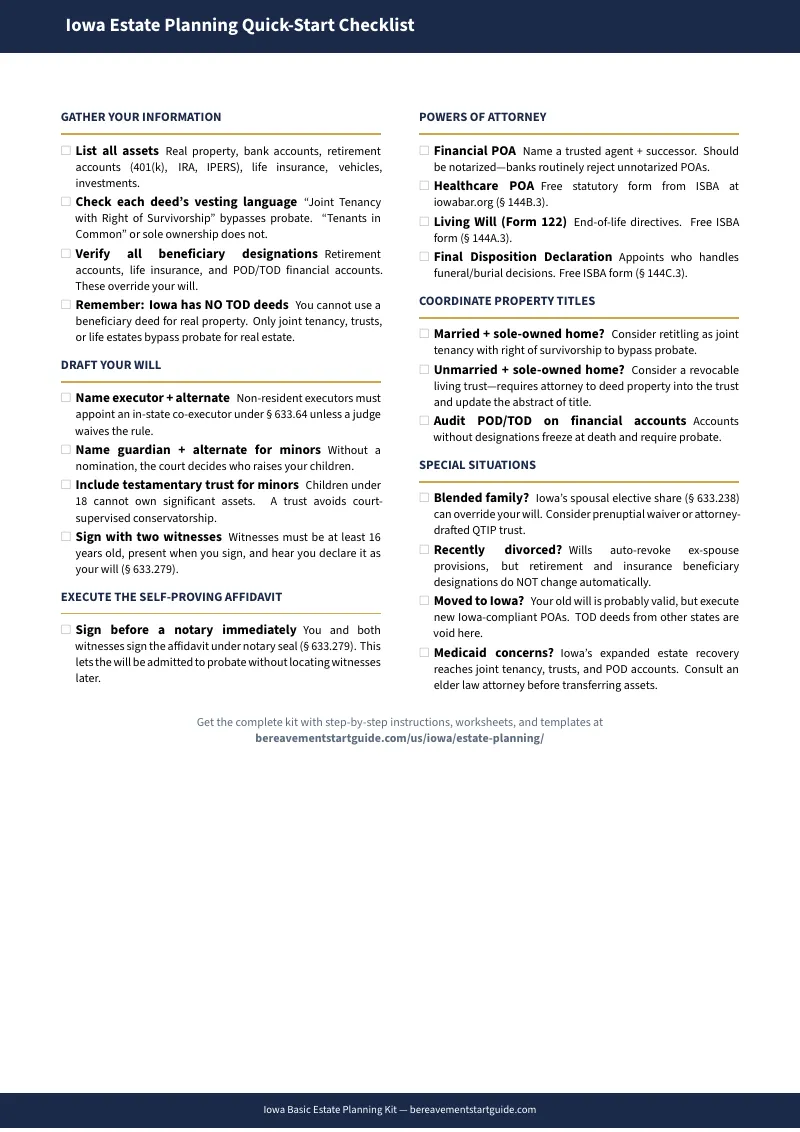
Download the free Iowa Estate Planning Checklist to see exactly what your plan needs. When you are ready to work through the full system — every chapter, every worksheet, every coordination step — the complete kit is waiting.
Frequently Asked Questions
What if the rules change after I buy?
We update the guide when the rules change. Email us any time, even years later, and we'll send you the current edition free.