
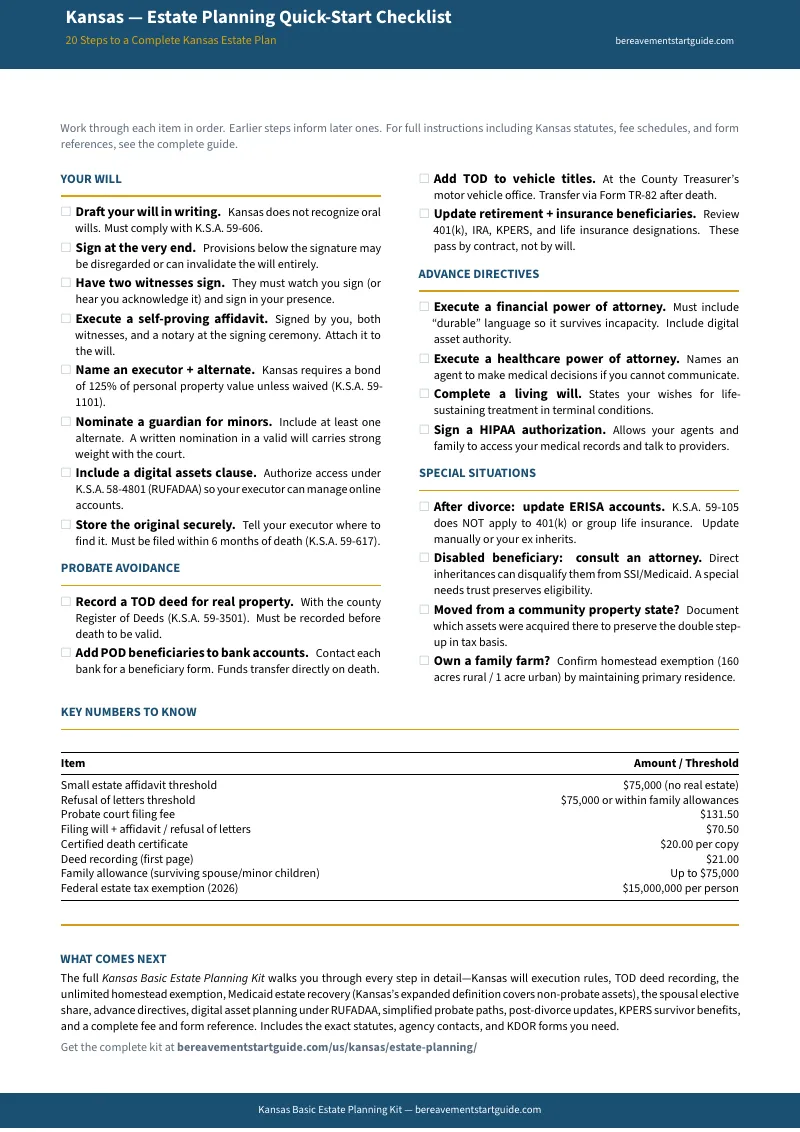
Kansas Gives You Powerful Tools to Protect Your Family — If You Know Where to Find Them
Most Kansas families know they should have a will. What they don't know is that a will alone leaves almost everything exposed.
Without a transfer-on-death deed filed with your county Register of Deeds, your home goes through probate — even if your will says otherwise. Without updated beneficiary designations, your ex-spouse may still inherit your retirement account thanks to federal ERISA rules that override Kansas law. And if you or your spouse ever need long-term care, Kansas has one of the most aggressive Medicaid estate recovery programs in the country — reaching past probate into joint accounts, TOD deeds, POD accounts, and even revocable living trusts.
The problem isn't that Kansas law is unfair. The state actually provides excellent statutory tools for protecting your family: constitutional homestead protection (160 acres rural, 1 acre in town), transfer-on-death deeds, simplified probate paths for smaller estates, and robust advance directive provisions. The problem is that these tools are scattered across dozens of statutes, county offices, and government websites — with no instructions for how they fit together.
The Kansas Estate Protection Roadmap
The Kansas Basic Estate Planning Kit organizes every relevant Kansas statute, form, and filing requirement into a single, step-by-step system. This isn't a stack of blank forms. It's a plain-English roadmap that tells you which documents to complete, in what order, where to file them, and exactly how they coordinate to protect your family.
The kit covers the full spectrum of Kansas estate planning: valid will requirements under K.S.A. 59-606, transfer-on-death deeds, POD bank designations, homestead exemption documentation, trust evaluation, Medicaid (KanCare) estate recovery protection, spousal elective share planning, advance directives, durable powers of attorney, KPERS retirement benefits, digital assets under Kansas RUFADAA, and the simplified administration paths that keep smaller estates out of court entirely.
What You Get — 10 Printable PDFs
- Complete Estate Planning Guide — 16 chapters covering every aspect of Kansas estate planning. From basic will requirements and the two-witness attestation rule to advanced Medicaid recovery protection and the spousal elective share scale (3% to 50% based on marriage length). Written in plain English with every relevant K.S.A. statute cited, so you know exactly which law applies to your situation.
- Quick-Start Estate Planning Checklist — a compact, printable reference of every document, designation, and filing in priority order. Covers wills, TOD deeds, POD accounts, vehicle titles, advance directives, powers of attorney, and beneficiary audits — with the Kansas-specific thresholds and deadlines that determine which steps apply to you.
- Estate Inventory Worksheet — fillable tables for every asset category: bank accounts, real estate, vehicles, retirement accounts, life insurance, and other property. Tracks titling, beneficiary designations, and probate vs. non-probate classification.
- Beneficiary Audit Worksheet — verify every beneficiary designation across retirement accounts, life insurance, POD bank accounts, TOD deeds, and vehicle titles. Flags ERISA-governed accounts that Kansas divorce law cannot automatically update.
- TOD Deed Filing Guide — step-by-step instructions for drafting, notarizing, and recording a transfer-on-death deed with the county Register of Deeds under K.S.A. 59-3501. Print this and bring it to the county office.
- Post-Divorce Beneficiary Overhaul Checklist — every document to update after a Kansas divorce is finalized, with the ERISA-governed accounts that require manual changes highlighted.
- KanCare Estate Recovery Reference — what Kansas Medicaid can and cannot reach under K.S.A. 39-709, which exceptions actually protect your assets, and how to challenge a recovery claim.
- Spousal Elective Share Reference — the complete percentage table by marriage length under K.S.A. 59-6a202, plus family allowances and blended family planning strategies.
- Digital Asset Inventory — fillable tables for email accounts, financial logins, social media, subscriptions, and cryptocurrency. Includes Kansas RUFADAA provisions and custodian tool setup instructions.
- Costs, Fees & Forms Reference — every court filing fee, recording fee, death certificate cost, key form number, and agency contact on one printable page.
Who This Is Built For
- Homeowners who want their property to pass directly to family without probate court fees, delays, or public records
- Parents of minor children who need to name guardians now — before a district court appoints someone you wouldn't have chosen
- Farm families protecting agricultural land from Medicaid recovery and keeping acreage intact across generations using the constitutional homestead exemption
- Newly divorced individuals who need to strip an ex-spouse from every beneficiary designation, power of attorney, and legal document — including the federal ERISA accounts that Kansas divorce law doesn't automatically override
- Adults relocating to Kansas from community property states who need to reconcile existing wills and trusts with Kansas common law rules
- Adult children helping aging parents complete estate paperwork while they still have legal capacity to sign — because once capacity is gone, the only option is guardianship court
Why Not Just Use the Free State Forms?
Kansas offers free forms through the Judicial Council and Legal Services. They're real legal documents — but that's all they are.
The free will form doesn't explain the "at the end" signature requirement that has invalidated Kansas wills in court. The small estate affidavit form doesn't mention the 30-day mandatory waiting period. The TOD deed form doesn't warn you that a subsequent will cannot revoke a recorded deed. And none of these forms explain how they coordinate with each other — or with your bank accounts, retirement plans, and vehicle titles.
Kansas gives you the pieces. The kit shows you how they fit together — and warns you about the gaps between them that catch people off guard.
Why Not LegalZoom or Another Online Service?
National platforms charge $89 to $299+ for initial document creation, then bill annual subscription fees of $49 to $299 just to maintain access to your own files. Cancel the subscription and you lose your documents.
More importantly, they use standardized templates that routinely miss Kansas-specific procedures. They won't explain the expanded Medicaid estate recovery under K.S.A. 39-709, the county Register of Deeds recording process for TOD deeds, or the six-month will filing deadline under K.S.A. 59-617 that bars wills from probate if missed.
The Kansas Basic Estate Planning Kit is a one-time purchase. No subscriptions, no annual renewal, no paywall between you and your estate plan.
— Less Than One Hour of Attorney Time
Kansas estate planning attorneys charge $300 or more per hour. A basic will runs $300 to $1,200. A trust-based plan starts at $2,500 and goes up from there.
The kit doesn't replace an attorney for genuinely complex situations — multi-state property, special needs trusts, business succession. And it tells you exactly when professional help is worth the cost. But for the vast majority of Kansas families who need clear, state-specific instructions and a structured plan, the kit delivers immediate protection at a fraction of professional fees.
And if you do hire an attorney later, the asset inventory and decision worksheets you've completed become your intake package — saving hours of billable time at $300/hour.
Money-Back Guarantee, No Time Limit
Download the kit, review the guide and checklists. If the plain-English instructions don't clarify the exact steps needed to protect your family — or if you decide to hire a local attorney for a custom trust instead — email us at any time for an immediate, full refund. No questions asked.
Important notice: Bereavement Start Guide is a publisher of educational resources and legal templates. This kit assists individuals in organizing their estate affairs and completing standard statutory forms. It does not provide personalized legal, financial, or tax advice, does not act as a law firm, and does not establish an attorney-client relationship. For complex assets, multi-state property, or custom trust structures, consultation with a licensed Kansas attorney is strongly recommended.
Frequently Asked Questions
What if the rules change after I buy?
We update the guide when the rules change. Email us any time, even years later, and we'll send you the current edition free.