
Your Family Shouldn't Have to Guess What You Want
A sudden hospitalization. A stroke in the middle of the night. A diagnosis that changes everything. In that moment, your family has to make decisions about life support, tube feeding, and resuscitation — and if you haven't documented your wishes, they're guessing.
In Kentucky, that guess can turn into a court battle. Without a valid advance directive, medical decisions fall to a court-appointed guardian. Your spouse, your children, your parents — they have no legal authority until a judge says so. The process takes weeks. It costs thousands. And it happens while you're lying in a hospital bed, unable to speak for yourself.
The Kentucky Healthcare Decision System
The Kentucky Advance Directive & Living Will Kit isn't a stack of blank forms you download and hope you fill out correctly. It's a complete decision-documentation system built around the specific statutes, witness rules, and legal traps that make Kentucky different from every other state.
Most people don't realize that Kentucky has its own version of POLST called the "Medical Orders for Scope of Treatment" (MOST) form. Or that your advance directive is automatically suspended during pregnancy. Or that a single disqualified witness — your sister, your doctor, a nurse at your hospital — invalidates the entire document.
The kit walks you through every decision, every form, and every Kentucky-specific rule so your wishes are documented, legally binding, and actually enforceable when it matters most.
What's Inside
Living Will Directive & Healthcare Surrogate Designation
Document your treatment preferences for life-sustaining procedures, tube feeding, ventilators, and comfort care — following the exact requirements of KRS 311.623. Then designate a trusted surrogate with full legal authority to make decisions on your behalf under KRS 311.625. The kit explains who can and cannot serve as your surrogate, what powers they hold, and how to name alternates.
MOST Form & DNR Walkthrough
Kentucky doesn't use POLST. It uses the "Medical Orders for Scope of Treatment" — a broader clinical order that covers intubation, antibiotics, and tube feeding, not just CPR. The kit explains when you need a MOST form versus a DNR, how to get one signed by your physician, and what happens when your MOST form conflicts with your advance directive (your directive controls).
Witness & Notary Compliance Checklist
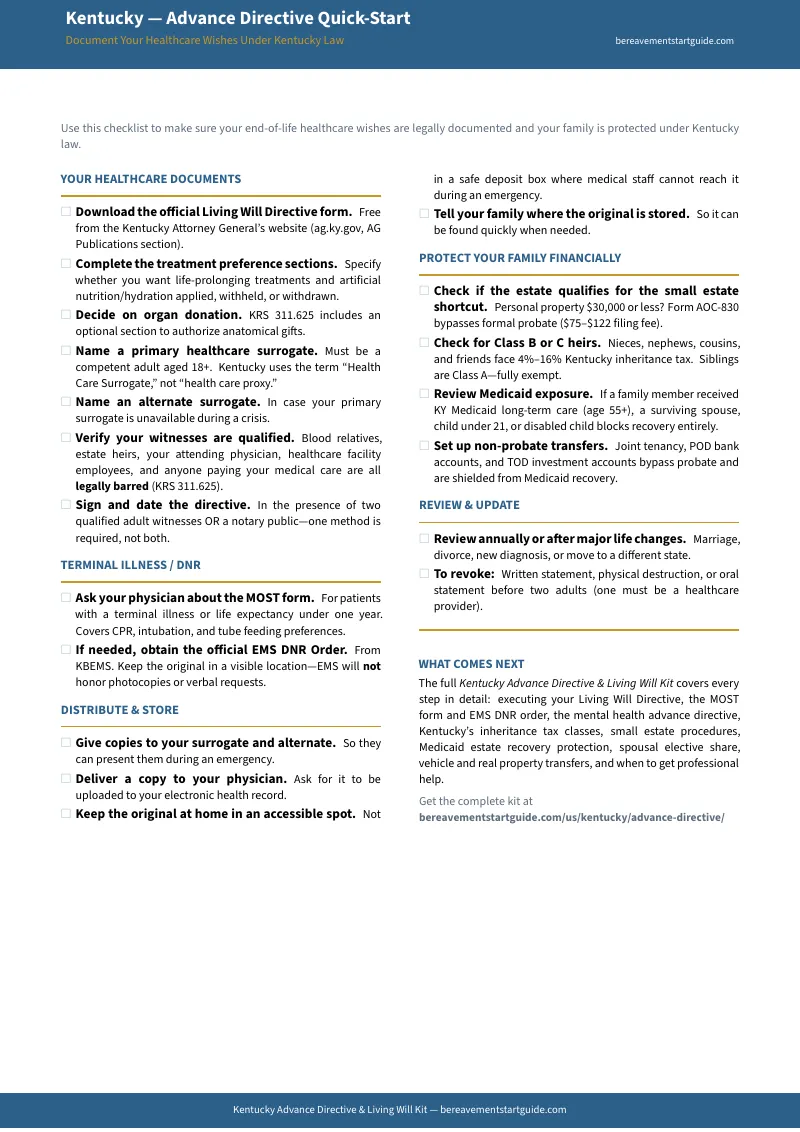
Under KRS 311.625, your advance directive requires either two qualified witnesses or a notary acknowledgment. Kentucky bars five categories of people from witnessing — blood relatives, estate beneficiaries, your attending physician, anyone financially responsible for your care, and healthcare facility employees. One wrong witness and the entire document is void. The printable checklist makes sure you get it right the first time.
Medicaid Asset Protection Worksheet
Kentucky nursing home care averages $70,000–$80,000 annually, and Medicaid limits countable assets to just $2,000 for an individual. But Kentucky uses a "probate-only" definition for estate recovery — meaning assets that bypass probate are completely protected. The standalone worksheet walks you through inventorying your assets by transfer type and converting exposed assets to protected designations (TOD, POD, joint tenancy).
Small Estate Eligibility Worksheet
For estates under $30,000 in personal property, Kentucky offers a simplified process called "dispensing with administration" using Form AOC-830. The printable worksheet helps you total your personal property, check eligibility requirements, and follow the filing steps — so you know before you visit the courthouse whether formal probate is required.
Revocation & Update Guide
Changed your mind about a treatment preference? Remarried and need a new surrogate? Kentucky law provides three methods to revoke or update your directive — written, physical destruction, or oral statement in the presence of two adults (one must be a healthcare provider). The kit covers all three, including when each method makes sense.
8 Standalone Printable Tools
In addition to the full guide and quick-start checklist, the kit includes 8 standalone worksheets and reference cards you can print individually: witness compliance checklist, document decision tree, inheritance tax reference, Medicaid protection worksheet, small estate eligibility worksheet, forms quick reference, vehicle title transfer guide, and post-death notification checklist.
Who This Kit Is For
- Adults who want their medical wishes legally documented — not buried in a hospital form they signed without reading
- Adult children managing aging parents — especially those facing nursing home decisions and Medicaid spend-down anxiety
- Blended families — where Kentucky's dower and curtesy laws (KRS 392.020) mean a surviving spouse can override the deceased's will and claim up to half the estate
- Families with non-lineal beneficiaries — nieces, nephews, cousins, and friends face Kentucky inheritance taxes of 4–16% (Class B) or 6–16% (Class C), while direct family pays nothing
- Anyone who tried the free forms and got stuck — the Attorney General's Living Will Packet and hospital templates don't explain the witness restrictions, pregnancy suspension, or MOST form interaction
Why Free Forms Aren't Enough
The Kentucky Attorney General's office provides a free Living Will Packet. Norton Healthcare hands out advance directive templates during pre-admission. So why does anyone need this kit?
Because those free forms assume you already know Kentucky law.
They don't tell you that your daughter can't witness your advance directive because she's a blood relative. They don't mention that if you're pregnant, your directive is legally suspended. They don't explain that a MOST form signed by your doctor can conflict with your living will — or that your living will wins when it does.
The average elder law attorney in Kentucky charges $1,000–$3,000 to draft an estate plan. The free forms cost nothing but come with zero guidance. This kit sits in the space between: complete, Kentucky-specific instructions at a fraction of the legal fee.
— Less Than One Hour of Legal Consultation
Kentucky elder law attorneys charge $200–$400 per hour. A full estate plan runs $1,000–$3,000. The kit gives you the same core documents — living will, surrogate designation, probate tools, Medicaid protection strategies — with step-by-step instructions that replace hours of billable consultation time.
If a single invalid witness forces your family into a guardianship hearing, they'll spend more in the first afternoon than this kit costs.
100% Satisfaction Guarantee
If the kit doesn't give you what you need to document your wishes and protect your family, email us for a full refund. No questions, no hassle.
Start Protecting Your Family Tonight
Download the free Kentucky Advance Directive Quick-Start to see how the kit works. Or get the complete kit now and have your wishes documented, your surrogate designated, and your family protected before your next doctor's appointment.
Frequently Asked Questions
What if the rules change after I buy?
We update the guide when the rules change. Email us any time, even years later, and we'll send you the current edition free.