Someone You Love Just Died in Malaysia. The Bank Froze Every Account This Morning. You Have Been Told You Need a Lawyer, but Nobody Mentioned That a Government Agency Will Do the Same Work for 0.2% of the Estate — and You Are About to Pay Ten Times More Than You Have To.
You are standing in a place nobody prepared you for. Maybe you just lost your father and Maybank locked his account before you could withdraw money for the funeral. Maybe your mother died and the family home is in her name alone, and someone told you that you need to go to the High Court — which sounds expensive, complicated, and terrifying. Maybe you are the eldest child and everyone in the family is looking at you for answers about EPF death withdrawals, LHDN tax clearance, and a legal process you have never encountered before. Maybe you are a Malaysian living in Singapore or Australia, trying to manage all of this remotely while your siblings back home disagree about what to do next.
Here is the part that makes this worse: Malaysia has three completely different routes for settling an estate. The High Court, which requires a private lawyer charging RM4,000 to RM10,000 or more. AmanahRaya (ARB), the government trustee company that charges 5% on the first RM25,000 of the estate and 2% on the rest — meaning a RM600,000 estate costs you RM14,000 or more in fees. And JKPTG (the Land Office / MyLand), which handles estates under RM5 million for a fee of just 0.2% — meaning that same RM600,000 estate costs RM1,200. Most families do not know the third option exists. Most families pick the wrong route, and by the time they realise the mistake, they have already signed documents and paid fees that cannot be undone.
Meanwhile, the clock is running. JPN requires death registration within 7 days in Peninsular Malaysia (24 hours in Sabah and Sarawak). LHDN can hold executors personally liable for unpaid taxes under Section 74 of the Income Tax Act. EPF nominations may be outdated or missing entirely, which changes whether the money goes to the nominee or the estate administrator. Joint bank accounts — which most families assume are safe — get frozen the moment the bank learns of the death, locking the surviving spouse out of grocery money, utility payments, and the funeral deposit.
And if the deceased was Muslim, a parallel legal system applies. The Syariah Court must issue a Sijil Faraid before distribution. Harta sepencarian (jointly acquired matrimonial property) must be separated from the estate before faraid applies. And the family can agree to a muafakat (consensual redistribution) — but only if every single heir consents, including minor children through their guardian.
The When Someone Dies in Malaysia — Estate Settlement Guide is a Route Selection System for every legal, financial, and administrative step between the hospital and final distribution. Not a law textbook. Not a generic checklist from a western bereavement website that does not know JPN from JKPTG. A structured, Malaysia-specific manual that tells you which of the three estate settlement routes is cheapest for your situation, walks you through the paperwork for that route, and separates what must be done in the first 48 hours from what legally cannot happen until tax clearance is complete — so you stop guessing, stop overpaying, and start working through this in the right order.
What's Inside the Route Selection System
A 14-chapter guide and the First 48 Hours Checklist — covering every stage from the moment of death through final asset distribution, built specifically for Malaysian law, Malaysian institutions, and the dual civil-Syariah legal system that makes settling an estate here unlike anywhere else:
Emergency First Steps: The First 48 Hours
The moment someone dies in Malaysia, the clock starts on multiple deadlines. JPN requires death registration within 7 days in Peninsular Malaysia — but only 24 hours in Sabah and Sarawak, a difference that catches East Malaysian families off guard. You need a police report if the death was unnatural or unattended. You need to secure the home, vehicles, and personal documents before relatives or tenants access them. And you need to understand what a burial permit requires and which religious authority is involved — because Muslim burials in Malaysia typically happen within 24 hours, compressing the administrative window to almost nothing. This chapter covers every action in the order it needs to happen, including the one thing most families skip: calling the deceased's bank to ask about compassionate release of funeral costs before the formal freeze takes effect.
Understanding Malaysia's Dual Estate System
Malaysia runs two parallel legal systems for estate matters: civil law for non-Muslims and a combination of civil and Syariah law for Muslims. The Distribution Act 1958 governs intestate estates for non-Muslims. Faraid (Islamic inheritance law) governs Muslim estates, with the Syariah Court issuing a Sijil Faraid that determines each heir's share. But here is the complication most families do not expect: even for Muslim estates, the administrative process (applying for Letters of Administration, transferring property, clearing taxes) still goes through the civil system — JKPTG, the High Court, or AmanahRaya. This chapter maps how the two systems interact, because getting this wrong at the start means filing in the wrong court, with the wrong forms, and losing months.
The Route Selection Matrix: High Court vs JKPTG vs AmanahRaya
This is the chapter that saves families the most money. Most Malaysians assume you need a lawyer to settle an estate. That assumption costs thousands of Ringgit. The guide walks you through a decision tree: if the estate includes immovable property (land or buildings) and is valued under RM5 million, you almost certainly qualify for the JKPTG / MyLand route — the Small Estates Distribution process where the government handles the application for a fee of just 0.2%. That threshold was raised from RM2 million to RM5 million in July 2024 under the Small Estates (Distribution) (Amendment) Act 2022, but most online advice still references the old limit. AmanahRaya charges 5% on the first RM25,000 and scales from there. A private lawyer through the High Court charges RM4,000 to RM10,000 in legal fees alone, plus court filing fees. The guide tells you exactly which route applies to your estate and what each one costs, so you pick the cheapest legal path — not the one that someone with a financial interest in your confusion recommended.
Bank Accounts and the Joint Account Trap
Joint bank accounts in Malaysia do not work the way most families think. Unlike some countries where joint accounts pass automatically to the survivor, Malaysian banks routinely freeze joint accounts upon notification of death — locking the surviving spouse out of their own money. The guide covers how each major bank (Maybank, CIMB, Public Bank, RHB, Hong Leong) handles deceased accounts, the documents required to unfreeze them, how to request compassionate release for funeral expenses before formal probate, and the specific scripts to use when the branch manager says no. It also covers the RM25,000 EPF death withdrawal that SOCSO provides for funeral expenses, which most families do not claim because nobody tells them it exists.
EPF, SOCSO, and Government Benefits
EPF (KWSP) death claims are one of the most confusing parts of Malaysian estate settlement. If the deceased had a valid EPF nomination, the money goes directly to the nominee — it does not pass through the estate. If the nomination is missing, outdated, or was never updated after a marriage or divorce, the money goes to the estate administrator instead, requiring Letters of Administration from the court or JKPTG. For Muslims, the nominee system works differently: EPF treats the nominee as a trustee, not a beneficiary, meaning the money must still be distributed according to faraid. The guide covers the EPF death claim process, the SOCSO RM3,000 funeral benefit (claimed through Form 44), and the PERKESO benefits that employed workers' families are entitled to but rarely claim.
Property Transfer, Tax Clearance, and Everything Else
The remaining chapters cover real estate transfers through the land office (including the April 2023 stamp duty waiver — 100% exemption on the first RM1 million for transfers between family members under the "Love and Affection" instrument), vehicle transfers through JPJ (Form K3A and the Puspakom B5 inspection requirement), debts and liabilities (including the myth that children inherit parents' debts — they do not, under Malaysian law), LHDN tax clearance (Form TP, the Tax Identification Number for estates, and the Section 74 personal liability trap for executors), faraid and Syariah law for Muslim families (Sijil Faraid, harta sepencarian, muafakat), executor and administrator duties (fiduciary obligations, personal liability, how to renounce if you do not want the job), cross-border and diaspora estates (resealing foreign grants, managing from overseas), and the 14 most common mistakes that cost Malaysian families time and money.
Who This Guide Is For
- The surviving spouse whose partner just died and whose bank accounts were frozen this morning — who needs to know how to get compassionate release of funeral costs from Maybank or CIMB, whether the joint account passes automatically or requires probate, and how to start the JKPTG process instead of hiring a RM10,000 lawyer
- The adult child named as executor or administrator who has never dealt with JPN, JKPTG, LHDN, or EPF — who needs the complete route selection decision tree, every form explained, and a timeline that separates what is urgent from what must wait for tax clearance
- The Muslim family navigating the intersection of civil and Syariah law — who needs to understand when faraid applies, how to get a Sijil Faraid from the Syariah Court, what harta sepencarian means for the surviving spouse's share, and when a muafakat can override the standard faraid distribution
- The Malaysian diaspora family living in Singapore, Australia, the UK, or the Middle East and trying to manage estate settlement remotely — who needs to understand which steps require physical presence in Malaysia, how to appoint a local representative, and how to reseal a foreign grant of probate
- The family without a will who just learned that the Distribution Act 1958 or faraid dictates everything — who needs to understand who has priority to apply as administrator, how the statutory distribution formula works, and whether JKPTG or the High Court handles their estate
- The executor worried about personal liability who has heard that LHDN can come after them personally for the deceased's unpaid taxes — who needs to understand Form TP, the tax clearance timeline, Section 74 of the Income Tax Act, and when it is safe to distribute assets without risking personal exposure
Why Free Resources Will Not Get You Through This
The information exists. It is scattered across JPN, LHDN, JKPTG, EPF, SOCSO, JPJ, the Syariah Courts, AmanahRaya, and a dozen institutional portals that do not reference each other. Here is what you actually encounter when you try to settle an estate using free sources alone:
- Government portals are accurate but fragmented. JPN tells you how to register a death. JKPTG tells you how to apply for small estate distribution. LHDN tells you about tax clearance. EPF tells you about death claims. None of them tell you the sequence — which step must come before which, what to do when agencies contradict each other, or how the civil and Syariah systems interact. You end up with twelve browser tabs open and no idea where to start.
- Law firms deliberately provide incomplete information. Malaysian estate lawyers publish blog posts that explain just enough to make the process sound terrifying — then end with "contact us for a consultation." They will not tell you that JKPTG handles estates under RM5 million for 0.2%, because referring you to JKPTG earns them RM0. A single consultation costs RM500 to RM1,000, and by the time you learn about the cheaper route, you have already signed a retainer.
- AmanahRaya downplays cheaper alternatives. ARB is a government-linked company with a financial interest in administering your estate. Their website explains their own services clearly but does not compare their 5% fee structure against JKPTG's 0.2%. On a RM600,000 estate, the difference is RM12,800. They are not lying — they are just not telling you the full picture.
- Forum advice is anecdotal and outdated. Reddit and Lowyat threads about estate settlement in Malaysia frequently reference the old RM2 million JKPTG threshold that was raised to RM5 million in July 2024. They mix up Muslim and non-Muslim procedures. They confuse EPF nominee claims with estate administrator claims. One upvoted comment can cost you months of wasted effort.
- Western bereavement checklists do not apply. Generic guides assume a single legal system, a single probate court, and institutions that exist in every English-speaking country. They do not cover JPN, JKPTG, EPF/KWSP, SOCSO, faraid, the Syariah Court, or harta sepencarian. They are useless for Malaysian families.
Free resources give you fragments from a dozen sources that do not reference each other and frequently contradict each other. The Route Selection System puts every Malaysian statute, form, institution, deadline, and procedure into one document, in the order you actually need them — with the dual civil-Syariah system mapped out so you never file in the wrong place.
— Less Than One Hour With a Malaysian Estate Lawyer
A single consultation with a Malaysian estate lawyer costs RM500 to RM1,000. Full legal representation through the High Court starts at RM4,000 — and that only covers obtaining the grant. AmanahRaya charges 5% on the first RM25,000 of the estate, plus 2% on the balance. JKPTG charges 0.2%. This guide costs less than one hour of a lawyer's time and shows you exactly which route to take — so you stop the expensive one before it starts.
Your download includes the complete 14-chapter guide, the standalone First 48 Hours Checklist, and 6 printable quick-reference sheets — the Route Selection Matrix, bank account unfreezing procedures, emergency benefits tracker, faraid and Syariah law guide, property transfer guide, and LHDN tax clearance guide. Print the ones you need and bring them to the bank, land office, or LHDN. Plus a money-back guarantee, no time limit. If the guide does not give you clarity on what to do next and confidence that you are doing it in the right order, email us for a full refund. No questions asked.
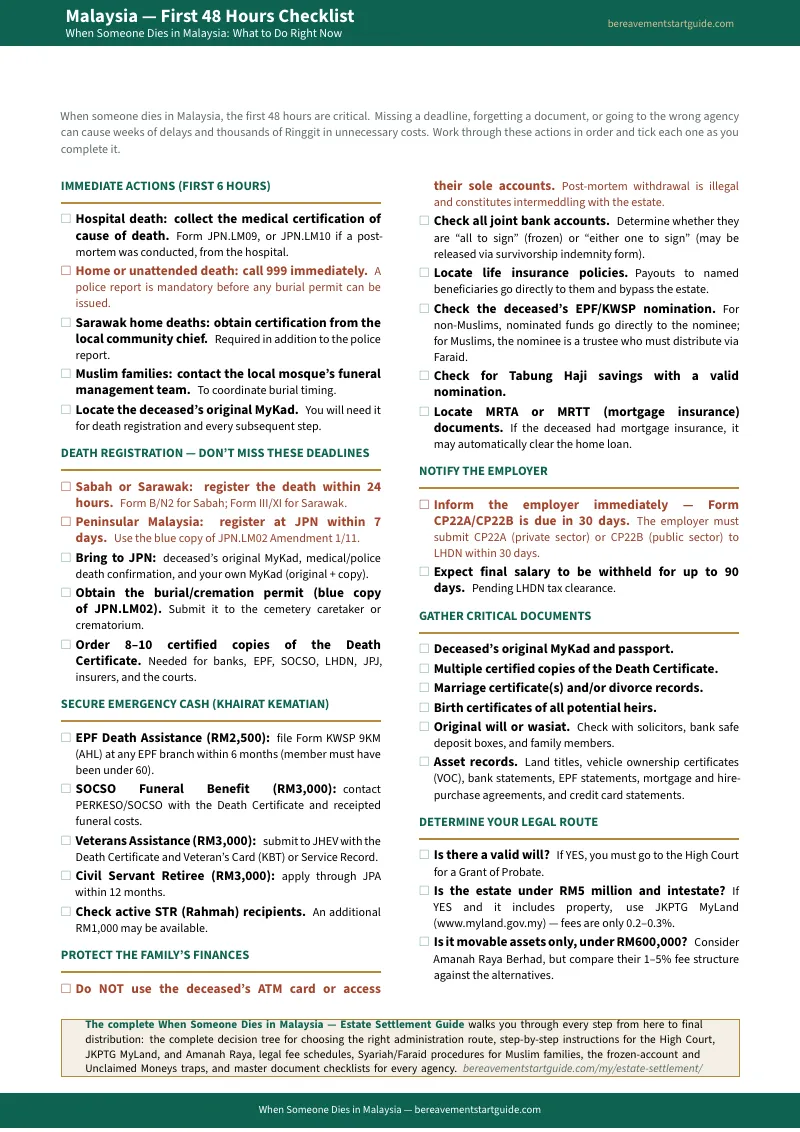
Not ready for the full guide? Download the free Malaysia — First 48 Hours Checklist — the most urgent actions covering everything that must happen in the first two days after a death in Malaysia: death registration at JPN, securing property, notifying banks, EPF and SOCSO claims, and the one decision — choosing your estate settlement route — that determines whether you pay RM1,200 or RM14,000. It is enough to get through tonight and tomorrow.
You did not ask for this job. But you can do it. The guide shows you how, one step at a time.