Your Spouse Just Died in Malaysia. The Bank Froze the Accounts. Your Employer Is Withholding the Final Salary. And Somewhere in the System, There Are RM8,500 or More in Death Benefits That Nobody Told You How to Claim.
You are standing in a government office holding a stack of documents, and you do not know if you are in the right building. Maybe you just lost your husband and someone told you to go to SOCSO, but you are not sure if he was even covered. Maybe your mother was a civil servant and a colleague mentioned a RM3,000 JPA funeral grant — but nobody explained the form, the deadline, or whether it applies to retirees. Maybe you are trying to claim your father's EPF savings, and the counter officer just told you that the nomination was never updated after his second marriage, which changes everything about who gets the money and how. Maybe you are in Singapore or London, trying to coordinate all of this by phone with siblings who are as lost as you are.
Here is what makes this so painful: Malaysia has more than a dozen death-related benefits scattered across agencies that do not talk to each other. EPF offers RM2,500 in death assistance — but only if the member was under 60 with an active account, and for Muslims, the nominee is legally a trustee under Syariah law, not a beneficiary. SOCSO pays a RM2,000 funeral benefit and an ongoing survivor's pension — but only if the deceased met a 24-month minimum contribution requirement that most families cannot verify without digging through old payslips. JPA provides a RM3,000 funeral grant for civil servants — but only if claimed within 12 months, using a form most families never see. ASNB pays RM200 to RM2,000 in Khairat Kematian based on the deceased's unit trust balance — but only if claimed within 6 months. MySalam pays RM1,000 in Khairat Kematian — but only if the deceased was an eligible STR/B40 recipient. Selangor's KDE pays RM1,000 — but only to voters aged 50 or older or those registered as OKU. And that is before you reach the employer's final salary, which LHDN has instructed them to withhold for 90 days until tax clearance is complete.
Each agency has its own forms, its own documents, its own eligibility rules, and its own deadlines. None of them tell you about the others. The EPF website does not mention SOCSO. SOCSO does not mention JPA. JPA does not mention ASNB. And none of them tell you the sequence — which claims to file first, which documents unlock which benefits, and which deadlines are days away while others give you months.
The Malaysia Survivor Benefits Navigator is an Agency-by-Agency Roadmap that puts every Malaysian death benefit, survivor pension, government grant, insurance claim, and employer obligation into a single chronological sequence — with the exact forms, documents, eligibility rules, and deadlines for each one. Not a generic bereavement checklist from the United States or the United Kingdom that does not know KWSP from PERKESO. Not a law firm blog post designed to make everything sound terrifying so you hire them. A structured, plain-language manual built for the specific agencies, deadlines, and dual civil-Syariah legal framework that make claiming survivor benefits in Malaysia unlike anywhere else in the world.
What's Inside the Agency-by-Agency Roadmap
A comprehensive guide, the Survivor Benefits Checklist, and printable quick-reference sheets — covering every benefit, pension, and financial entitlement available to surviving families in Malaysia, organised in the chronological order you actually need them:
The First 72 Hours: Emergency Benefits and Funeral Funds
When someone dies in Malaysia, your household liquidity can vanish overnight. Banks freeze the deceased's accounts — including joint accounts, which most families assume are safe. Meanwhile, funeral costs are immediate and non-negotiable. This chapter maps every source of emergency cash available in the first 72 hours: the EPF RM2,500 death assistance, the SOCSO RM2,000 funeral benefit, the JPA RM3,000 grant for civil servants' dependents, the ASNB Khairat Kematian (RM200 to RM2,000 based on unit holdings), the MySalam RM1,000 benefit for eligible B40/STR individuals, and state-level programs like Selangor's Khairat Darul Ehsan. Each one includes the exact form, the required documents, and the claim window — because some of these expire in 6 months, and families who discover them at month 7 get nothing.
Bank Freezes, Joint Accounts, and the 90-Day Salary Hold
Malaysian banks freeze sole accounts immediately upon learning of a death. Joint accounts with a survivorship clause and "either to sign" mandate may stay open — but the surviving spouse usually needs to sign an indemnity form, and the deceased's share legally remains part of the estate under tenancy-in-common principles. This chapter explains how each major bank handles the freeze, how to request compassionate release for funeral costs, and the critical LHDN mechanism that causes employers to withhold the deceased's final salary, gratuity, and compensation for 90 days until tax clearance is granted. Understanding why the employer is holding money — and that Form CP22A triggers the release — prevents weeks of frustration and angry calls to HR.
EPF and KWSP Death Claims: The Nominee Trap
EPF death claims are the single most confusing benefit in Malaysia. If the deceased had a valid nomination, the money goes directly to the nominee — unless the deceased was Muslim, in which case the nominee is legally a Wasi (trustee), not a beneficiary, and must distribute the funds according to Faraid principles. If the nomination was never updated after a marriage, divorce, or birth of a child, it may be invalid — sending the money to the estate administrator instead, which requires a Letter of Administration from the court or JKPTG. This chapter walks through the EPF claim process form by form, explains the nominee versus administrator distinction that catches most families off guard, and tells you exactly what documents to bring to the EPF office so you do not get turned away and lose another day.
SOCSO Survivor's Pension: The Benefit That Lasts for Life
The SOCSO Pencen Penakat (survivor's pension) pays 50% to 65% of the deceased's average insured wages to surviving dependents — and for widows and widowers, it continues indefinitely, even after remarriage. But qualifying requires the deceased to have died before age 60 with a minimum 24-month contribution history. This chapter covers the eligibility criteria, the payout calculation, the application process, and the lesser-known benefits most families miss entirely: the SOCSO education loan for children of the deceased under age 21, the constant-attendance allowance if the deceased was receiving permanent disablement benefits, and the funeral benefit that is claimed separately from the pension. One agency, four different benefits, four different forms.
Government Pensions: JPA, KWAP, and the Derivative Pension
If the deceased was a government employee or retiree, a separate pension system applies through JPA and KWAP. The Derivative Pension (Pencen Terbitan) provides ongoing income to the widow or widower (2 shares) and each eligible child (1 share). The Derivative Gratuity (Ganjaran Terbitan) provides a lump-sum payment. And the Ex-Gratia death benefit provides additional compensation. This chapter details the application forms (including Borang JPA.BP.SPT.B06 for pension crediting), the documentation required, and the special provisions for families in Sabah and Sarawak who receive payments by warrant rather than bank transfer — so nothing falls through the cracks simply because you live outside Peninsular Malaysia.
Life Insurance and Takaful: Nominated vs Un-Nominated Policies
A nominated life insurance policy pays directly to the beneficiary — fast, clean, outside the estate. An un-nominated policy falls into the estate, requires a Grant of Probate or Letter of Administration, and becomes vulnerable to the deceased's outstanding creditors. For accidental deaths, the insurer will require a police report, post-mortem report, and possibly toxicology screening — documents that take weeks to obtain and that the insurer will not process the claim without. This chapter provides the complete document checklist for both natural and accidental death claims, explains how Takaful policies differ from conventional insurance, and covers the nomination rules that determine whether a payout takes 30 days or 18 months.
Faraid, Harta Sepencarian, and Muslim Family Rights
For Muslim families, the distribution of survivor benefits and estate assets follows Faraid — Islamic inheritance mathematics where a widow typically receives 1/8 if there are children, daughters receive half the share of sons, and extended family members (including the deceased's brothers) may have legally enforceable claims. But before Faraid applies, harta sepencarian (jointly acquired matrimonial property) must be separated from the estate — a step that protects the surviving spouse's own contribution to the marriage. And if all heirs consent, a muafakat (mutual agreement) can legally override the standard Faraid distribution, providing a pathway to keep the family home intact. This chapter explains the Sijil Faraid process, the Syariah Court's role, and the instruments that can protect vulnerable widows from being forced to liquidate everything.
Non-Traditional Families, Unmarried Partners, and the Diaspora
Unmarried partners have no automatic inheritance rights under Malaysian law — not under the Distribution Act 1958 for non-Muslims, and not under Faraid for Muslims. If your partner dies and you are not married, the deceased's blood relatives can claim every asset, potentially evicting you from a home you shared for decades. This chapter covers the legal strategies available to unmarried and non-traditional families, the critical difference between tenancy-in-common and joint tenancy for jointly owned property, and how diaspora families can appoint a local representative via Power of Attorney to manage benefit claims without repeatedly flying back to Malaysia during a process that can take 6 to 12 months.
Who This Guide Is For
- The surviving spouse whose bank accounts were frozen this morning and whose employer just explained that the final salary is on hold for 90 days — who needs to know which emergency benefits to claim first, how to file for compassionate release of funeral costs, and how to start the SOCSO survivor's pension before the paperwork window closes
- The adult child coordinating from overseas who has two weeks of bereavement leave to sort out EPF claims, SOCSO applications, insurance paperwork, and bank unfreezing procedures — who needs every agency, form, and deadline in one document instead of twelve government portals that do not reference each other
- The executor or administrator who just discovered that LHDN will hold them personally liable for the deceased's taxes if they distribute assets too early — who needs the tax clearance timeline, the Form TP filing process, and a clear sequence that separates what must be done now from what legally cannot happen until clearance is granted
- The unmarried partner with no automatic inheritance rights under Malaysian law — who needs to understand their legal standing, what protections exist for jointly owned property, and how to work within a system that was not designed for non-traditional families
- The Muslim family navigating Faraid mathematics, harta sepencarian, and the Sijil Faraid process — who needs to understand how EPF nominee rules differ for Muslim members, when a muafakat can override standard distribution, and how the Syariah Court interacts with the civil estate system
- The HR professional or funeral director who advises grieving families as part of their job — who needs a reliable reference that covers the full landscape of Malaysian death benefits without the commercial bias of a law firm or trust company
Why Free Resources Will Not Get You Through This
The information exists. It is scattered across EPF, SOCSO, JPA, KWAP, LHDN, ASNB, MySalam, and a dozen institutional portals that were each built to explain one agency's rules — not to help you navigate the full landscape of what a surviving family in Malaysia is entitled to. Here is what you actually encounter when you try to claim survivor benefits using free sources alone:
- Government portals are accurate but siloed. The EPF portal explains its RM2,500 death assistance but does not mention the SOCSO funeral benefit, the JPA grant, the ASNB Khairat Kematian, or the MySalam payout. Each agency documents its own benefits in isolation. You are left to discover the others by accident — or not at all. Families routinely miss thousands of Ringgit in benefits simply because no single source lists them together.
- Law firms provide deliberately incomplete information. Malaysian estate lawyers publish articles that explain the complexity of survivor benefits just enough to make you feel overwhelmed — then end with "contact us for a consultation." A consultation costs RM500 to RM1,000. They will not tell you that the SOCSO survivor's pension continues after remarriage, or that the JKPTG Small Estate route costs 0.2% instead of AmanahRaya's 5%, because explaining those details earns them nothing. Their content is marketing, not guidance.
- Forum advice is empathetic and legally dangerous. Reddit and Lowyat threads about death benefits in Malaysia are full of well-meaning people sharing their experiences. They also contain advice to withdraw money from the deceased's account using their ATM card before the bank finds out — which constitutes fraud and can unravel your entire probate application. Forum posts mix up Muslim and non-Muslim EPF nominee rules. They reference SOCSO eligibility thresholds that changed years ago. One confidently wrong answer can cost you a benefit you were entitled to.
- Western bereavement checklists are useless here. Generic guides assume Social Security, an IRS, a single probate court. They do not cover EPF/KWSP, SOCSO/PERKESO, Faraid, the Syariah Court, harta sepencarian, ASNB Khairat Kematian, or the dual legal system that makes Malaysia fundamentally different. Downloading a checklist designed for American or British families and trying to adapt it to Malaysia is worse than starting from zero — it gives you false confidence that you have covered everything when you have covered nothing relevant.
Free resources give you one agency's rules at a time, with no sequencing, no cross-references, and no deadlines mapped against each other. The Agency-by-Agency Roadmap puts every Malaysian death benefit, survivor pension, government grant, insurance claim, and employer obligation into a single chronological document — so you claim everything you are entitled to, in the right order, before the deadlines pass.
— Less Than the Filing Fee for One Missed Benefit Claim
The EPF death assistance alone is RM2,500. The SOCSO funeral benefit is RM2,000. The JPA grant is RM3,000. A single missed ASNB Khairat Kematian claim can cost RM2,000. Families who do not know about these benefits do not claim them — and agencies do not chase you down to tell you what you are owed. This guide costs less than a fraction of any single benefit it helps you claim, and it tells you about all of them.
Your download includes the complete guide, the standalone Survivor Benefits Checklist, and printable quick-reference sheets — the Emergency Benefits Tracker (every death benefit with forms, deadlines, and claim amounts), the EPF Death Claim Walkthrough, the SOCSO Survivor's Pension Guide, the Insurance and Takaful Claims Checklist, the Faraid and Muslim Family Rights Reference, and the Bank Freeze and Tax Clearance Guide. Print the ones you need and bring them to the EPF office, SOCSO counter, or bank. Plus a money-back guarantee, no time limit. If this guide does not help you identify benefits you did not know existed and give you the confidence to claim them in the right order, email us for a full refund. No questions asked.
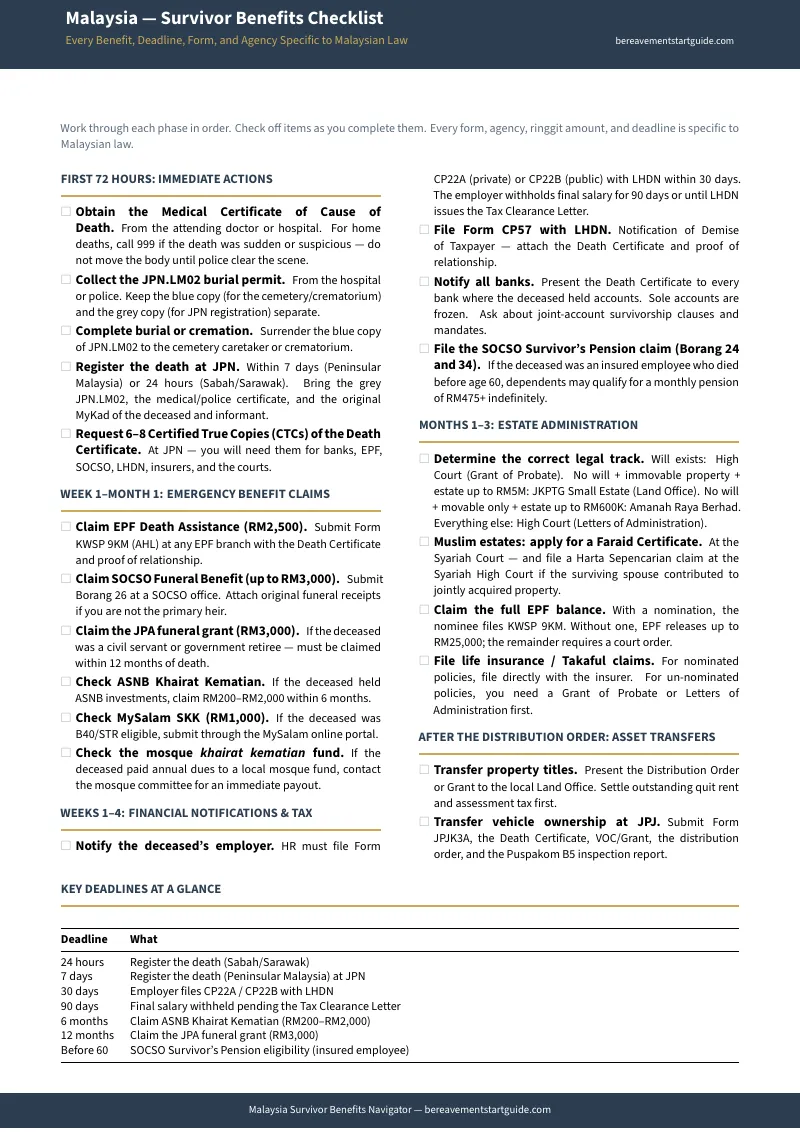
Not ready for the full guide? Download the free Malaysia — Survivor Benefits Checklist — a printable overview of the major death benefits available in Malaysia, which agencies administer them, and the documents you need to start. It covers the EPF, SOCSO, JPA, and ASNB basics — enough to identify what you might be entitled to and take the first step tonight.
You should not have to figure this out while you are grieving. The guide puts every benefit, every form, and every deadline in one place — so you can focus on your family instead of twelve government portals.