Your Parent Is in the ICU. The Bank Won't Release a Dollar.
You're standing at the branch counter with a power of attorney your father signed two years ago. The teller takes it to the back. Fifteen minutes later, the compliance officer says they need to "review it with legal" and asks you to come back next week. Your father's mortgage payment is due tomorrow. His utility shutoff notice arrived yesterday.
This happens constantly in Indiana. Banks reject valid POAs because the document doesn't include specific initialed grant language under IC § 30-5-5-1, or the witness pool violated the exclusion rules in IC § 30-5-4-1.3, or the compliance department simply doesn't know the law. Meanwhile, the bills pile up and the care decisions can't wait.
The Indiana Caregiver Authority System
This kit is built around one principle: a power of attorney is only as good as the institutions that accept it. Instead of handing you generic templates and hoping for the best, the Indiana Caregiver Authority System walks you through every document — from choosing the right type of POA for your situation to presenting your paperwork at the bank counter in a way that gets compliance approval on the first visit.
The full guide covers the four documents Indiana families actually need: durable financial POA under IC Chapter 30-5, healthcare representative appointment, living will declaration, and Transfer-on-Death deeds under IC § 32-17-14. Each chapter gives you the exact statutory references, execution procedures, and institutional acceptance strategies for Indiana's specific requirements.
What's Inside the Kit
The kit includes a comprehensive 13-chapter guide, a quick-start checklist, and 9 standalone printable PDFs — everything you need to establish legal authority, protect assets from Medicaid recovery, and bypass probate for a modest Indiana estate. 11 PDFs total.
- Durable financial POA with initialed grant language — Indiana lets you customize exactly which powers your agent receives by initialing specific authority categories under IC § 30-5-5-1. The guide walks you through each power — banking, real estate, tax filing, vehicle transfers — so you don't accidentally leave gaps that surface during a crisis. Includes the immediate vs. springing decision and why springing POAs leave families stranded at the hospital while they hunt for a physician's written incapacity determination.
- Healthcare representative appointment and living will — Indiana separates medical decision-making into two roles: the proactive Healthcare Representative you appoint yourself, and the default statutory appointment a hospital makes under IC § 16-36-1-5 when you have no documents. The guide covers both, plus HIPAA authorization and Physician Orders for Scope of Treatment (POST) so your agent can actually access medical records and talk to the care team. Includes a standalone Healthcare Directive Checklist you can print and bring to your signing appointment.
- Bank acceptance demand letter — Indiana's Three-Day Law (IC § 30-5-9-9) gives you powerful leverage. Any institution that refuses a valid POA without written justification within three business days faces treble damages, your attorney fees, and prejudgment interest. The kit includes a standalone printable Bank Demand Letter — fill in the blanks, print, and hand it to the compliance officer.
- Transfer-on-Death deed checklist — TOD deeds bypass probate for real estate, but Indiana has traps that invalidate the transfer without warning. If a married couple owns property as tenants by the entirety, the deed is void unless both spouses sign (IC § 32-17-14-11(e)(1)). The standalone TOD Deed Checklist covers every pitfall, including the county auditor endorsement requirement and the 9-month Medicaid safe harbor.
- 2026 Medicaid estate recovery reference — Indiana is an "expanded-estate" state, which means the FSSA can pursue recovery against TOD deeds, joint bank accounts, POD designations, and revocable trusts — not just probate assets. The standalone Medicaid Recovery Reference shows exactly what FSSA can and cannot take, the mandatory family protections, and the new 9-month recovery window.
- Vehicle title transfer guide — Standalone printable with BMV Form 3811 for proactive TOD vehicle titles, Form 18733 for post-death transfers without administration, and the quick-reference fee table.
- Small estate affidavit guide — The standalone Small Estate Affidavit Guide covers the $100,000 threshold, what counts and doesn't count toward it, and the step-by-step filing process after the 45-day waiting period.
- INPRS pension POA requirements — Standalone reference for filing a POA with the Indiana Public Retirement System, including the "magic phrase" requirement, DOR Form POA-1 for tax authority, and the Social Security representative payee warning.
- Forms directory and action timeline — Two standalone printable PDFs: the Forms & Resources Directory with every state agency, form number, and filing fee, and the Action Timeline covering every step from initial planning through post-death transfers with deadlines and costs.
Who This Kit Is For
- Adult children managing an aging parent's finances after a dementia diagnosis, stroke, or hospitalization — and running out of time to get documents signed before capacity is lost
- Spouses preparing for a partner's cognitive decline or an upcoming surgery and need legal authority established before the anesthesia
- Caregivers turned away at the bank — you have a POA but the branch rejected it, and you need Indiana-compliant documents with the statutory leverage to force acceptance
- Families planning probate avoidance through TOD deeds, POD account designations, and small-estate affidavits for estates under $100,000
- Anyone in Indiana who wants legally sound estate planning documents without a $2,000–$5,000 attorney bill
Why Free Forms from State Websites Fall Short
The Indiana State Department of Health publishes free advance directive forms. The state bar association maintains a document library for licensed attorneys. These are bare statutory templates — no instructions, no execution guidance, no institutional acceptance strategy.
Here's what goes wrong with the free forms:
- No bank compliance guidance. The free form doesn't explain the Three-Day Law, doesn't include a demand letter template, and doesn't tell you which grant language to initial for banking authority. Banks reject these forms routinely — and most families don't know they have statutory leverage to force acceptance.
- No witness exclusion explanation. Under IC § 30-5-4-1.3, a witness cannot be the named agent, a successor agent, any beneficiary, or any spouse or descendant of those individuals. The free forms don't explain this. Families pick a spouse or adult child as witness and the entire POA is invalid.
- No TOD deed coordination. The free forms cover healthcare directives only. Nothing about Transfer-on-Death deeds, county auditor endorsement, the tenants-by-entirety trap, or the new 9-month Medicaid recovery window that makes timing critical.
- No Medicaid planning. Indiana's expanded-estate recovery program can claim assets from TOD deeds, joint accounts, and revocable trusts. The free forms don't mention this — leaving families exposed to state liens they didn't know existed.
National legal websites like Nolo and SmartLegalForms charge per document and use templates that miss Indiana-specific requirements. They don't cover the Three-Day Law, the witness exclusion rules, or the July 2026 Medicaid recovery changes.
What About Hiring an Attorney?
For complex trust structures, high-value estates, or contested family situations, an elder law attorney is the right choice. But most families facing an immediate caregiving crisis cannot wait weeks for an appointment or spend $2,000–$5,000 on a full estate planning package.
This kit gives you the same statutory forms and execution guidance that local attorneys use, at a fraction of the cost. And if your situation turns out to need professional help, the guide tells you exactly when and why to escalate — including specific triggers for consulting an estate planning attorney, a CPA, or a licensed funeral director.
100% Acceptance Guarantee
If any Indiana bank, hospital, or state agency refuses to accept documents prepared using this kit's instructions, email us and we'll issue a full refund — no questions asked.
— Less Than One Hour of an Attorney's Time
The full kit is a one-time purchase. No subscription, no hidden fees. You get the complete 13-chapter guide plus the quick-start checklist immediately.
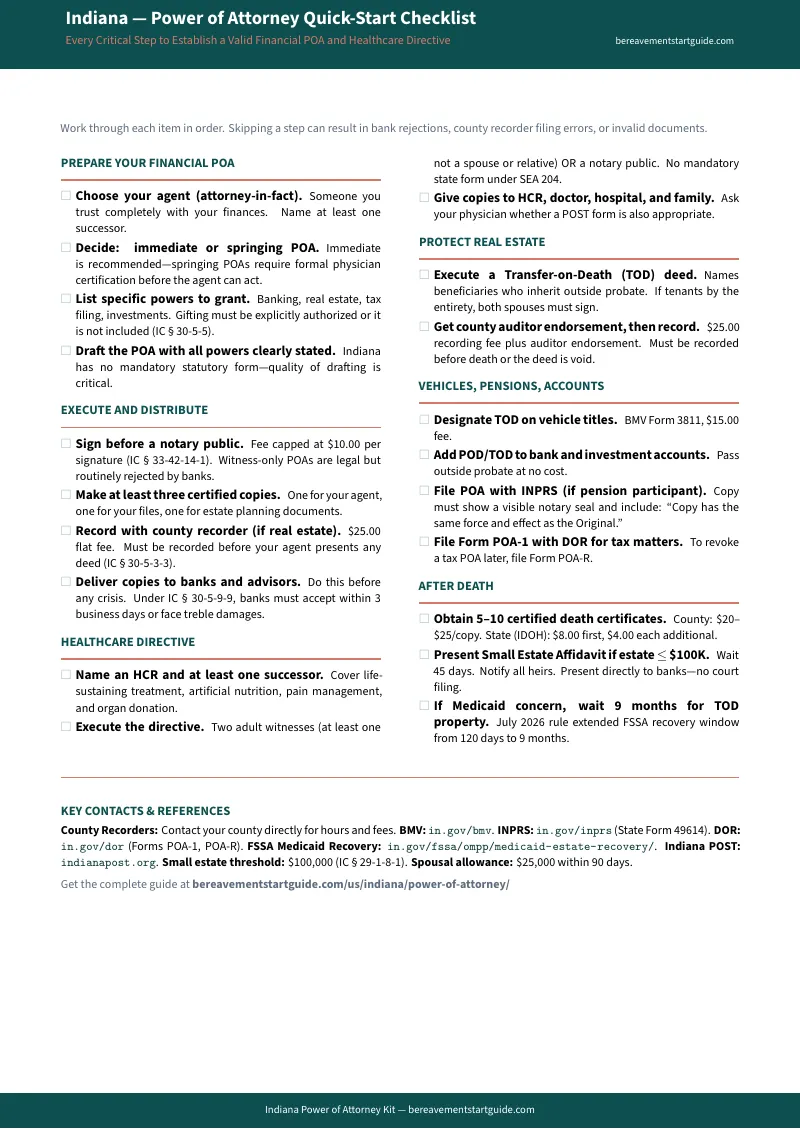
Or start with the free Indiana POA Quick-Start Checklist — a one-page overview of the execution requirements, witness rules, and notarization basics. It covers the essentials. The full guide goes deeper into every chapter, every form, and every institutional strategy.
Frequently Asked Questions
What if the rules change after I buy?
We update the guide when the rules change. Email us any time, even years later, and we'll send you the current edition free.