You Have Days, Not Weeks — And Every Decision Has a Rule Behind It
The phone call comes, and the timeline is already running. Polish law says the death must be registered within three days. Social custom says the burial should happen within three to four days. The parish office cannot schedule a funeral Mass without the official Akt Zgonu from the Urząd Stanu Cywilnego. The funeral home is asking about coffin materials, transport distances, and whether the family wants a viewing. And you are standing in the middle of all of it, trying to figure out what happens in what order while everyone around you assumes you already know.
The parish priest will handle the liturgy. The funeral home will handle logistics. But nobody is handling the gap between them — the civil filings, the ZUS claim, the cemetery lease, the family arguments about cremation, the question of whether the Pusta Noc is expected or optional. That gap is where families lose time, lose money, and make decisions they regret.
The Polish Funeral Navigator — A Complete Coordination System
The Catholic Funeral — Poland guide is built for the person doing the actual coordinating. It brings together the civil administrative process, the Catholic liturgical requirements as applied by the Polish Episcopate, and the regional folk traditions into one timeline — so you know what to do on Day 1, what questions to ask the parish priest on Day 2, and what paperwork to bring to the USC before their office closes.
This is not a summary of customs or a collection of tips from forums. It is a step-by-step coordination system that walks you through every decision from the first hour after death through the burial, the stypa, and the memorial milestones that follow.
What's Inside
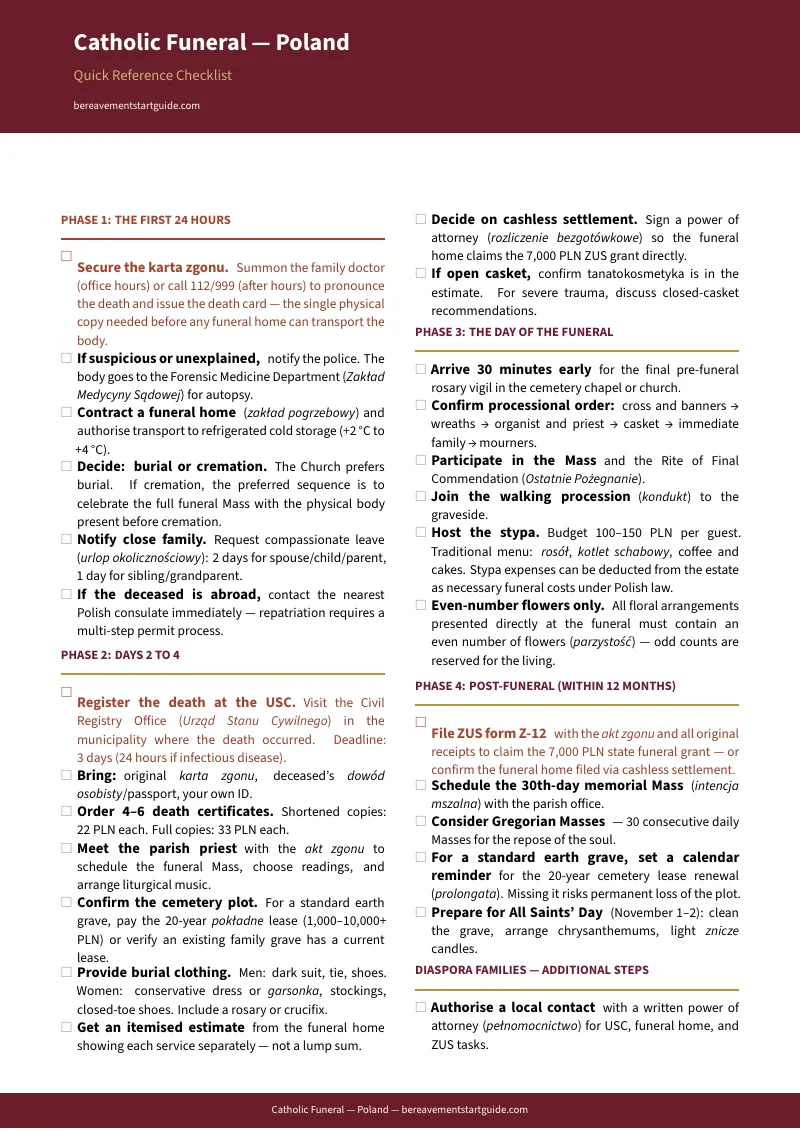
- First-72-hours crisis checklist — the exact sequence of steps from obtaining the Karta Zgonu to registering the death at the USC, with filing deadlines and office hours so nothing slips through a holiday or weekend gap
- Parish coordination scripts — word-for-word guidance for your first meeting with the parish office, including how to discuss the co łaska (priest's stipend) without awkwardness, how to request a specific liturgy format, and how to handle situations where the priest raises objections about the deceased's level of observance
- Cremation decision framework — the Polish Episcopate's current rules, broken down into practical scenarios: when the Mass must happen before cremation, when an urn Mass is permitted, and what the Church strictly prohibits (scattering, dividing, or keeping ashes at home). Includes a coordination template for scheduling the two-stage service
- ZUS funeral allowance claim guide — which receipts ZUS will reimburse, which costs are explicitly excluded, the family-versus-non-family payout distinction, and a step-by-step walkthrough of the filing process so you do not leave money on the table or have your claim rejected for missing documentation
- Cemetery lease navigator — how the 20-year pokładne system works, how parish cemeteries index fees to the ZUS allowance, the process for renewing an existing family plot, the legal consequences of a lapsed lease, and the difference between standard plots and family vaults
- Regional traditions map — dedicated sections on the Pusta Noc prayer vigil (Kaszuby and Podlasie), Podhale Highlander funeral customs (traditional dress, horse-drawn processions, coffin items), and Silesian workplace mourning traditions — with guidance on which customs apply to your region and how to handle conversations with relatives who expect unfamiliar practices
- Funeral home screening questions — a structured list of questions that help you compare vendors, understand what is included in a quoted price versus what will appear as an add-on, and identify common upselling tactics before you sign a contract
- Stypa planning template — traditional menu options (rosół, kotlet schabowy, kluski śląskie, szarlotka), guest count estimation, venue options, alcohol customs, and a coordination sheet for splitting responsibilities among family members
- Diaspora coordination chapter — civil registration from abroad, authorizing a local representative, body transport permits for distances exceeding 60 km within Poland, international repatriation document checklist, and remote parish and vendor coordination
- Post-funeral obligations — mourning period conventions (żałoba) by relationship, how to arrange the 30th-day memorial Mass, annual anniversary Mass planning, and preparation for the All Saints' Day grave tending on November 1st
Who This Is For
This guide is built for anyone who has been handed the responsibility of organizing a Catholic funeral in Poland — whether or not they grew up navigating these systems.
- Adult children planning a parent's funeral — especially those who are secular or semi-observant and need to manage a traditional service under pressure from extended family
- Diaspora relatives coordinating from abroad — first- or second-generation emigrants in the US, UK, Canada, or Western Europe who must travel on short notice or manage logistics remotely
- Interfaith or non-Catholic family members — partners or relatives who need to organize a Catholic service to honor the deceased's wishes without prior liturgical knowledge
- Executors and close friends stepping in — anyone assisting a grieving family that is too overwhelmed to manage the administrative and logistical coordination alone
Why Not Free Information?
Free information exists, but it is scattered across sources that each cover only their own piece. Parish websites explain liturgical requirements in dense theological language and assume you are a practicing parishioner. Funeral homes provide price lists but focus on selling their own products rather than helping you manage your budget. Government portals (ZUS, gov.pl) list required documents but do not explain which funeral home receipts will actually be accepted for reimbursement. Forum posts (Reddit, Wykop) offer real-world cost breakdowns but are inconsistent, regional, and impossible to verify on a deadline.
The result is that families spend hours piecing together conflicting advice from five or six different sources while under intense time pressure and emotional strain — or they rely entirely on the funeral home and the parish priest, neither of whom covers the full picture. The guide replaces that patchwork with a single, coordinated planning system that covers the civil, religious, financial, and social dimensions in one place.
Our Guarantee
If the guide does not save you time and reduce the stress of organizing the funeral, contact us and we will refund your purchase — no questions asked.
Get Started
Download the free one-page checklist to see the essential steps at a glance. When you are ready for the full coordination system — with scripts, worksheets, cost frameworks, and regional traditions coverage — get the complete Catholic Funeral — Poland guide for .
Frequently Asked Questions
What if the rules change after I buy?
We update the guide when the rules change. Email us any time, even years later, and we'll send you the current edition free.