
You Live in the Only State Where a Generic Will Template Can Be Declared Legally Void. Your Power of Attorney Does Not Exist Here. And Your Children Can Inherit Your House Whether You Want Them to or Not.
You moved to Louisiana, or you have lived here your whole life, and you finally decided to get your estate plan in order. So you searched online. You found a will template. You downloaded a power of attorney form. You thought you were done.
You are not done. You may have made things worse.
Louisiana is the only state in America that runs on a civil law system — rooted in French and Spanish legal traditions, not English common law. What the other forty-nine states call a "power of attorney," Louisiana calls a "mandate." What they call "probate," Louisiana calls "succession." What they call a "holographic will," Louisiana calls an "olographic testament" — and it must be written entirely in your own handwriting, dated, and signed, or it is invalid. The generic form you downloaded? It probably references legal concepts that do not exist in Louisiana law.
And then there is forced heirship — the rule that catches almost everyone off guard. Louisiana is the only state where your children under the age of twenty-four can legally override your will and claim a mandatory share of your estate. It does not matter what your testament says. If you have a twenty-two-year-old child, they are entitled to at least one-quarter of everything you own. If you have two or more qualifying children, they split half of your estate. No other state does this. No generic template accounts for it. And if you are in a blended family with children from a prior marriage, forced heirship can hand your stepchildren naked ownership of your family home — leaving your surviving spouse with a usufruct that terminates the moment they remarry.
The Louisiana Basic Estate Planning Kit is a Civil Law Navigation System built specifically for the legal framework that makes estate planning in Louisiana different from every other state. Not a common law template with "Louisiana" stamped on top. Not a generic internet form that uses terminology your parish court will reject. A structured, statute-specific planning guide that walks you through every unique Louisiana requirement — from executing a notarial testament that qualifies as self-proving under the 2025 Act 30 reforms, to customizing your spousal usufruct so forced heirship does not leave your spouse homeless.
What's Inside the Civil Law Navigation System
A 15-chapter guide with 6 appendices, 10 standalone printable worksheets and reference cards, and a one-page estate planning checklist — covering every dimension of Louisiana's civil law estate planning framework, including the 2025 statutory reforms that most attorneys have not yet incorporated into their practices:
Testament Execution Protocol: Validity vs. Self-Proving Status
On August 1, 2025, Act 30 modernized Louisiana's will execution requirements. A notarial testament no longer needs a verbal declaration or signatures on every page to be valid. But here is the trap that catches families every week: a testament that is valid but not self-proving forces your heirs to locate the original notary and witnesses — years after execution — to testify in court before the will can be admitted. The guide gives you the complete execution protocol for both validity and self-proving status under Code of Civil Procedure article 2891, including the exact attestation clause language and the witness-and-notary sequence that eliminates post-death court delays.
Forced Heirship and the Legitime Calculation
If you have children under twenty-four, or permanently disabled children of any age, Louisiana law requires that a portion of your estate pass to them regardless of what your testament says. One qualifying forced heir means twenty-five percent of your estate is protected. Two or more means fifty percent. The legitime is calculated on a notional mass that includes assets at death minus debts plus lifetime donations — meaning you cannot avoid forced heirship by giving away assets before you die. The guide walks you through the calculation, shows you exactly how to structure the disposable portion, and explains the planning tools that let you protect your surviving spouse within the forced heirship framework.
Spousal Usufruct Planning Worksheets
When a married person dies intestate in Louisiana, the surviving spouse receives a legal usufruct over the deceased's share of community property. That sounds protective until you read the fine print: this usufruct terminates automatically upon remarriage. If you are fifty-five and your spouse dies, and you later remarry at sixty, your stepchildren from the first marriage immediately gain full ownership of the family home. You may need their consent to sell, refinance, or even remain in the house. The worksheets in this kit let you customize a testamentary usufruct that lasts for your spouse's lifetime — expressly overriding the remarriage termination trigger — waive the security bond requirement, and prevent the cascade of stepfamily disputes that intestacy creates in blended families.
Mandates: Louisiana's Version of Powers of Attorney
If you hand a Louisiana bank or notary a document titled "Power of Attorney," they will know you got it from an out-of-state template. Louisiana uses "mandates" — and the requirements differ. A mandate authorizing someone to sell your real estate must be notarized and in the same form as the act it authorizes. A durable financial mandate must explicitly state that it survives your incapacity, or it terminates the moment you can no longer make decisions. Without a valid mandate, your family faces an interdiction proceeding — Louisiana's version of guardianship — which requires a court hearing, legal representation, and ongoing supervision. The guide covers general mandates, special mandates, healthcare directives, and the specific execution requirements for each.
Community Property vs. Separate Property Audit
Louisiana is one of nine community property states, but its civil law system creates classification rules that differ from California, Texas, and the rest. Assets acquired during marriage are presumed community. Inheritances and gifts received by one spouse are separate — unless they are commingled with community funds in a joint account, at which point tracing becomes the only way to reclaim the separate classification. The guide includes an asset audit worksheet that helps you classify every account, property, and investment before a succession court does it for you under rules you might not agree with.
Small Succession Affidavit vs. Full Succession
If the gross value of the estate is under $125,000, Louisiana allows a simplified transfer using a Small Succession Affidavit under Code of Civil Procedure article 3431. But the threshold is based on gross value — not net. A house worth $200,000 with a $150,000 mortgage counts as $200,000 and disqualifies the estate. If there is real estate, you must wait ninety days from the date of death. If there is an olographic testament, you must first probate the handwriting in a separate judicial proceeding. The guide maps every qualification criterion and gives you a decision tree so you know before you file whether your family qualifies for the shortcut or needs full succession with independent administration authority.
Tutorship: Naming Guardians Under Louisiana Law
Other states call it guardianship. Louisiana calls it tutorship — and the framework is more structured. A surviving parent is the natural tutor. But if both parents die, the testament must name a tutor and an undertutor (a separate person who oversees the tutor's management of the child's property). Without these nominations, a judge chooses — and family members who disagree will spend months in court. The guide covers tutorship nominations, the undertutor requirement, the family meeting procedure, and what happens when the named tutor lives in another state.
Trusts: Revocable, Irrevocable, and Medicaid Asset Protection
Louisiana trust law operates under its own Trust Code, not the Uniform Trust Code used by most states. A revocable living trust can avoid succession but does not protect assets from Medicaid estate recovery. An irrevocable trust can shield the family home from the Louisiana Department of Health's recovery program — but only if funded at least sixty months before a Medicaid application. The guide explains both structures, walks you through the five-year look-back period, and helps you evaluate whether a trust belongs in your estate plan based on your actual asset profile and risk exposure.
Medicaid Estate Recovery and the Five-Year Look-Back
The Louisiana Department of Health recovers long-term care costs from the estates of deceased Medicaid recipients aged fifty-five and older. The primary target is the family home. While the home is exempt during your lifetime up to $752,000 in equity, that exemption vanishes at death. Recovery is deferred only while a surviving spouse is living or a child under twenty-one, blind, or permanently disabled resides in the home. The guide covers the look-back period, the hardship waiver criteria, the income threshold for first-degree heirs, and the planning steps you can take now to reduce your family's exposure.
Digital Assets and Modern Estate Planning
Online accounts, cryptocurrency, social media profiles, digital subscriptions, cloud storage — none of these existed when Louisiana's Civil Code was drafted. The guide includes a digital asset inventory worksheet and explains the legal framework for granting your succession representative access to accounts that most service providers will lock upon notification of death.
Who This Kit Is For
- Married and remarried couples in Louisiana who need to structure their estate plan around forced heirship and usufruct — especially blended families where children from a prior marriage could claim naked ownership of the family home, leaving the surviving spouse with a usufruct that evaporates upon remarriage
- Louisiana residents approaching 55 or older who are beginning to plan for long-term care costs and need to understand the Medicaid five-year look-back period, estate recovery rules, and whether an irrevocable trust should be part of their plan
- People who moved to Louisiana from another state and discovered that their existing will, power of attorney, and TOD deed use terminology and legal structures that Louisiana does not recognize — who need to execute valid Louisiana mandates and a notarial testament before their out-of-state documents create a succession nightmare
- Parents of minor children who need to name a tutor and undertutor under Louisiana law rather than a common law guardian — and want to understand the family meeting procedure and property management rules that apply to their children's inheritance
- Anyone who wants to avoid a contested succession by planning now — whether that means qualifying for the Small Succession Affidavit, authorizing independent administration, or structuring a trust that keeps the family home out of the succession estate entirely
Why Generic Online Templates Fail in Louisiana
You have seen the national platforms: LegalZoom, Rocket Lawyer, FormSwift. They offer will templates and power of attorney forms that work in forty-nine states. Louisiana is the one where they do not — and the failures are not minor formatting issues. They are legal voids.
- National platforms still sell "Power of Attorney" forms for Louisiana. Louisiana does not use powers of attorney. It uses mandates — and the requirements for a valid mandate differ from common law POAs in ways that affect whether your family can access your bank accounts, sell your house, or make medical decisions if you become incapacitated. A "Power of Attorney" form presented to a Louisiana notary or financial institution signals that the document was not drafted under Louisiana law.
- Generic will templates do not account for forced heirship. If your will leaves everything to your spouse and you have a twenty-two-year-old child, Louisiana law overrides your will and gives that child at least one-quarter of your estate. No national template warns you. No generic checklist walks you through the legitime calculation. And no free internet form helps you structure the disposable portion or grant a lifetime usufruct that protects your spouse within the forced heirship framework.
- Most templates have not been updated for Act 30 of 2025. Before August 2025, omitting an attestation clause or failing to sign every page could invalidate a Louisiana will entirely. Act 30 changed this — those omissions no longer void the testament, but they strip it of self-proving status. Templates that still require the old execution ceremony are demanding steps that are no longer legally necessary. Templates that removed those steps without explaining the self-proving distinction are creating testaments that will cost your heirs thousands in court verification fees.
- No national platform explains that Louisiana does not recognize Transfer on Death deeds. If you have a TOD deed on your Louisiana real estate, it is legally ineffective. Your property must go through succession — and your family will discover this only after you die, when it is too late to fix.
The Civil Law Navigation System is built from Louisiana's Civil Code, the 2025 Act 30 reforms, and the specific rules that make estate planning in this state structurally different. Every template, every worksheet, every chapter references the statutes that actually govern your estate — not the common law concepts that Louisiana rejected two centuries ago.
Your Purchase Is Risk-Free
If the kit does not give you a clear, actionable path through Louisiana's estate planning requirements, email hello@bereavementstartguide.com and we will make it right. No complicated process, no fine print.
— Less Than One Hour of Attorney Time
A Louisiana estate planning attorney charges $250 to $400 per hour. A basic notarial testament runs $500 to $1,200. A complete estate planning package with mandates, healthcare directives, and trust review costs $2,500 or more. This kit covers the same planning ground — and if you do choose to work with an attorney later, you will walk into their office with pre-organized documents, completed worksheets, and a clear understanding of Louisiana's civil law framework that saves hours of expensive billable time.
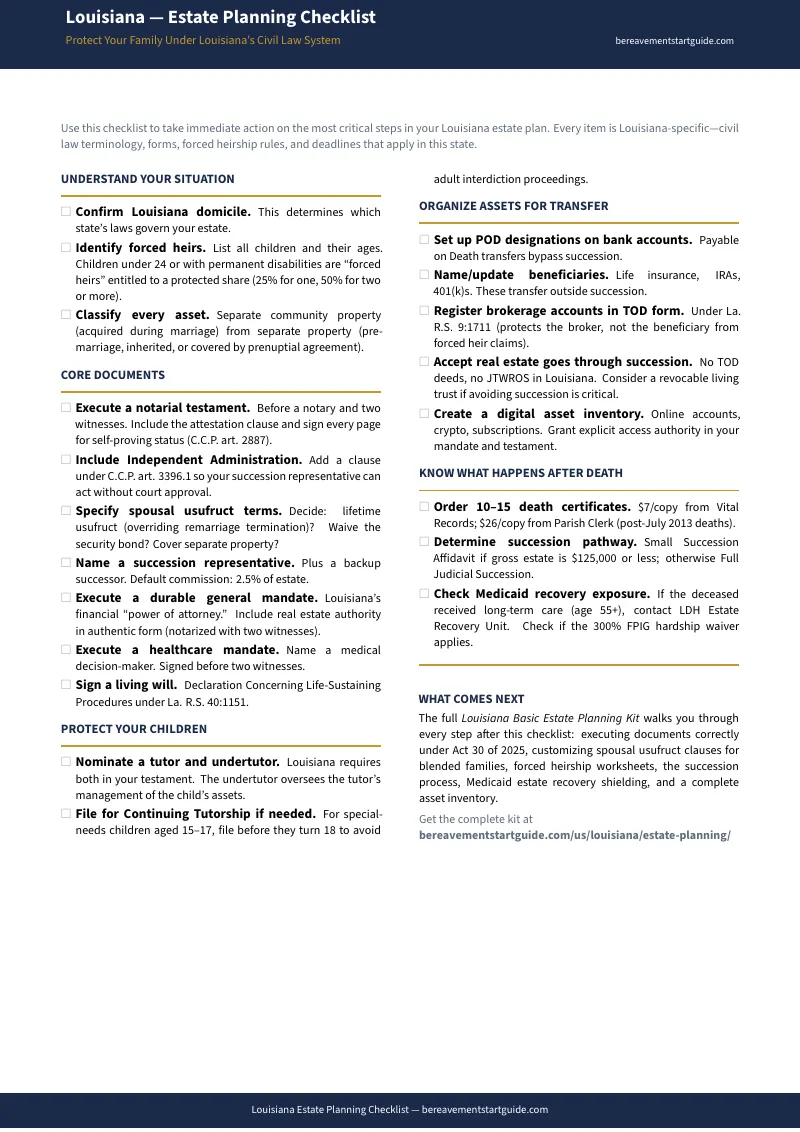
Download the free Estate Planning Checklist to see the first steps. When you are ready for the full guide with templates, worksheets, and the complete execution protocols, the full kit is here.
Frequently Asked Questions
What if the rules change after I buy?
We update the guide when the rules change. Email us any time, even years later, and we'll send you the current edition free.