Your Mother's Bank Account Is Frozen. The Hospital Wants a "Mandate," Not a "Power of Attorney." The Notary Says Your Template Is Null. And Louisiana Just Became the Only State Where a Generic POA Form Can Trigger a $5,000 Court Proceeding.
Your father was diagnosed with early-stage dementia last month. You downloaded a "Louisiana Power of Attorney" from a national website, printed it, had him sign it in front of a notary, and drove it to his bank in Baton Rouge. The branch manager looked at it for two minutes, circled the words "attorney-in-fact," and told you the bank cannot accept it. Louisiana law does not recognize an "attorney-in-fact" — the correct term is mandatary. The document uses "power of attorney" — the correct Louisiana term is mandate. And because your form authorizes real estate transactions but was signed only by your father and a notary — without two additional witnesses present simultaneously — it is an absolute nullity under Louisiana Civil Code Article 1833.
You called an elder law attorney. The fee for a basic mandate package starts at $750. A trust-centered plan runs past $3,500. And your father's capacity window is closing. You need a document that Louisiana banks actually accept, that satisfies the authentic act execution requirements, and that covers the civil law terminology your hospital, your notary, and the Parish Clerk of Court expect to see — not the common-law vocabulary that every other state uses.
The Louisiana Mandate & Incapacity Protection Kit is a Civil Code Compliance System built entirely around Louisiana Civil Code Articles 2989 through 3032 and the state's unique execution formalities — mapping every mandate type, every express power, every witness requirement, and every institutional submission procedure into one step-by-step sequence. It diagnoses which powers your mandatary needs under Article 2997, walks you through the authentic act execution that makes your mandate legally enforceable, and includes a statutory bank submission letter citing La. R.S. § 6:311.1 so your financial institution accepts the document before a crisis occurs.
What's Inside the Civil Code Compliance System
A 17-chapter guide, a 20-item printable action checklist, and 10 standalone worksheets and reference sheets — covering every mandate type, healthcare directive, execution formality, and institutional acceptance procedure under Louisiana law:
Chapters 1–2: Louisiana's Civil Law System and the Contract of Mandate
Why every other state's POA template fails in Louisiana. The complete common-law-to-civil-law terminology translation table: "power of attorney" becomes mandate, "agent" becomes mandatary, "guardianship" becomes interdiction, "probate" becomes succession, "real estate" becomes immovable property. How mandates work as bilateral contracts under Article 2989. Why Louisiana mandates are durable by default under Article 3024 — no special "durability" language required. Why no official state form exists, and what that means for your document.
Chapters 3–4: Choosing Your Mandatary and Defining Authority
Fiduciary duties under Louisiana law — what your mandatary can and cannot do. The critical Article 2997 express authority requirement: six categories of powers (real estate, donations, loans, taxes, trusts, healthcare) that must be individually and explicitly granted or the mandatary has zero authority to act. Checkbox-driven power selection so you grant exactly what is needed and nothing more. Immediate vs. springing mandates — why springing triggers create dangerous clinical delays that leave families locked out during the critical hours after a stroke or fall.
Chapters 5–6: Authentic Act Execution and the Healthcare Mandate
The step-by-step authentic act execution protocol: principal, mandatary, notary, and two competent witnesses — all in the same room, at the same time, signing the same document. Why a "split signing" (different people signing at different times) makes the mandate absolutely null. Healthcare mandate execution: witness qualifications, treating physician restrictions, and the critical difference between a healthcare mandate and a living will. How the Louisiana Physician Orders for Scope of Treatment (LaPOST) system interacts with your healthcare directives.
Chapters 7–9: Living Wills, Bank Submission, and Real Estate
The Natural Death Act declaration — when it applies, when it does not, and the specific life-sustaining treatments you can accept or refuse. The bank pre-acceptance strategy: how to submit your mandate to every financial institution where the principal holds accounts before a crisis, using the statutory cover letter citing La. R.S. § 6:311.1. Real estate mandate requirements: the equal dignity rule under Article 2993, parish recorder filing, and why immovable property transactions demand the highest execution standard.
Chapters 10–13: Forced Heirship, Medicaid Planning, and Special Situations
Louisiana's forced heirship rules — the only state where children under 24 (or of any age with a permanent disability) are legally entitled to 25–50% of the estate regardless of the will. How to draft mandate authority that permits strategic gifting for Medicaid asset protection without violating the légitime. The 60-month look-back period and the penalty calculation formula. Community property protections for the surviving spouse. Mandates for military families, non-resident property owners, and business owners.
Chapters 14–17: Revocation, Interdiction Avoidance, and Emergency Execution
How to properly revoke a mandate — written revocation via authentic act plus mandatory written notice to every financial institution under La. R.S. § 6:311.1. The interdiction nightmare: what happens when no mandate exists and the family must petition the court to appoint a curator — $5,000+ in fees, months of proceedings, and the legal stripping of the incapacitated person's civil rights. The emergency hospital execution checklist: how to execute a valid mandate in a hospital room before surgery when time is measured in hours, not weeks.
Who This Kit Is For
- The caregiver child whose parent is declining — your father can still recognize family members and understand what he is signing, but the window is closing. You need a mandate executed correctly on the first attempt because there may not be a second chance. Once capacity is permanently lost, interdiction is the only remaining option.
- The proactive couple planning ahead — you own property in Jefferson Parish, have retirement accounts at a local credit union, and want your spouse to manage everything seamlessly if something happens. You compared the $750 attorney fee against doing it yourself and want to know whether a self-executed mandate provides the same legal protection. It does — if executed as an authentic act.
- The emergency decider facing surgery — the procedure is scheduled for next week. You need a durable financial mandate and a healthcare directive executed in a hospital or home setting with a mobile notary, two witnesses, and no room for error on the formalities.
- The family protecting assets from Medicaid recovery — your parent may need nursing home care within the next five years. You need a mandate that explicitly grants gifting authority under Article 2997 so the mandatary can make strategic donations and establish asset protection trusts before the 60-month look-back window closes.
- The out-of-state child managing Louisiana property — your mother lives in another state but owns a rental property in Orleans Parish. A generic power of attorney will not transfer Louisiana immovable property. You need a mandate executed as an authentic act with express real estate authority filed with the parish recorder.
Why Generic POA Templates Do Not Work in Louisiana
Every mandate template in this kit is drafted under the Louisiana Civil Code. Here is why that matters — and why the free forms from national websites do not survive first contact with a Louisiana bank, hospital, or parish clerk:
- Wrong vocabulary gets rejected at the counter. Louisiana banks and hospitals use civil law terminology. A document that says "power of attorney" instead of "mandate," "agent" instead of "mandatary," or "guardian" instead of "curator" signals a form drafted for common-law states. Financial institutions reject these documents not because they are malicious, but because they do not match the legal framework their compliance departments are trained on.
- Missing express powers mean zero authority. Under Article 2997, sensitive powers — selling real estate, making donations, contracting loans, filing taxes — must be individually and explicitly granted. A generic form that says "I grant my agent full authority" gives the mandatary exactly nothing for these critical categories. The bank checks for express language; if it is missing, the transaction stops.
- Execution defects are not fixable after the fact. If a financial mandate authorizing real estate transactions was signed without two witnesses present simultaneously alongside the notary, it is an absolute nullity. Not voidable — null. A court will not cure the defect. The only remedy is executing a new document, which requires the principal to still have legal capacity.
- No generic guide covers forced heirship. Louisiana is the only U.S. state where a mandatary's authority to make gifts can violate the légitime owed to forced heirs. National templates do not account for this because it does not exist anywhere else. A mandate that permits unlimited gifting can trigger clawback litigation from forced heirs after the principal's death.
- Attorney websites explain the problem. They withhold the solution. Louisiana elder law firms publish detailed articles about mandate complexity. The content is accurate. It is also deliberately incomplete — designed to trigger a $750 consultation call, not to empower you to handle it yourself. The question is not "how complicated is this?" but "does my mandate actually require an attorney?" For the vast majority of Louisiana families executing a standard durable financial and healthcare mandate, the answer is no — if the execution formalities are followed precisely.
Free resources give you one form at a time — a financial template from one source, a healthcare proxy from another, a living will from a third — with no sequencing, no cross-referencing, and no way to verify that your execution formalities satisfy the authentic act standard. The Civil Code Compliance System maps every mandate type, every express power, and every execution requirement into one integrated sequence — so your documents survive their first encounter with a Louisiana bank teller, hospital administrator, or parish clerk.
— Less Than One Hour of an Elder Law Attorney's Time
A Louisiana elder law attorney charges $750 or more for a basic mandate package — $3,500+ for a trust-centered estate plan. You are not paying for magic words on a page. You are paying for their hourly office overhead. The Civil Code Compliance System delivers the same structural code compliance — Article 2997 express powers, authentic act execution protocol, bank submission procedures, forced heirship protections — at a fraction of the cost. One-time purchase. Instant download. No subscription. No recurring fees.
If the kit does not meet your expectations, email hello@bereavementstartguide.com and we will make it right.
Get Started Today
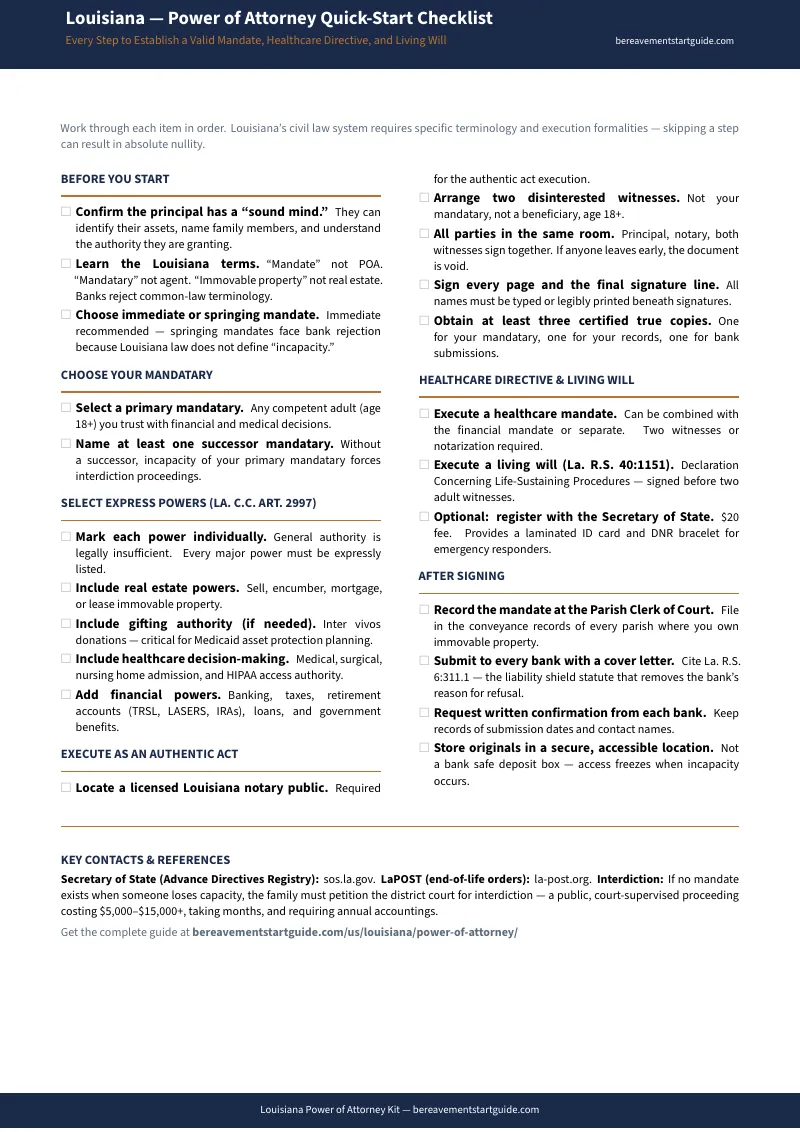
Download the free Louisiana POA Quick-Start Checklist to see the 20 items you need to address — then decide whether the full kit is right for your family. The checklist covers what to do. The full kit covers how — with chapter-by-chapter instructions, execution checklists, and the bank submission letter that eliminates institutional rejection.
Frequently Asked Questions
What if the rules change after I buy?
We update the guide when the rules change. Email us any time, even years later, and we'll send you the current edition free.