The Bank Froze Every Account the Moment You Showed Them the Death Certificate. The Funeral Bill Is Due. And the One Thing Everyone Tells You to Do — Tap His ATM Card to Pay for It — Is a Criminal Offence That Can Cost You the Entire Value of What You Touch.
You walked into HSBC with the death certificate, expecting to settle the funeral and keep the household running. Instead, a teller told you the accounts are frozen — every sole-name account, savings, fixed deposits, all of it — and nothing moves until you produce a sealed Grant from the High Court. Nobody warned you that in Hong Kong, nothing transfers automatically. A surviving spouse has no authority over a sole-name account. The money your family needs is sitting right there, and you are legally locked out of it.
So you do what every well-meaning relative does, what the forums and the WhatsApp groups quietly suggest: you reach for his ATM card, or the online-banking login, or the pre-signed cheques — just to pay the undertaker, just to keep things moving. Stop. Under Section 60J of the Probate and Administration Ordinance, that is the criminal offence of intermeddling — dealing with a deceased person's property without lawful authority. The penalty is not a slap on the wrist. It is a fine plus a further penalty equal to the entire value of whatever you touched. Withdraw HK$300,000 "to be safe," and a court can penalise you HK$300,000 on top of the fine. This is exactly why the banks bury that warning in their bereavement brochures — they are protecting themselves, not you.
Meanwhile, the relatives are calling. Siblings are arguing about a sea burial versus a niche their parents always wanted — and the public columbarium waitlist is four years long. An overseas brother in London wants to fly in for a week to "close the accounts," not knowing the bank's paperwork runs sequentially with the government's and takes weeks. Underneath all of it, the question that keeps you awake: if I file the wrong form, mismatch a name on the Schedule of Assets, or distribute before I clear the tax — am I the one who pays for it?
The honest answer is yes, the executor's personal liability is real, and it starts earlier than anyone expects. But the longer answer — the one that involves applying to the Home Affairs Department for the Certificate for Necessity of Release of Money that legally pays the funeral directly within the hour, the HK$500,000 statutory legacy a spouse takes before the estate is even divided, the safe-deposit-box inspection protocol you cannot lawfully skip, the difference between a HAD Confirmation Notice for tiny estates and a full Grant of Representation, and the single name-mismatch on a Schedule of Assets that triggers a Registrar's requisition and adds six months to the wait — that answer is what separates families who settle the estate in months from families who spend a year untangling mistakes they never knew they were making.
The When Someone Dies in Hong Kong — Estate Settlement Guide is a Guided DIY Administration manual for every legal, financial, and administrative step between the moment of death and the final winding-up of the estate. Not a law-school textbook. Not a generic "probate" planner written for American or English courts that has never heard of the Probate Registry, the EBSU, or Cap. 73. A structured, Hong Kong-specific manual that follows the exact sequence of forms, departments, court rules, and fees — so you stop guessing, stop paying for mistakes, and start working through this in the right order.
What's Inside the Guide
A 13-chapter guide and the standalone First 48 Hours Checklist — covering every stage from the moment of death through final estate distribution, built specifically for Hong Kong statutes and the departments you will actually deal with:
The First 48 Hours: Certifying the Death
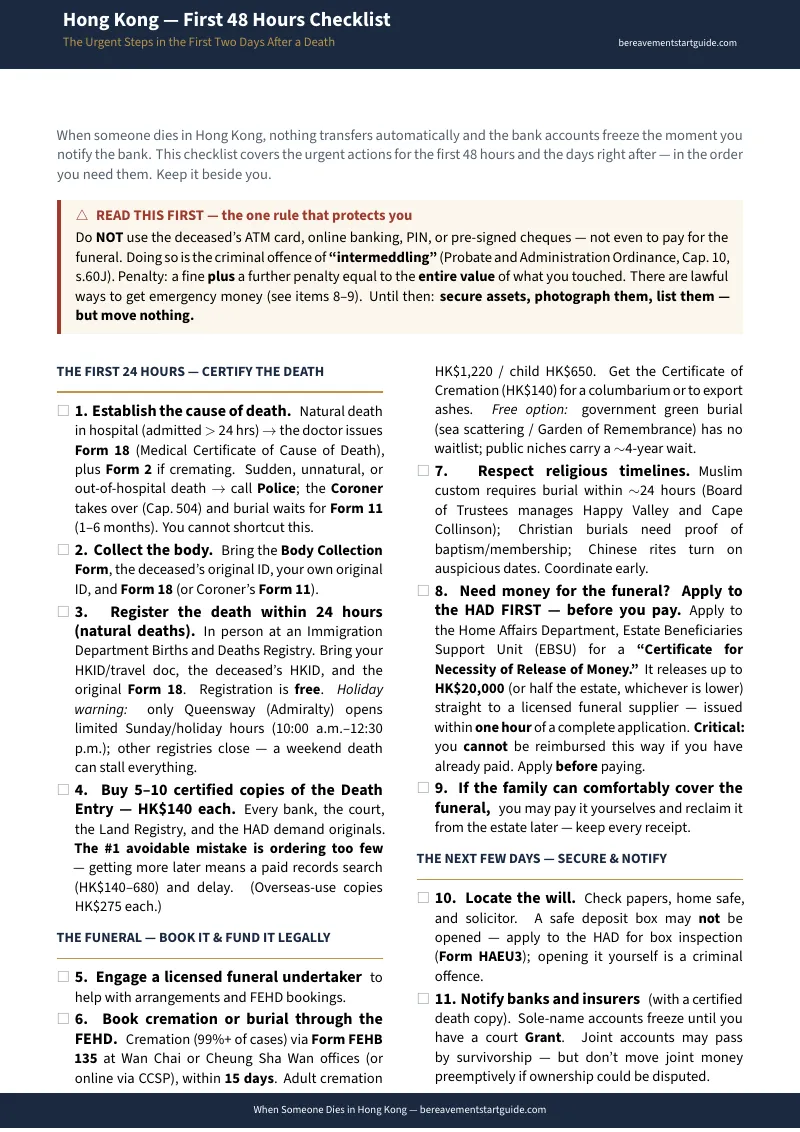
Everything turns on one question — was the death natural or unnatural? This chapter covers the critical fork between a hospital death (Form 18 from the attending doctor, registered within 24 hours) and a sudden or unexplained death (the Coroner takes over under Cap. 504, the body goes to a public mortuary, and burial waits one to six months for Form 11). It covers collecting the body, registering at the Births and Deaths Registry, the weekend-and-holiday bottleneck that can stall the entire chain, and the single most common avoidable mistake in Hong Kong estate administration: ordering too few certified copies of the Death Entry. Buy five to ten — running short later means a paid records search and weeks of delay.
STOP: The Intermeddling Trap
The shortest and most important chapter in the book. A plain-language explanation of Section 60J — exactly what you must not do (use the ATM card, cash a pre-signed cheque, quietly empty a joint account, "safekeep" the jewellery) before you have authority, what the ruinous penalty actually is, and the lawful routes to immediate money that exist instead. Read this before you touch anything.
The Liquidity Trap: Getting Emergency Funds Legally
The cruelest stretch — the funeral invoice falls due exactly when the accounts freeze. This chapter covers why banks are legally obliged to freeze sole-name accounts, how joint accounts and the right of survivorship really work (and the hidden "convenience account" dispute that can claw the money back into the estate), and the Home Affairs Department's three statutory lifelines — starting with the Certificate for Necessity of Release of Money that pays a licensed undertaker directly, up to HK$20,000 or half the estate, issued within one hour. The one rule that catches families: you must apply before you pay — the HAD will not reimburse you afterward.
The Discovery Phase and the Small-Estate Shortcuts
How to find the will, the safe-deposit-box inspection protocol (it is a criminal offence to open the box yourself — even a joint renter with a key), and how to build the Schedule of Assets and Liabilities the High Court demands. Then the three shortcuts that can save you months and tens of thousands in legal fees: the HAD Confirmation Notice for cash-only estates under HK$50,000, summary administration by the Official Administrator for liquid estates under HK$150,000, and the fatal small-print in each that disqualifies families who do not read it carefully.
The High Court: Obtaining the Grant of Representation
The heart of the process. The exact forms for Grant of Probate (with a will) versus Letters of Administration (no will), the strict statutory order of who may apply, and the intestacy distribution rules under Cap. 73 — the HK$500,000 statutory legacy, the half-to-spouse-half-to-issue split, the definition of "issue" that surprises families (it includes illegitimate children but excludes unadopted stepchildren), and the illiquid-home problem when the only asset is the family flat. Plus the requisitions that cause months of delay — name mismatches, stale valuations, missing translations — and exactly how to pre-empt every one.
When Families Fight, Cross-Border Estates, and Closing the Estate
Caveats and contentious probate (the blended-family pattern where children from a first marriage freeze everything), the remote executor route for diaspora and BNO relatives abroad (Power of Attorney, resealing a Commonwealth grant, fresh ancillary grants for Mainland or US estates), the inheritance rights of same-sex spouses and unmarried partners after Ng Hon Lam Edgar, clearing the deceased's final taxes with the IRD before you distribute, transferring property and vehicles, and the Section 43 notice that protects you from unknown creditors. Plus the master timeline, the essential-documents checklist, the agency directory, and the full schedule of costs and fees.
Who This Guide Is For
- The family coordinator who just lost a parent or spouse and is fielding calls from the undertaker, the bank, the Home Affairs Department, and relatives all at once — who needs a single document that says exactly what to do, which form to file, and in what order
- The accidental executor who has never set foot in the Probate Registry and is terrified of personal liability — who needs the complete Grant application explained in plain language, with every form number, fee, and deadline mapped, and the requisition traps flagged before they hit them
- The diaspora or BNO relative settling a Hong Kong estate remotely from the UK, Canada, or Australia — who needs to understand the Power of Attorney route (Forms W1.2a/b), resealing a foreign grant, the jurisdiction limits of the High Court, and why a single fly-in trip will not close the accounts
- The family facing intestacy with no will — who needs to know exactly who has the right to apply, how the Cap. 73 formula divides the estate, when two co-administrators are legally required, and how to defuse the family arguments these rigid rules ignite
- The unmarried or same-sex partner navigating a precarious legal standing — who needs absolute clarity on what the Ng Hon Lam Edgar decision changed for overseas same-sex marriages, and the evidentiary threshold for a dependency claim under Cap. 481 when there is no automatic right to inherit
Why Free Resources Will Not Get You Through This
The information exists. It is scattered across the Immigration Department, the FEHD, the Home Affairs Department, the Probate Registry, the Inland Revenue Department, the Land Registry, the MPF trustees, and a dozen private banks — none of which reference each other or tell you what comes next. Here is what you actually run into when you try to do this with free sources alone:
- Government portals are fragmented and written in dense legal jargon. GovHK, the Judiciary's Guide to Probate Practice, the HAD, and the IRD each accurately describe what their own department does — and none of them tells you when to approach each one. There is no centralised estate office and no chronological decision tree. You are expected to already know that the safe-deposit-box inspection comes before the Grant, that the IRD notice is due within a month, and which form feeds into which.
- Law-firm blogs are lead-generation, not instructions. Hong Kong solicitors publish excellent previews of the probate process — and deliberately stop short of the forms, the sequence, and the practical scripts, because that is what they bill HK$20,000 to HK$80,000 to do. The article is the hook; the retainer is the catch.
- Bank bereavement guides are narrow and self-protective. HSBC, Hang Seng, and Bank of China each publish a leaflet focused entirely on their own internal compliance requirements. They emphasise the intermeddling warning to shield themselves from liability — and tell you nothing about the High Court, the HAD, or the steps at every other institution you must deal with.
- Forum and social-media advice is legally perilous. Reddit threads and diaspora Facebook groups are full of empathetic, well-meaning people sharing advice that is anecdotal, outdated, or flatly dangerous. "Just empty the joint account before you tell the bank" is a recipe for an intermeddling prosecution. The consequences of following bad advice range from a rejected application to a criminal penalty equal to the value of the estate.
- Generic bereavement planners are built for US or UK law. The digital market is dominated by "probate" and "estate planning" guides written for American or English courts. They have never heard of Cap. 10A, the EBSU, the Confirmation Notice, the statutory legacy, or the intermeddling offence. They cannot help you in Hong Kong.
Free resources give you fragments from a dozen departments that do not reference each other. This guide puts every Hong Kong statute, form, fee, deadline, and procedure into one document, in the exact order you need them.
— Less Than a Hundredth of a Solicitor's Probate Bill
A Hong Kong solicitor charges HK$20,000 to over HK$80,000 to handle a straightforward probate application — and far more when cross-border or Mainland assets are involved. The official court fee, by contrast, is just HK$337 (a HK$265 filing fee plus HK$72 engrossment). The gap between those two numbers is almost entirely the administrative groundwork — the asset schedule, the form-filling, the document-gathering — which this guide teaches you to do yourself. It costs a tiny fraction of one hour of legal time and gives you the complete Hong Kong-specific roadmap: every form, every fee, every deadline, the intestacy formula, the requisition traps, and the lawful routes to emergency money while the accounts are frozen.
Your download includes the complete 13-chapter guide, the standalone First 48 Hours Checklist, and three printable worksheets you can use alongside the guide: an Asset & Liability Summary for building the court-required schedule, a Probate Timeline Planner for tracking your progress through each phase, and an Agency Directory & Fees Reference card with every department, form number, and fee in one place. Plus a money-back guarantee, no time limit. If the guide does not give you clarity on what to do next and the confidence that you are doing it in the right order, email us for a full refund. No questions asked.
Not ready for the full guide? Download the free Hong Kong — First 48 Hours Checklist — the urgent actions, forms, and the one rule that protects you from the intermeddling trap, covering everything from certifying the death through funding the funeral legally and securing the assets. It is enough to keep you safe today.
You did not ask for this. But you can get through it. The guide shows you how, one step at a time.