
Someone You Love Just Died in Hong Kong. The Funeral Director Is Quoting You HK$50,000. You Do Not Know What You Are Legally Required to Pay, What You Can Refuse, or Whether the Columbarium Niche He Is Selling You Is Even Licensed.
The hospital called, and now everything is moving too fast. A licensed undertaker is walking you through packages — mortuary preparation, coffin rental, ceremonial hall hire, paper offerings, hearse, cremation surcharges — and the total is climbing past HK$40,000 before anyone has explained what is legally required and what is optional. The salesperson across from you knows you have never done this before. The Consumer Council has documented that different staff within the same funeral parlour quote drastically different prices to different customers, adjusting figures based on perceived wealth and emotional vulnerability. You are exhausted, you are grieving, and the unspoken pressure in the room says: this is what a filial family does.
Nobody tells you that under the Trade Descriptions Ordinance (Cap. 362), that funeral director is committing a criminal offence if they use your grief to pressure you into a more expensive package, make misleading claims about what is "required" for cremation, or refuse to provide an itemised written quote. Nobody tells you that the penalty is a HK$500,000 fine and five years imprisonment. Nobody tells you that the ICAC has previously prosecuted hospital mortuary attendants who accepted bribes to steer families toward specific funeral agents — Operation "Gypsy" — and that the referral pressure you are feeling right now may not be accidental.
Meanwhile, a relative is insisting on a traditional Taoist funeral with three days of rites, another wants a simple cremation, and no one can determine who actually has the legal right to decide — the executor named in the will, the surviving spouse, or the eldest son who believes Chinese custom gives him authority. The deceased's bank accounts are frozen. The Immigration Department's 14-day registration deadline is running. And someone just mentioned that public columbarium niches cost HK$2,800 but have a years-long waiting list, while the private market starts at HK$200,000 — and some of those private columbaria are operating without a licence.
The Hong Kong Funeral Laws & Consumer Rights Guide is a Funeral Defence Protocol — a single, commercially independent resource that puts every Hong Kong funeral statute, consumer protection, and regulatory sequence into one document, in the order things actually happen. Not a funeral parlour brochure designed to upsell you. Not a Gov.hk factsheet written for civil servants. Not a law firm blog designed to convince you that you need a HK$35,000 solicitor. A practical manual that tells you exactly what the law says, what your rights are, and what you can legally refuse — so you stop overpaying, stop guessing, and stop letting funeral directors make decisions that belong to you.
What's Inside the Funeral Defence Protocol
A multi-chapter guide and the First 48 Hours Checklist — covering every stage from the moment of death through final disposition of ashes, built specifically for Hong Kong ordinances and the consumer protections that most families never learn about until they have already been overcharged:
Your Consumer Rights Under the Trade Descriptions Ordinance
Hong Kong does not have a named "Funeral Rule" like the United States FTC. But Cap. 362 gives you something arguably stronger — criminal penalties for funeral directors who engage in aggressive commercial practices, misleading omissions, or bait advertising. If a funeral parlour pressures you into upgrading a coffin by suggesting it is "required for cremation" or implies that choosing the cheapest option will bring bad fortune, that is a criminal offence carrying a HK$500,000 fine. The guide teaches you how to invoke these rights in real time: demanding itemised written quotes, refusing bundled packages, insisting on line-by-line pricing, and knowing exactly when the Customs and Excise Department will act on your complaint.
The First 48 Hours: Death Certificate, Registration, and Body Release
The attending doctor issues the Medical Certificate of the Cause of Death (Form 18). The Immigration Department requires death registration within 14 days. The Joint Offices in Wan Chai and Cheung Sha Wan allow simultaneous registration and cremation permit application. Missing Form 18, failing to bring the correct identity documents, or not understanding the Joint Office procedure costs families days of delay during the most painful week of their lives. The guide maps the exact sequence, the exact forms, and the exact documents you need — so you walk into the Joint Office once and walk out with everything done.
Cremation Cost Benchmarks and Eco-Coffin Rights
A public cremation costs HK$1,200. A public coffin burial costs HK$3,200 — but the law mandates exhumation after six years. The Consumer Council has advocated for eco-coffins specifically designed for cremation, which cost a fraction of the heavy wood caskets that funeral parlours push. You can legally insist on a simpler, cheaper coffin for cremation. You do not need the HK$15,000 rosewood casket that will be incinerated within hours. The guide gives you the benchmark costs so you can see exactly how much markup you are being charged — and the legal basis to refuse it.
The Columbarium Trap: Verifying Licences Before You Pay
Public columbarium niches cost HK$2,800 but the waiting list stretches for years. Private niches range from HK$200,000 to over HK$1,000,000. Some private columbaria operate without a valid Private Columbaria Licence, violate land lease conditions, or sit on land zoned for other uses. If you buy a niche in an unlicensed facility, you risk the government shutting it down and your family having to relocate the ashes — with no guarantee of a refund. The guide includes a due diligence checklist for verifying planning permission, licence status, and land lease compliance before you hand over a deposit.
Passing Away at Home: What Must Be in Place to Avoid a Police Investigation
More Hong Kong families are choosing home death for elderly and terminally ill relatives. This is legally permissible — but only if the patient's terminal status is documented by a registered medical practitioner. Without that documentation, a death at home triggers a mandatory police investigation for sudden, unexplained death. The guide explains exactly what medical documentation must be in place before the death occurs, so the family can grieve in peace rather than facing police questioning.
Repatriation: Getting a Body Into or Out of Hong Kong
Repatriating remains from Hong Kong to another country requires embalming certification, consular coordination, and import permission from the receiving government. Shipping a body to the United States costs approximately US$20,000. Cremation and ash shipment costs approximately US$4,700. The guide covers the entire repatriation logistics chain — embalming requirements, airline cargo rules, consular document checklists, and how to check whether travel insurance or life insurance covers repatriation costs. It also covers the reverse: bringing a body into Hong Kong for burial or cremation when the death occurred overseas.
Who Has the Legal Right to Direct the Funeral
The executor named in the will holds the primary right. If there is no will, authority follows the intestacy hierarchy under the Intestates' Estates Ordinance (Cap. 73) — surviving spouse first, then children, then parents, then siblings. Unmarried partners have no automatic right. Common-law relationships do not grant intestacy standing in Hong Kong. When family members disagree — and they frequently do, especially across generational and cultural lines — the guide maps the exact legal hierarchy, so the person with authority knows they have it, and the person without authority understands why.
Religious and Cultural Funeral Customs Without the Upsell
Taoist, Buddhist, Catholic, and Protestant funerals each have specific ceremonial requirements. Funeral parlours know this and routinely bundle expensive ceremonial add-ons — specific priests, quantities of paper offerings, extended hall hire — into packages presented as culturally mandatory. The guide separates genuine religious requirements from commercial additions, so families can honour their traditions without being financially exploited by salespeople who weaponise cultural guilt.
Who This Guide Is For
- The executor named in a will who is suddenly responsible for the funeral and does not know the legal boundaries of their authority — who needs to understand that their decision overrides the family's preferences, how to handle a relative insisting on an expensive traditional ceremony the deceased did not want, and what the Trade Descriptions Ordinance entitles them to demand from the funeral director
- The surviving spouse or eldest child acting without a will who has been told "you are in charge" but does not know the Cap. 73 intestacy hierarchy, the difference between executor authority and family seniority, or what happens when siblings disagree about cremation versus burial
- The family facing a HK$50,000 funeral quote with frozen bank accounts who needs to know their legal right to demand itemised pricing, how to benchmark against HK$1,200 public cremation costs, how the Tung Wah Group of Hospitals provides subsidised packages for CSSA recipients, and how to access estate funds for funeral expenses through the Home Affairs Department
- The family buying a columbarium niche who needs to verify the operator's Private Columbaria Licence, check land lease compliance, and understand the risks of an unlicensed facility before handing over HK$200,000 or more
- The overseas relative coordinating from abroad who needs to understand Hong Kong's registration deadlines, repatriation logistics, document apostille requirements, and how to direct the process from a different time zone without expensive emergency travel
- The anticipatory planner helping an ageing parent prepare — who needs to understand eco-burial options, the home death documentation requirements, the Gardens of Remembrance and sea scattering alternatives, and how to record the dying person's wishes in a way that carries legal weight
Why Free Resources Will Not Get You Through This
The information exists. It is scattered across Gov.hk, the Food and Environmental Hygiene Department, the Immigration Department, the High Court Probate Registry, the Consumer Council, the Private Columbaria Licensing Board, and a dozen other agency websites that do not reference each other. Here is what you actually encounter:
- Gov.hk explains the procedure but not the strategy. The government's "What To Do Following a Death" pages list the forms and agencies involved. They do not tell you how to use the Joint Office efficiently, how to avoid the most common document mistakes that cause delays, or how to defend yourself against aggressive funeral parlour pricing. The bureaucratic sequence is there; the consumer defence is not.
- Law firm blogs are designed to generate billable hours. Firms like Slotine and Gallant publish excellent technical articles on probate timelines and cross-border estates. The articles are written to demonstrate expertise and convince you that you need a solicitor at HK$35,000 to HK$90,000 for a standard estate. They do not teach you that official court fees total HK$337, that many estates qualify for the simplified Confirmation Notice process, or that you might not need a solicitor at all.
- Funeral parlour websites are designed to sell. The Tung Wah Group of Hospitals provides transparent pricing on basic packages. Commercial operators do not. Neither is going to teach you how to invoke the Trade Descriptions Ordinance, demand itemised billing, or refuse ceremonial add-ons without cultural guilt.
- Consumer Council reports document the problem but do not solve it. Their investigations confirm that the funeral industry is opaque, that pricing varies wildly, and that consumers are vulnerable to aggressive tactics. The reports do not provide scripts, comparison frameworks, or step-by-step defensive strategies for the family sitting across from a salesperson right now.
- Expat forums and Reddit are dangerously unreliable. Facebook groups and r/HongKong threads contain authentic pain and real cost anecdotes. They also contain outdated advice, legally inaccurate claims about next-of-kin authority, and secondhand information about forms and deadlines that may have changed. Following wrong advice during a 14-day registration window does not produce a learning experience — it produces a delayed funeral.
Free resources give you fragments from a dozen agencies that do not talk to each other. The Funeral Defence Protocol puts every Hong Kong-specific ordinance, consumer right, deadline, and procedure into one document, in the order things actually happen.
— Less Than One Hour With a Hong Kong Solicitor
A single consultation with an estate solicitor in Hong Kong costs HK$2,000 to HK$5,000 per hour. The average family overpays by HK$10,000 to HK$30,000 on funeral costs because they do not know they can demand itemised pricing, refuse bundled packages, and benchmark against public cremation fees. A private columbarium niche purchased without licence verification can cost HK$200,000 or more — with no recourse if the facility is shut down. This guide costs a fraction of one professional consultation and gives you the complete Hong Kong-specific reference — every ordinance, every consumer right, every form, and the defence framework that funeral parlours hope you never learn.
Your download includes the complete guide, the standalone First 48 Hours Checklist, and printable standalone references — a Funeral Quote Comparison Worksheet, Consumer Rights Defence Card, Legal Authority Decision Path, Columbarium Due Diligence Checklist, Repatriation Logistics Guide, Religious Customs Quick Reference, Key Deadlines Reference, and Complaints and Agency Directory. Plus a money-back guarantee, no time limit. If the guide does not give you clarity on your rights and confidence that you are making informed decisions, email us for a full refund. No questions asked.
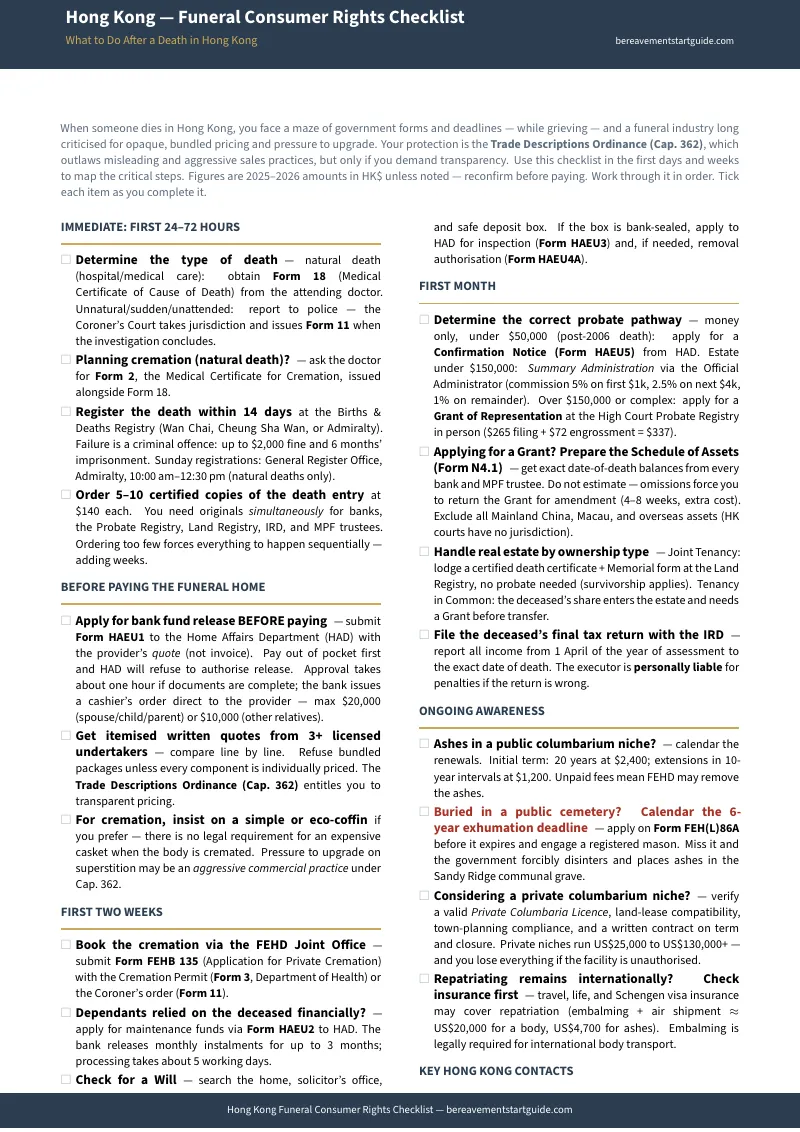
Not ready for the full guide? Download the free Hong Kong — Funeral Consumer Rights Checklist — the most urgent actions covering everything that must happen in the first 48 hours: getting the death certified, registering at the Joint Office, establishing who has legal authority, choosing a funeral director (and the Trade Descriptions Ordinance rights you can invoke immediately), starting cremation paperwork, and checking subsidised funeral eligibility. It is enough to get through tonight and tomorrow.
You should not have to make the most expensive decisions of your life while you are grieving. The guide makes sure you do not have to make them blind.