Someone You Love Just Died in Ireland. The Bank Froze Their Accounts. Revenue Wants a Form SA.2 Before the Probate Office Will Even Look at Your Application. And Nobody Mentioned That the Courts Service Charges You Double the Filing Fee Because You Are Not a Solicitor.
You are standing in a place nobody prepared you for. Maybe you were named executor in a will you barely remember reading, and now the funeral director is waiting for a decision while you try to figure out how many certified death certificates to order from the General Register Office. Maybe there was no will at all, and because you are the eldest child or the surviving spouse, everyone is looking at you for answers about a legal process governed by the Succession Act 1965 that you have never heard of. Maybe AIB just told you the accounts are frozen and you cannot access a single euro to pay the electricity bill, the mortgage, or the funeral deposit that ranges from four to seven thousand euro depending on which funeral director you called.
You are grieving and sleep-deprived, but the paperwork does not wait. The funeral director needs you to understand the difference between the Medical Certificate of Cause of Death and the death certificate from the Registrar. The Department of Social Protection needs notification within days or the estate will owe back overpayments on the State Pension. Siblings are already asking about the house. Revenue will require a full Statement of Affairs before the Probate Office will grant an appointment. And somewhere in the back of your mind, a terrifying question keeps circling: if I miss a deadline I do not know about, or distribute assets before the legal timeframes close, or accidentally trigger a Capital Acquisitions Tax liability by miscalculating the valuation date for the IT38 return — am I personally liable?
The short answer: the estate pays its debts, not you. But the long answer — the one that involves the Revenue Commissioners requiring a completed SA.2 before the Courts Service will accept your application, bank account thresholds that vary between institutions (AIB at €25,000, Bank of Ireland at €35,000, credit unions offering up to €27,000 through Death Benefit Insurance), a statutory filing fee that is doubled for personal applicants (up to €1,300 for estates over €1 million), and a Capital Acquisitions Tax levied at 33% above thresholds that reset based on a "valuation date" mechanic most people only discover when the penalty notice arrives — that answer is what separates families who settle an estate in months from families who spend years and thousands of euro untangling mistakes they did not know they were making.
The When Someone Dies in Ireland — Estate Settlement Guide is a Revenue-to-Courts Roadmap for every legal, financial, and administrative step between the funeral home and final distribution. Not a law textbook. Not a generic UK checklist that does not know Irish probate from English probate. A structured, Ireland-specific manual that separates what must be done in the first 48 hours from what legally cannot happen until the Revenue Notice of Acknowledgement arrives and the Probate Office schedules your appointment — so you stop guessing, stop panicking, and start working through this in the right order.
What's Inside the Revenue-to-Courts Roadmap
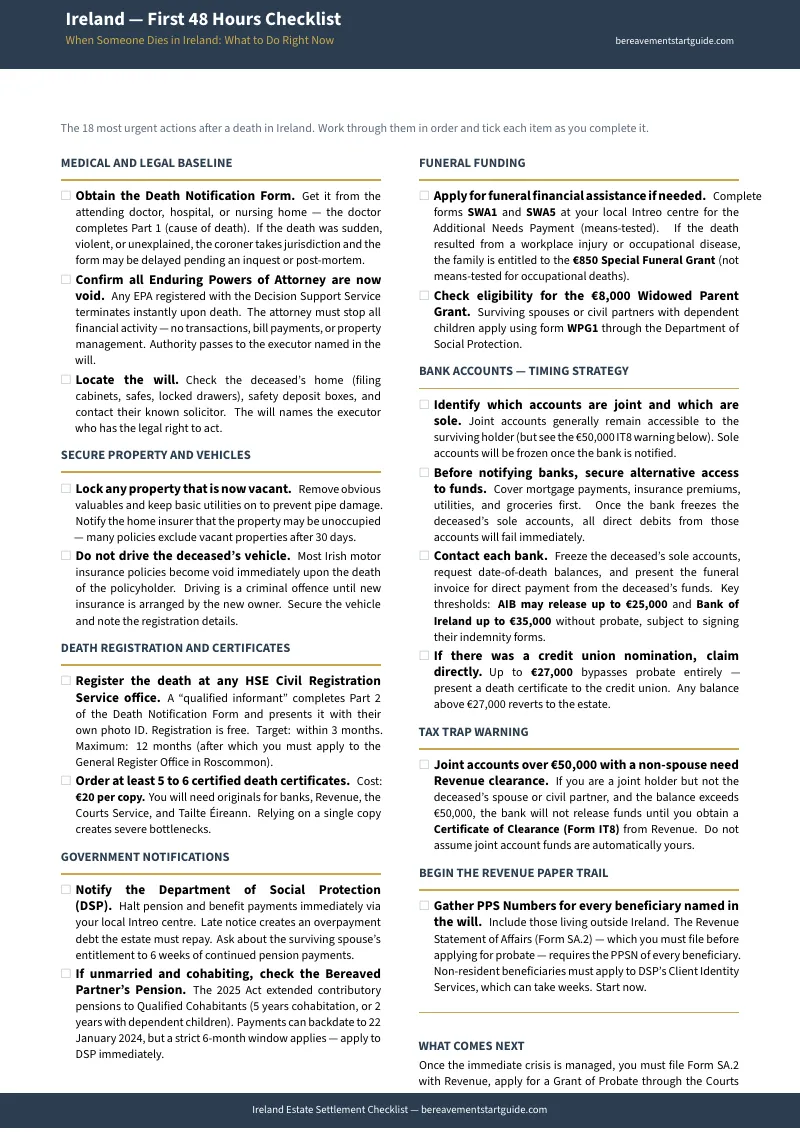
A comprehensive guide and the First 48 Hours Checklist — covering every stage from the moment of death through final asset distribution, built specifically for Irish law, the Revenue Commissioners, the Courts Service, and the state-specific rules that make settling an estate in Ireland different from anywhere else:
The First 48 Hours: Immediate Actions and Funeral Rights
The moment someone dies in Ireland, every Enduring Power of Attorney is legally void. If you managed their finances under an EPA, you no longer have authority. This chapter covers getting the death medically certified, choosing a funeral director (and knowing that funeral directors in Ireland are not statutorily regulated — there is no mandatory price transparency, no licensing requirement, and no obligation to show you their cheapest package), securing the home and property, and the critical step most families learn too late: if the family cannot afford a funeral, contact the Department of Social Protection about an Exceptional Needs Payment before signing any private contract, because signing first may weaken your application.
Administrative Foundations: Death Certificates, Notifications, and the Asset Inventory
Death certificates cost €20 each from the General Register Office or any local civil registration office — and you need at least four certified originals because banks, Revenue, and the Probate Office all require them. The guide gives you the calculation so you order the right number now instead of waiting weeks for extras later. It covers the notification sequence (Department of Social Protection for the six-week pension continuation and bereavement grant, utility companies, financial institutions, Revenue), building the complete asset and liability inventory that determines whether probate is required, and gathering the Personal Public Service Numbers (PPSNs) of every beneficiary — including those living abroad — because Revenue will not process the SA.2 without them.
The Probate Decision: When You Need It and When You Can Skip It
This is the most critical decision point in the entire process. Probate is mandatory if the deceased owned real property in their sole name or as tenants in common. For bank accounts, it depends on each institution's internal small estate threshold — and those thresholds are corporate policy, not law, meaning they can change without notice. The guide includes the current threshold for every major bank, explains the survivorship rules for joint accounts (including the "convenience account" trap where the Presumption of a Resulting Trust means the funds may not automatically pass to the survivor), covers Nomination Forms for credit union accounts (which bypass probate entirely if valid and under the statutory limit), and maps the exact scenarios where you can settle without going to court.
Navigating the SA.2 and the Revenue-to-Courts Sequence
This is the chapter that does not exist in any free resource. Before the Probate Office will accept your application, you must complete the Revenue Commissioners' online Statement of Affairs (Probate) Form SA.2 through the Revenue Online Service (ROS) or myAccount portal. This form requires detailed asset valuations, liability declarations, and the PPSN of every single beneficiary worldwide. If a beneficiary lives in Australia, Canada, or the United States and does not have an Irish PPSN, you must arrange one through the Department of Social Protection's Client Identity Services — a process that can delay the entire estate by months if you do not start it immediately. Revenue then issues a Notice of Acknowledgement, which you must present to the Probate Office before they will schedule your appointment. The guide walks you through every field of the SA.2, explains what documentation Revenue expects, and tells you exactly when to start this process so it runs in parallel with your other tasks rather than creating a bottleneck.
Applying for Probate at the Courts Service
Once you have the Revenue Notice of Acknowledgement, you apply to the Probate Office. If you are the executor named in the will, you apply for a Grant of Probate. If there is no will, the next of kin applies for a Grant of Administration Intestate. The guide covers the Personal Application Form, the Oath for Executor (or Administrator), the current filing fees — and the fact that personal applicants pay double what solicitors pay for identical applications. For an estate valued at €500,000, a solicitor pays €350 while you pay €700. For estates over €1 million, personal applicants pay up to €1,300. The guide includes exact cost comparison tables so you can make an informed decision about whether to apply personally or hire a fixed-fee solicitor for just the court filing. It also covers the current 10-to-12-week processing delay for personal applicants at the Dublin Probate Office and strategies to ensure your application is accepted on the first attempt.
Transferring Property Through Tailte Eireann
Real estate is typically the largest asset in an Irish estate, and the transfer rules are entirely different depending on how the property was owned. Joint tenancy: the surviving owner lodges a Form 47 (Application for Survivorship) with Tailte Eireann — no probate needed. Sole ownership or tenants in common: the executor must obtain probate first, then execute an Assent using Form 35 or Form 36 and lodge it with the Land Registry. The guide covers both paths, explains the Land Registry fees based on property value, and addresses the critical distinction between the Property Registration Authority (registered land) and the Registry of Deeds (unregistered land) — because the forms and procedures differ depending on which system the property is in, and no free resource explains this clearly.
Taxation: Capital Acquisitions Tax, IT38, and Executor Obligations
Tax is where many executors unknowingly expose themselves to personal liability. The Capital Acquisitions Tax (CAT) is levied at 33% above specific thresholds — currently €400,000 for Group A (parent to child), €40,000 for Group B (siblings, grandparents), and €20,000 for Group C (all others). But the filing deadline depends on the "valuation date" — a concept that confuses even accountants. If the valuation date falls between 1 January and 31 August, the IT38 return is due by 31 October of the same year. If it falls between 1 September and 31 December, the deadline shifts to 31 October of the following year. The guide explains the valuation date in plain English, includes the complete CAT threshold charts, and covers the executor's obligation to ensure all tax is paid before distributing assets — because if you distribute first and a beneficiary fails to pay their CAT, Revenue can come after you personally.
Intestacy, Distribution, and the Executor's Year
The remaining chapters cover intestacy under the Succession Act 1965 (including the surviving spouse's "legal right share" — one-third if there are children, one-half if there are none — which overrides the will itself), the Section 117 right of children to challenge the will if they were not adequately provided for, the precise order of estate distribution, the "Executor's Year" convention (the first twelve months during which beneficiaries cannot compel distribution), communication templates for managing anxious beneficiaries during that waiting period, the role of the Probate Office in contested estates, edge cases (insolvent estates, missing wills, pension death benefits, cross-border estates involving UK assets), pre-death planning (Enduring Power of Attorney, Advance Healthcare Directive, and the new Decision-Making Representative roles under the Assisted Decision-Making (Capacity) Act 2015), and the 2025 Act extending the Bereaved Partner's Pension to qualifying unmarried cohabitants.
Who This Guide Is For
- The surviving spouse or civil partner whose partner just died and whose bank accounts were frozen this morning — who needs to know which accounts stay accessible under survivorship, how to get AIB or Bank of Ireland to release funds for funeral expenses using their small estate indemnity process, and how to apply for the €6,000 Widowed or Surviving Civil Partner Grant from the Department of Social Protection
- The adult child named as executor who has never navigated the Revenue Commissioners or the Probate Office and is terrified of making a mistake that triggers personal liability — who needs the complete SA.2 walkthrough, every Probate Office form explained, the double-fee cost comparison, and a timeline that separates what is urgent from what must wait for the Revenue Notice of Acknowledgement
- The family with no will who just learned that the Succession Act 1965 dictates everything — who needs to understand who has priority to apply for Letters of Administration, how the surviving spouse's legal right share works, and whether Section 117 claims by children could disrupt the expected distribution
- The executor living abroad who emigrated to London, Sydney, or Toronto and cannot walk into the Dublin Probate Office — who needs to understand how to obtain PPSNs for overseas beneficiaries, whether to grant a Power of Attorney to a solicitor in Ireland for the court attendance, and how to manage Tailte Eireann property transfers remotely
- The financially constrained family who cannot afford a funeral or a solicitor — who needs to know about the Exceptional Needs Payment from the Department of Social Protection, credit union Death Benefit Insurance, and the small estate bank release procedures that avoid probate entirely for accounts under the threshold
- The proactive planner organising affairs after a terminal diagnosis or dementia progression — who needs to assemble an Enduring Power of Attorney before capacity is lost, understand how the new Decision-Making Representative roles work under the Assisted Decision-Making (Capacity) Act, and create a "death folder" so their family never has to scramble through this process blind
Why Free Resources Will Not Get You Through This
The information exists. It is scattered across Citizens Information, Revenue.ie, Courts.ie, Tailte Eireann, the Department of Social Protection, and a dozen institutional portals that do not reference each other. Here is what you actually encounter when you try to settle an estate using free sources alone:
- Citizens Information tells you what to do but not how to do it. Their bereavement checklists are excellent broad overviews. They tell you that you need to register the death, apply for probate, and notify Revenue. They do not walk you through the SA.2 field by field, explain how to handle beneficiaries who live abroad and lack a PPSN, or warn you about the double filing fee that personal applicants face. They assume baseline legal and financial literacy that most grieving families do not have.
- Law firm blogs highlight complexity to justify retainer fees. TheProbate.ie publishes detailed breakdowns of probate timelines and processing delays. Online Legal Services offers a €129 "Probate Guidance Pack." All of their content is designed to convince you the process is too dangerous to handle alone — and that you need a solicitor retainer starting at €1,500 plus VAT. For contested estates, that is true. For the majority of straightforward estates, the answer costs a fraction of a solicitor's hourly rate.
- Bank bereavement pages protect the bank, not you. AIB, Bank of Ireland, and Permanent TSB each publish deceased estate procedures. Every one is focused on institutional liability protection. They explain why accounts are frozen. They do not explain how the small estate indemnity process actually works, why their thresholds differ from the bank across the road, or how the Presumption of a Resulting Trust can turn a "joint" account into a probate asset.
- Revenue and Courts Service portals are designed for solicitors. The SA.2 form on ROS assumes you already know what a "valuation date" is. The Courts Service Personal Application Form assumes you understand the oath requirements. Tailte Eireann Forms 35, 43, and 47 assume you are a qualified conveyancing solicitor. None of these portals provide plain-English guidance for a grieving family member doing this for the first time.
- Funeral directors stop after the ceremony. Funeral directors in Ireland provide empathetic aftercare and help with the first 48 hours. Their advice ends where the hard questions begin: Revenue forms, probate applications, property transfers, CAT obligations, and executor liability.
Free resources give you fragments from a dozen sources that do not reference each other. The Revenue-to-Courts Roadmap puts every Irish statute, form, deadline, and procedure into one document, in the order you actually need them.
— Less Than Fifteen Minutes With an Irish Probate Solicitor
A single consultation with an Irish probate solicitor costs €200 to €400 per hour plus 23% VAT. Standard probate representation starts at €1,500 — and that only covers obtaining the grant. The actual estate administration (closing accounts, managing Revenue, organising property transfers) is billed separately at hourly rates. This guide costs less than fifteen minutes of professional legal time and gives you the complete Ireland-specific roadmap — every statute, every Revenue form, every Probate Office deadline, and the SA.2-to-Courts sequence that nobody explains in plain language.
Your download includes the complete guide, the standalone First 48 Hours Checklist, and four print-ready worksheets — Agency Notification Tracker, Asset and Liability Summary, Probate Timeline Planner, and Beneficiary Communication Log. Six PDFs total. Plus a money-back guarantee, no time limit. If the guide does not give you clarity on what to do next and confidence that you are doing it in the right order, email us for a full refund. No questions asked.
Not ready for the full guide? Download the free Ireland — First 48 Hours Checklist — the most urgent actions covering everything that must happen in the first two days after a death in Ireland: death certificates, securing property, funeral rights, Exceptional Needs Payment eligibility, bank notifications, and what not to pay. It is enough to get through tonight and tomorrow.
You did not ask for this job. But you can do it. The guide shows you how, one step at a time.