Your Spouse Just Died in Ireland. The Bank Froze Their Accounts. The DSP Website Lists Fourteen Different Payments You Might Qualify For. And Nobody Mentioned the Six-Week Welfare Bridge That Expires Whether You Know About It or Not.
You are sitting at a kitchen table covered in sympathy cards and paperwork you did not ask for. Maybe the bank called this morning to say the accounts are frozen and you cannot access a single euro until you produce a Grant of Probate — or maybe nobody called at all, and you discovered it when your card was declined at the supermarket. Maybe you know you are supposed to contact the Department of Social Protection, but the website lists the Bereaved Partner's Contributory Pension, the Bereaved Partner's Non-Contributory Pension, the Widowed or Surviving Civil Partner Grant, the Bereaved Parent Grant, the Additional Needs Payment, the One-Parent Family Payment, and the Guardian's Payment — and you cannot tell which ones apply to you, which ones overlap, and which ones you will permanently lose if you do not apply within a deadline you have not been told about.
Meanwhile, the funeral director needs a decision about the funeral, which will cost between €6,000 and €10,000. You are pretty sure there is a state grant for that, but you have found three different grants with similar names and different eligibility rules, and the free government pages explain each one separately without ever telling you which combination maximises your total payout. The six-week window during which the DSP continues paying the deceased's social welfare payment directly to you has already started counting down — and if you draw that payment after it expires, even by a single week, the DSP will classify it as fraud and pursue repayment.
If you are an unmarried cohabitant, the situation is worse. The landmark O'Meara Supreme Court ruling and the 2025 Social Welfare Act extended survivor pensions to cohabitants for the first time — but claiming requires proving an "intimate and committed relationship" for at least five continuous years, with evidence the DSP has never clearly defined. There is a six-month retroactive application window that is already shrinking. And if you also need to make a Section 194 claim against the estate because your partner died without a will, the Succession Act gives you just six months from the Grant of Representation before your rights expire permanently.
The Ireland Survivor Benefits Navigator is a 90-Day Execution System built for the specific bureaucratic reality of claiming benefits, accessing frozen funds, and protecting your financial position after a death in the Republic of Ireland. Not a summary of government websites. Not a generic bereavement pamphlet. A structured, chronological manual that separates what must happen in the first 48 hours from what legally cannot happen until probate is granted — so you stop missing deadlines you did not know existed and start working through the most complex administrative experience of your life in the right order.
What's Inside the 90-Day Execution System
An 11-chapter guide with 8 appendices, plus 9 standalone printable worksheets and the Quick Start Checklist — covering every stage from the moment of death through long-term financial protection, built specifically for Irish statutes, the Irish Probate Office, and the DSP rules that make claiming benefits here uniquely complicated:
The First 48 Hours: Emergency Triage
Register the death at any Civil Registration Service office (free, but order at least six certified copies at €20 each — you will need originals simultaneously for the bank, the DSP, Revenue, and the Probate Office). Secure the six-week welfare bridge by notifying the DSP immediately — the deceased's social welfare payment continues to you for six weeks (twelve if you were receiving Carer's Allowance), but the clock starts whether or not you know about it. Access emergency cash by contacting the deceased's bank with the funeral director's invoice — banks will release funds directly to the funeral director without probate. Check Credit Union membership for Death Benefit Insurance (up to €3,250) and the statutory nomination mechanism that releases up to €27,000 completely outside the probate system.
Funding the Funeral Without Debt
Irish funerals average €6,000 to €10,000. The guide maps every available funding source and explains which ones stack: the €6,000 Widowed or Surviving Civil Partner Grant (strict entitlement, not means-tested), the Additional Needs Payment via Forms SWA1 and SWA5 (discretionary, averaging €3,100, cannot be appealed to the Social Welfare Appeals Office), the Occupational Injuries Funeral Grant (a separate €850 if the death was work-related), Credit Union Death Benefit Insurance, and the bank indemnity thresholds that let you access the deceased's accounts without waiting for probate — AIB up to €25,000, Bank of Ireland up to €35,000, Permanent TSB up to €30,000.
The Bereaved Partner's Pension: Contributory vs Non-Contributory
The single largest ongoing entitlement — up to €299.30 per week. The guide walks you through the PRSI contribution requirements (260 paid contributions plus a specific yearly average), the means test for the non-contributory version, the BPP1 application form, and the critical six-month application window after which you permanently forfeit earlier entitlement. It covers the interaction with other payments you might already receive, the Child Support Payment add-ons (€58/week per child under 12, €78/week per child 12+), and what happens if the deceased worked in Northern Ireland or another EU country and you need to combine PRSI records.
Cohabitant Claims After O'Meara
The 2025 Social Welfare Act rewrote the rules for unmarried partners. The guide explains exactly how to prove five years of continuous cohabitation (or two years with dependent children), what evidence the DSP accepts and what it rejects, the retroactive application window and its deadline, the renamed Bereaved Parent Grant that now covers cohabitants, and the separate Section 194 Succession Act claim that you must file within six months of the Grant of Representation or lose all rights to the estate forever.
Probate, Property Tax, and the Revenue Commissioners
The Probate Office operates on zero tolerance for errors. An improperly calculated administration bond, a Jurat that fails to comply with S.I. No. 95 of 2009, or a Statement of Affairs (Form SA.2) with more than three queries will get your application rejected — and a rejected application goes to the back of the seven-week queue, not the front. The guide covers the SA.2 form step by step, the correct bond calculation (strictly double the gross Irish estate value), the year-of-death tax rules (including the €4,000 Married Person Tax Credit you must actively claim through Revenue), and the Local Property Tax deferral via Form LPT1 that prevents compounding penalties when you eventually sell the property.
Long-Term Protection and Forward Planning
The final chapters cover Enduring Powers of Attorney under the Assisted Decision-Making (Capacity) Act 2015, the Ward of Court phase-out deadline of October 2027, medical card retention rules for surviving spouses over 70, and the pre-death planning steps that prevent your own family from facing this same bureaucratic emergency.
Who This Guide Is For
- The surviving spouse whose income just disappeared — who needs to secure the six-week welfare bridge, transition to the Bereaved Partner's Pension without a gap in payments, and understand whether the contributory or non-contributory version applies based on PRSI records they have never seen
- The unmarried cohabitant who was just told they have no legal standing — who needs to know that the O'Meara ruling changed everything, how to prove five years of cohabitation to the DSP, and that the six-month window to claim against the estate under Section 194 is already counting down
- The executor or adult child named in the will — who needs to extract a Grant of Probate from the Probate Office without triggering a rejection that resets the seven-week queue, navigate the SA.2 form, and calculate the administration bond correctly the first time
- The family who cannot afford the funeral — who needs the complete funeral funding matrix showing every available grant, the exact SWA1 and SWA5 forms, the bank indemnity thresholds, and the Credit Union nomination mechanism that can put up to €27,000 in their hands within days
- The organised planner preparing for a parent's decline — who needs to set up an Enduring Power of Attorney before the Capacity Act transition deadline, optimise medical card eligibility, and structure the estate so probate is as straightforward as possible
Why Citizens Information Will Not Get You Through This
The information exists. It is scattered across Citizens Information, the Department of Social Protection, MyWelfare.ie, Revenue.ie, the Courts Service, the Irish Hospice Foundation, and a dozen bank-specific estate pages that do not reference each other. Here is what you actually encounter when you try to navigate survivor benefits using free sources alone:
- Government pages list benefits alphabetically, not chronologically. Citizens Information explains eligibility criteria for every payment in exhaustive detail. It does not tell you which payment to apply for first, which ones interact with each other, or what to do when you qualify for three overlapping grants with different forms and different deadlines. You get rules without a sequence.
- The DSP assumes you already know which form to use. MyWelfare.ie provides direct access to BPP1, SWA1, SWA5, and a dozen other forms. It does not explain which form applies to your specific situation, why using the wrong one wastes weeks, or how to handle the means test for the non-contributory pension while simultaneously claiming the Additional Needs Payment.
- Law firm blogs emphasise complexity to justify fees. Irish solicitors publish excellent technical breakdowns of the O'Meara ruling, Capacity Act timelines, and Probate Office procedures. All of it is designed to convince you the process is too dangerous to attempt without a retainer starting at €2,500. For contested estates, that is true. For the majority of straightforward claims, the answer costs a fraction of one billable hour.
- Bank bereavement pages protect the bank, not you. AIB, Bank of Ireland, and PTSB each publish deceased estate processes. Every page explains why accounts are frozen. None of them explain the specific indemnity threshold below which they will release funds without probate, how to use a funeral director's invoice to unlock frozen accounts immediately, or that Credit Union nominations bypass their entire process.
- Bereavement charities focus on emotional support, not financial execution. The Irish Hospice Foundation and MABS provide compassionate, well-written guidance on coping with loss and managing debt. They deliberately avoid the hard-nosed financial troubleshooting — form-by-form, deadline-by-deadline — that determines whether you receive thousands of euros in state benefits or accidentally forfeit them.
Free resources give you fragments from a dozen sources that do not reference each other. The 90-Day Execution System puts every Irish-specific benefit, form, deadline, and bank threshold into one document, in the order you actually need them.
— Less Than Thirty Minutes With an Irish Solicitor
A single consultation with an Irish solicitor costs €200 to €350 per hour. Standard probate representation starts at €2,500 — and that covers obtaining the grant, not the benefit claims, pension applications, or tax filings. This guide costs less than half an hour of professional legal time and gives you the complete Ireland-specific roadmap — every DSP form, every bank threshold, every probate deadline, and the cohabitant pension rules that did not exist eighteen months ago.
Your download includes the complete 11-chapter guide with 8 appendices, 9 standalone printable worksheets (bank threshold matrix, DSP form decision tree, funeral funding worksheet, probate preparation checklist, PRSI pension eligibility worksheet, DSP welfare bridge tracker, means-test capital assessor, document gathering checklist, and forms and deadlines reference), plus the Quick Start Checklist — 11 PDFs covering every urgent action from the first 48 hours through the 90-day benefit-claiming window. Plus a money-back guarantee, no time limit. If the guide does not give you clarity on what to claim and confidence that you are doing it in the right order, email us for a full refund. No questions asked.
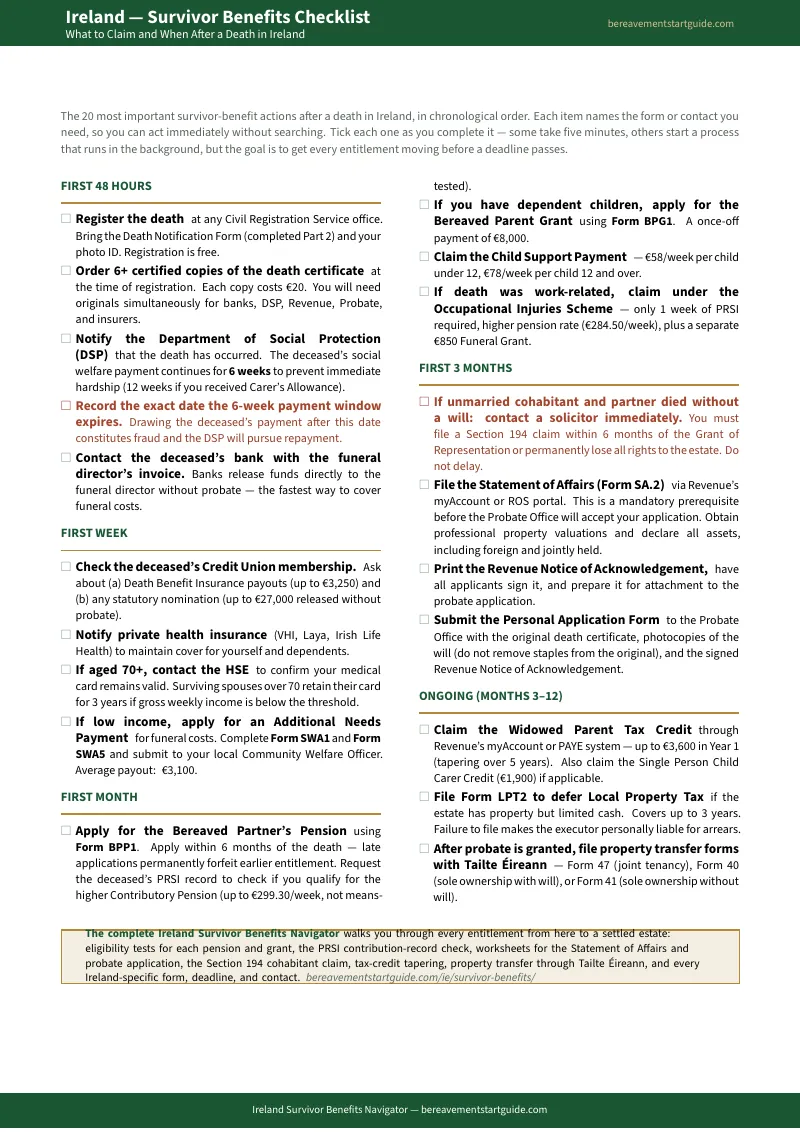
Not ready for the full guide? Download the free Ireland — Survivor Benefits Checklist — the most critical actions in chronological order, covering everything that must happen in the first 48 hours and the first month: death registration, the six-week welfare bridge, funeral funding sources, bank account access, and the pension application deadline. It is enough to get through this week without missing anything irreversible.
You did not ask for this. But the deadlines do not wait, and neither should you.