The Irish Funeral Rights Shield — Every Law, Every Form, Every Deadline Your Family Needs Before the Funeral Director Arrives
Someone has died. The hospital handed you a Death Notification Form. The funeral director is asking whether you want embalming, a premium casket, and their "complete care" package. Your brother thinks he's in charge because he's the eldest. Your mother's bank account is frozen. And every website you check seems to be giving you UK law instead of Irish law.
Nobody warned you that arranging a funeral in Ireland means navigating the Succession Act 1965, the Consumer Rights Act 2022, the Coroner's office, the Department of Social Protection, and the Civil Registration Service — all within days, while grieving.
The Irish Funeral Rights Shield is the single-document legal roadmap that replaces dozens of scattered government pages with one chronological action plan. Who has the legal authority to sign. What services you can refuse. How to access frozen bank funds before probate. How to apply for state financial aid before the funeral bill is finalised. Every form number, every deadline, every consumer right — written exclusively for the Republic of Ireland.
— Less Than 15 Minutes of a Solicitor's Time
Irish solicitors charge between EUR 200 and EUR 350 per hour for probate and succession advice. This guide gives your family the legal clarity to resolve administrative disputes, decline unnecessary services, and access financial supports — so if you do hire a solicitor, you spend their time on strategy, not on explaining who the executor is or what the Succession Act says.
What's Inside
The First 48 Hours: Legal Authority and Emergency Steps
Who has the legal right to arrange the funeral — and why the answer is not "the eldest child" or "the most upset relative." The executor named in the will holds overriding authority from the moment of death, before probate is even granted. If there's no will, the Succession Act 1965 sets a strict hierarchy: spouse, children, parents, siblings. The guide explains exactly how to assert that authority when a funeral director takes instructions from the wrong person, or when a sibling tries to override the executor's decisions.
The Consumer Rights Decoder
Ireland has no single "Funeral Rule" statute like the US or UK — but the Consumer Rights Act 2022 and CCPC guidelines give you powerful protections that most families never use. Your right to a written, itemised estimate before agreeing to anything. Your right to decline embalming — which is not legally required for domestic burial or cremation. Your right to supply your own coffin. The exact questions to ask a funeral director to separate their professional fees from third-party disbursements, so you know what you're actually paying for.
The Financial Aid Navigator
If the estate cannot cover funeral costs, the Department of Social Protection offers the Additional Needs Payment — but the application process is deliberately opaque. The guide walks you through the SWA1 and SWA5 forms step by step, explains what documentation the Community Welfare Officer actually needs, and warns you about the critical timing rule: apply before the funeral bill is settled, not after. Plus the bank threshold bypass — institutions like AIB and EBS may release up to EUR 25,000 without a formal Grant of Probate if you provide the right documentation.
The Coroner and Post-Mortem Module
When a death is sudden, unexplained, or unattended, the coroner is legally required to investigate. Post-mortems and toxicology reports can delay the funeral by weeks. But families don't have to wait for the final death certificate to start administrative tasks. The guide explains how to request an Interim Certificate of the Fact of Death — the bureaucratic bypass that lets you access bank accounts, notify insurance companies, and file welfare claims while the coroner investigation continues.
Cremation: Forms, Permissions, and the Medical Referee
Cremation in Ireland requires a specific chain of authorisation that funeral directors rarely explain in advance. The attending doctor must complete a form confirming they saw the deceased before and after death. The Medical Referee must review the form and confirm no coroner referral is needed. Pacemakers and other implanted devices must be documented and removed. The guide covers every step, every form, and what happens when the crematorium flags an issue.
Burial: Cemetery Rules, Family Graves, and Home Burial
Reopening a family grave requires written authorisation from the registered grave owner — and if ownership was never formally transferred after a previous death, you may need to resolve that first. Home burial on private land is legal in Ireland but requires planning permission from the local authority, which is frequently refused on environmental grounds (soil permeability, water table proximity). The guide explains the planning application process, Environmental Health requirements, and what "exclusive right of burial" actually means.
Repatriation: Bringing a Body Into or Out of Ireland
International repatriation requires coordination between the coroner, the embassy, the airline, and the destination country's authorities. If a non-Irish national dies in Ireland, the Coroner must issue an Out of State Order before the body can leave. Embalming is required for most international transits. The guide provides the complete document checklist: Consular Mortuary Certificate, embalming certificate, transit permit, airline cargo requirements, and the embassy contacts for the 20 most common repatriation routes.
Family Disputes: Legal Hierarchy and Resolution
When siblings disagree about burial versus cremation, or when an estranged family member tries to override the executor, the guide cuts through the emotion with the law. The executor's authority under the Succession Act 1965 supersedes all other family members. If no executor exists, the hierarchy is absolute: surviving spouse first, then children, then parents, then siblings. The guide explains what happens when disputes escalate to the High Court's inherent jurisdiction over bodily disposal — and why knowing the legal position usually prevents that from being necessary.
Who This Guide Is For
- Executors who need to know their legal authority, manage the estate, and arrange the funeral without costly legal missteps
- Surviving spouses facing funeral directors alone for the first time and needing an objective advocate against unnecessary upsells
- Families without savings or insurance who need to navigate the Additional Needs Payment process to cover funeral costs
- Immigrant and cross-border families managing the repatriation of a body into or out of Ireland
- Families in dispute over who controls the funeral, the method of disposal, or the location of burial
- Anyone arranging a funeral in Ireland who wants one clear, chronological action plan instead of 40 browser tabs
Why Not Just Use Citizens Information?
You can. Every form, statute, and eligibility rule in this guide exists somewhere across citizensinformation.ie, gov.ie, courts.ie, the CCPC website, the DSP website, and the Coroner Service pages. That's the problem — "somewhere" across dozens of disconnected government pages written in statutory language, with no chronological sequencing and no explanation of how one agency's requirements interact with another's.
Government websites are legally prohibited from giving you advice. They'll provide a blank form but won't tell you what to do first, second, or third. And they won't warn you that the SWA5 application is dramatically stronger if you submit it before the funeral bill is finalised, or that the executor's authority vests immediately — before probate. The state gives you the puzzle pieces. This guide gives you the picture on the box.
Worse, because Ireland shares a language with the UK, half the search results you find will be UK law — home burial rules, executor rights, cremation regulations — that simply do not apply in the Republic of Ireland. This guide is written exclusively for Irish law. No UK spillover. No American FTC references. Every citation is an Irish statute, an Irish agency, or an Irish court decision.
What You Get
- The Complete Guide — 13 chapters covering legal authority, death registration, consumer rights, burial, cremation, repatriation, financial aid, coroner procedures, pre-planning, disputes, and reference tables
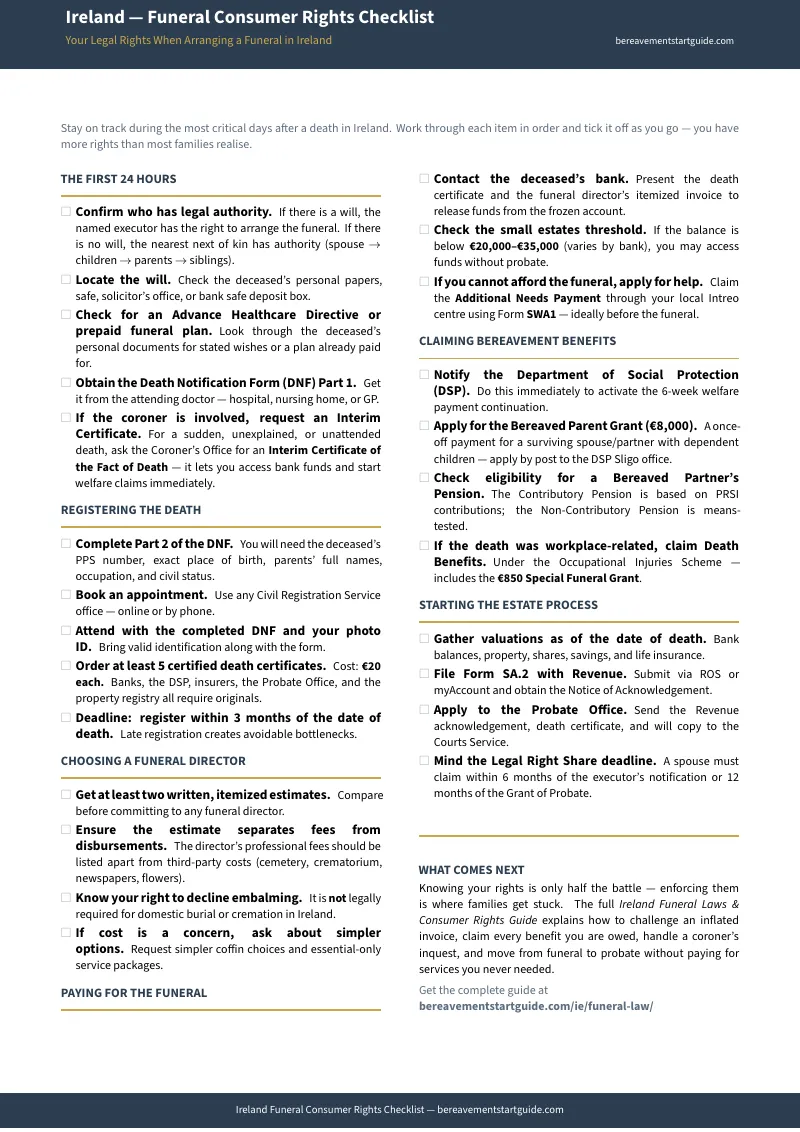
- Quick Start Checklist — the 20 most critical actions in chronological order, from the first 24 hours through the first 90 days
- Consumer Rights Decoder — one-page printable with your 5 rights under Irish consumer law, embalming rules, questions to ask the funeral director, and how to read an estimate
- Financial Aid Navigator — standalone walkthrough of the Additional Needs Payment (SWA1/SWA5), Bereaved Parent Grant, and bank threshold bypasses
- Repatriation Checklist — complete document chain for bringing a body into or out of Ireland, including Out of State Orders and airline requirements
- Critical Deadlines Reference — every deadline from death registration to probate, with consequences of missing each one
- Executor Authority Framework — one-page legal hierarchy reference to show funeral directors and family members who has decision-making authority
- Coroner Process Guide — what triggers a coroner investigation, the post-mortem timeline, and how to use the Interim Certificate to keep administrative tasks moving
- Forms and Contacts Reference — every form number, government portal, and agency contact in one printable sheet
Satisfaction Guarantee
If the guide doesn't save you time, confusion, or money — email hello@bereavementstartguide.com and we'll make it right. No questions, no hassle.
Start Protecting Your Family's Rights
Download the free Ireland Funeral Consumer Rights Checklist for the 20 most critical actions — or get the complete Guide with full legal breakdowns, consumer rights decoder, financial aid walkthroughs, repatriation checklists, and dispute resolution guidance.