The Funeral Director Just Handed You a $12,000 Estimate. You Do Not Know What Is Legally Required. You Do Not Know What You Can Refuse. And Nobody Told You That Embalming Is Not Compulsory, That You Do Not Need a Funeral Director at All, or That the Wrong Grant Application Could Cost Your Family $5,500.
You are sitting across from a funeral director who is walking you through a price list you have never seen before while you are still trying to process the fact that someone you love is dead. The "basic service fee" is $2,500. The casket is $3,800. Embalming is $900 and they are telling you it is standard practice. The hearse, the chapel hire, the flowers, the death notices — line items keep appearing and the total is climbing toward $12,000. You do not know which of these are legally required and which are optional charges you can decline. You do not know that New Zealand law does not require embalming for domestic funerals. You do not know that you could transport the body yourself in a private vehicle. You do not know that you could handle the entire funeral without a funeral director at all. And you certainly do not know that you are about to apply for the wrong government grant — the one worth $2,697.43 instead of the one worth $8,236.40 — because nobody explained the difference.
Meanwhile, the paperwork is piling up. Someone needs to file cremation Forms A and B with the Medical Referee — but what is a Medical Referee and who pays the fee? The funeral director mentions the BDM 28 form for death registration and says they will handle it, but they are also telling you the cremation cannot happen until the Medical Referee signs off and there is a two-day statutory stand-down period you did not know about. Your uncle wants a burial on the family farm in Waikato, but nobody can tell you whether that is legal or what the 32-kilometre rule means. Your cousin insists on a specific tikanga Maori process, but the executor named in the will wants cremation, and now the family is splitting into factions over a legal question that went all the way to the Supreme Court in Takamore v. Clarke.
The New Zealand Funeral Laws & Consumer Rights Guide is a Funeral Consumer Defense System built for exactly this moment. Not a funeral planning booklet. Not a pamphlet from the funeral home. A 17-chapter legal and financial manual that tells you what New Zealand law actually requires, what you can legally refuse, how to cut thousands from the funeral bill without cutting corners, and how to fight back when a funeral director overcharges — using the Fair Trading Act, the Consumer Guarantees Act, and the Disputes Tribunal's new $60,000 jurisdiction. It covers every form, every fee, every grant, every cultural right, and every consumer protection available to families in Aotearoa New Zealand.
What's Inside the Funeral Consumer Defense System
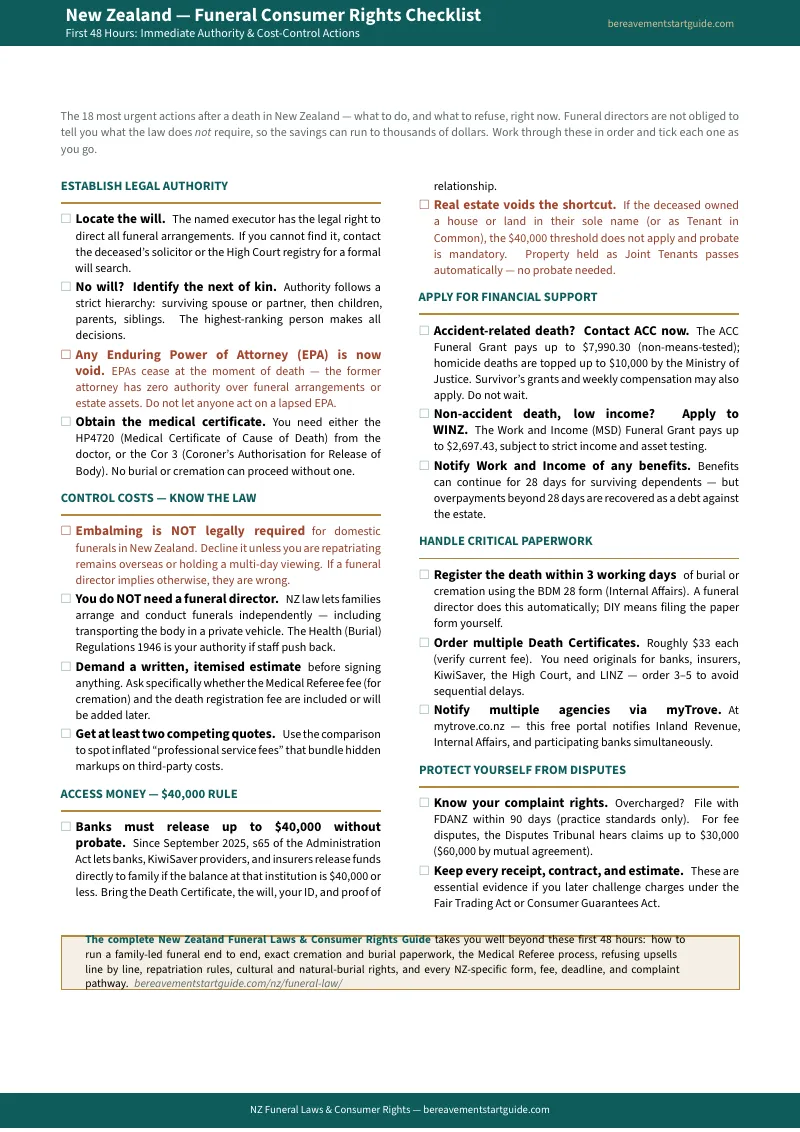
A 17-chapter guide and the First 48 Hours: Immediate Authority & Cost-Control Checklist — covering every legal requirement, consumer right, and financial shortcut from the moment of death through dispute resolution and advance planning, built specifically for New Zealand statutes and the agencies that administer them:
Chapter 1: The First Hours — Medical Certification (HP4720, Cor 3)
Nothing happens without a medical certificate. If the doctor was present, you get the HP4720 — Medical Certificate of Cause of Death. If the death was sudden, accidental, or suspicious, the Coroner takes jurisdiction and issues the Cor 3 — Coroner's Authorisation for Release of Body. This chapter explains the difference, how long each takes, what you can and cannot do while waiting, and why informing the Coroner's office of cultural or religious requirements for rapid burial is a legal right, not a request.
Chapter 2: Who Has the Legal Right to Make Decisions?
The executor named in the will holds primary authority over funeral arrangements — affirmed by the Supreme Court in Takamore v. Clarke (2012). If there is no will, a strict statutory hierarchy applies: surviving spouse or partner, then children, parents, siblings. This chapter covers the EPA trap that catches families constantly: every Enduring Power of Attorney issued under the PPPR Act 1988 is legally void the moment the person dies. The former attorney has zero authority. If the family has been operating under an EPA for years due to dementia, this transition is jarring and the chapter explains exactly what to do.
Chapter 3: Body Preparation — Embalming Is Not Legally Required
This is the chapter that saves families hundreds of dollars immediately. Embalming is not required by New Zealand law for domestic funerals. Funeral directors routinely present it as standard practice or imply it is necessary for viewing — it is not. The chapter explains when embalming is genuinely necessary (international repatriation, extended viewing periods), when it is purely optional, your right to decline it, and the alternative of refrigeration or dry ice that funeral directors rarely mention because it does not generate revenue.
Chapter 4: Burial — Permits, Cemeteries, and the Private Land 32km Rule
If the family wants a burial, you need a Burial or Cremation permit from the Registrar (issued alongside the death registration), and you need a cemetery plot or qualifying private land. Private land burial is legal in New Zealand, but the Burial and Cremation Act 1964 requires the burial site to be at least 32 kilometres from a city boundary and 30 metres from any dwelling, waterway, or bore — unless you obtain a specific exemption from the local authority. The chapter maps the full permit process, cemetery costs (ranging from $800 to $5,000+ depending on the council), exhumation rules, and the local authority notification requirements.
Chapter 5: Cremation — Forms A/B/BA/AB/F and the 2026 Changes
Cremation in New Zealand involves more paperwork than burial because a second medical opinion is required. The person authorising the cremation must complete Cremation Form A. The Medical Referee — an independent doctor appointed by the local authority — must complete Cremation Form B after verifying there is no reason the death should be investigated further. The chapter explains the full form chain, the Medical Referee fee (typically $75-$150, often not disclosed upfront by funeral directors), the mandatory two-working-day stand-down period, and the 2026 Form BA change that streamlines certification for deaths in residential care facilities.
Chapter 6: Transporting a Body — Your Rights and the DIY Option
You do not need a funeral director to transport a body in New Zealand. The Health (Burial) Regulations 1946 allow families to transport a deceased person in a private vehicle. Hospital staff may push back — they are wrong. This chapter covers the legal authority, the practical requirements (a suitable container, hygiene precautions), the rules for transporting remains between districts, and the specific documentation required for transporting remains by air within New Zealand or internationally.
Chapter 7: Registering the Death — BDM 28 Form
Death registration in New Zealand uses the BDM 28 form, filed with Births, Deaths and Marriages (Department of Internal Affairs). A funeral director does this automatically if you use one; if you are managing the funeral yourself, you must file the paper form. The deadline: within three working days of the burial or cremation. The chapter covers who can register the death, the information required, the fee for death certificates (approximately $33 each — order 3 to 5 copies upfront), and the common mistakes that delay registration.
Chapter 8: Paying for the Funeral — WINZ Grant vs ACC Grant
This is the chapter most families need and the one where the most money is left on the table. If the death was caused by an accident — car crash, workplace incident, fall, medical misadventure — the family qualifies for the ACC funeral grant of up to $8,236.40. This grant is non-means-tested. If the death was from natural causes or illness, the alternative is the WINZ funeral grant from Work and Income, capped at $2,697.43 and strictly means-tested. That difference of over $5,500 depends entirely on understanding the cause of death and flagging ACC eligibility with the funeral director in the first 24 hours. The chapter covers both grant applications, the ACC survivors' grants and weekly compensation, the WINZ asset test, and the Ministry of Justice top-up to $10,000 for homicide victims.
Chapter 9: Accessing the Deceased's Money — The $40,000 Threshold
Since September 2025, Section 65 of the Administration Act allows banks, KiwiSaver providers, and insurers to release up to $40,000 per institution directly to the family without any High Court application. The threshold was raised from $15,000 — a change that allows many families to access funds immediately for funeral costs and living expenses. But the threshold applies per institution, not per estate, and real property in the deceased's sole name voids the shortcut entirely. This chapter maps the exact scenarios where you can bypass the court and where you cannot, the indemnity form process for each major bank, and the joint tenancy rules that may mean the $40,000 question is irrelevant.
Chapter 10: Settling Taxes with Inland Revenue
IRD needs notification through myTrove. The executor must file the deceased's final individual tax return (IR3) covering April 1 to the date of death. If the estate earns income after death, a separate estate trust return (IR6) is required. The chapter covers both returns, the process for obtaining a separate IRD number for the estate, the student loan write-off most families do not know about, and the timing of notifications so you do not accidentally trigger account freezes before the family has access to alternative finances.
Chapter 11: Consumer Rights — Challenging Funeral Director Pricing
New Zealand has no equivalent of the US FTC Funeral Rule — but the Fair Trading Act 1986 and the Consumer Guarantees Act 1993 provide powerful protections. Funeral directors must not make misleading representations about what is legally required. If they imply embalming is mandatory or that you must use their casket, that is a potential breach. The chapter explains the specific legal provisions, how to request and compare itemised quotes, common pricing tactics (bundled "professional service fees" that obscure third-party costs), and when to escalate to the Commerce Commission.
Chapter 12: Filing Complaints and Resolving Disputes
If you have been overcharged, you have multiple avenues. The FDANZ (Funeral Directors Association of New Zealand) handles complaints about practice standards — but not fees, and membership is voluntary. The Disputes Tribunal handles claims up to $30,000 (or $60,000 by mutual agreement as of January 2026) — a powerful avenue for challenging funeral costs that many families do not know about. The chapter covers the FDANZ complaint process, the Disputes Tribunal filing procedure and fees, the distinction between practice complaints and fee disputes, and when the District Court or Commerce Commission is the appropriate escalation.
Chapter 13: Tikanga Maori, Cultural Rights, and the Takamore v. Clarke Precedent
The Supreme Court's 2012 decision in Takamore v. Clarke confirmed that the executor holds primary legal authority over burial arrangements — but that tikanga Maori customs must be given due weight and recognition. This chapter explains the ruling, the practical tension between executor authority and whanau expectations, the legal rights of Maori families to conduct tangihanga, the coronial service's obligation to respect tikanga during investigations, and the Maori Land Court's jurisdiction over burial on Maori land.
Chapter 14: Planning Ahead — Prepaid Funeral Trusts and Residential Care
For families planning ahead: prepaid funeral trusts lock in today's prices and are exempt from asset testing for the Residential Care Subsidy up to $10,000. But the trust structure matters — the money must be held by an approved trustee, not simply paid as a deposit to a funeral director. The chapter covers how prepaid trusts work, the legal protections, what happens if the funeral home closes, the $10,000 residential care exemption, and the differences between prepaid trusts and funeral insurance policies.
Chapter 15: Edge Cases — When Standard Procedures Fail
Not every death follows the standard path. This chapter covers deaths where no doctor was present and the Coroner refuses jurisdiction (creating a certification gap), bodies held indefinitely by the Coroner during complex investigations, disputes between family members over burial versus cremation, missing persons and presumption of death, deaths of foreign nationals in New Zealand, military and veteran funeral entitlements, organ and body donation, and the legal framework for families who want to challenge a Coroner's findings at inquest.
Chapter 16: Forms, Portals, and Fees — Quick Reference Directory
Every official form, digital portal, fee, and agency contact consolidated into one structured reference: HP4720, HP4721, Cor 3, BDM 28, Cremation Forms A/B/BA/AB/F, the Medical Referee fee, BDM death certificate fees, ACC and WINZ grant amounts, Disputes Tribunal filing fees, myTrove portal, and the specific contact details for every agency referenced in the guide.
Chapter 17: Deadlines at a Glance
A single-page reference of every time-sensitive deadline: death registration (3 working days after burial/cremation), cremation stand-down period (2 working days), FDANZ complaint window, Disputes Tribunal filing deadline, ACC claim deadline, WINZ grant application window, and the critical benefit overpayment window.
Plus 8 Standalone Printable Tools
Every key decision framework, comparison table, and worksheet extracted as a standalone PDF you can print and use independently — no need to flip through the full guide in a crisis moment:
- Consumer Defense Guide — your Fair Trading Act and Consumer Guarantees Act protections, the 4 pricing traps, and 8 questions to ask before signing. Bring it to the funeral director meeting.
- Price Comparison Worksheet — fill-in table to compare three funeral director quotes side by side
- Funeral Grant Comparison — ACC ($7,990.30) vs WINZ ($2,697.43) side-by-side with eligibility flowchart
- Cremation Forms Tracker — every form (A, B, BA, AB, F) in order with checkbox tracking
- DIY Funeral Authority — the legal citations to show hospital staff if they refuse to release the body
- Decision-Maker Worksheet — 4-step process to identify who has legal authority
- Disputes Tribunal Guide — 5-step escalation pathway for challenging funeral costs up to $60,000
- Forms, Fees and Deadlines Reference — every form, portal, fee, and deadline on two printable pages
Who This Guide Is For
- The executor or next-of-kin who just received a funeral estimate of $10,000 to $15,000 and does not know which line items are legally required and which can be refused — who needs to understand that embalming is optional, that you can transport the body yourself, and that demanding itemised quotes under the Fair Trading Act could cut thousands from the bill
- The financially constrained family who needs the funeral to cost as little as legally possible — who needs to know about the ACC grant ($8,236.40 non-means-tested if accident-related) versus the WINZ grant ($2,697.43 means-tested), the $40,000 bank release threshold, and the option to conduct the entire funeral without hiring a funeral director
- The family who wants a home funeral, natural burial, or DIY arrangement — who needs the exact legal authority for transporting the body in a private vehicle, the 32km private land burial rule, the permit requirements, and the death registration process when no funeral director is involved
- The whanau in conflict over burial versus cremation — where the executor wants one thing and the extended family wants another, where tikanga Maori expectations conflict with the will, and where the Takamore v. Clarke precedent determines who has the final legal say
- The person planning ahead after a terminal diagnosis or rest home admission — who needs to understand prepaid funeral trusts, the $10,000 residential care subsidy exemption, and how to document their wishes in a way that is legally enforceable rather than just aspirational
Why Free Resources Will Not Get You Through This
The information about funeral rights in New Zealand exists. It is scattered across a dozen government agencies, industry associations, and advocacy sites that do not talk to each other. Here is what you actually encounter when you try to navigate funeral costs and consumer rights using free sources alone:
- The Funeral Directors Association (FDANZ) represents funeral directors, not you. Their website provides planning checklists and general guidance written from the industry's perspective. It does not tell you which services are optional, does not explain your right to refuse embalming, does not mention that you can bypass a funeral director entirely, and does not provide any tools for challenging pricing. Their complaint process is voluntary — not all funeral directors are members — and it covers practice standards, not fees.
- Te Hokinga a Wairua covers the basics but avoids the hard questions. The government's end-of-life hub tells you that a funeral director can help with arrangements. It does not tell you what to do when the funeral director is the problem — when pricing is opaque, when services are misrepresented, or when the family is in conflict about what should happen. It assumes a cooperative family and a straightforward process.
- Consumer NZ sits behind a paywall and describes problems without solutions. Consumer NZ has published investigations into funeral industry pricing. Accessing the full content requires a paid membership. Even then, the articles describe the problem — high costs, lack of transparency, bundled fees — without giving families the specific legal mechanisms, form numbers, and step-by-step processes for actually challenging those charges.
- Public Trust uses funeral planning as a lead funnel for estate administration. Their funeral planning resources are thorough and well-written — and every page funnels toward their estate administration service, which starts at $6,355 plus $307 per hour. If you just need to know your funeral rights, you do not need a $6,000 professional relationship.
- Community Law centres provide accurate legal information in academic language. Community Law Manual entries on burial, cremation, and body disposal are legally precise. They are also written for lawyers, not for a grieving spouse sitting across from a funeral director at 9am on a Tuesday morning. There are no pricing defense tactics, no form-by-form walkthroughs, no "here is what to say when they tell you embalming is required."
- DIY Funeral NZ fills a gap but feels combative and outdated. The site is the primary NZ resource for families who want to handle funerals without a funeral director. The information is valuable but the website is dated, some content has not been updated, and the tone reads as adversarial toward the funeral industry rather than empowering for the consumer. It covers the DIY option well but does not address families who want to use a funeral director while still protecting their rights.
Free resources give you fragments from a dozen sources that never reference each other. The Funeral Consumer Defense System puts every New Zealand funeral law, consumer right, form, fee, grant, and dispute mechanism into one document, organised around the decisions you actually need to make.
— Less Than One Hour of a New Zealand Solicitor's Time
A single consultation with a solicitor about funeral rights costs $250 to $450 per hour. Consumer NZ membership costs $17 per month just to read their funeral pricing investigation — and it will not tell you what to do about it. A funeral director's "professional service fee" alone runs $2,000 to $3,000 before a single other line item is added. This guide costs less than one hour of professional advice and gives you the complete New Zealand-specific defense system — every consumer right, every form, every grant, every dispute mechanism, the embalming refusal authority, the DIY funeral legal basis, the ACC versus WINZ grant strategy, the $40,000 threshold shortcut, and the Disputes Tribunal process for challenging charges up to $60,000. Plus a money-back guarantee, no time limit. If the guide does not give you clarity on your rights and confidence that you are not overpaying, email us for a full refund. No questions asked.
Not ready for the full guide? Download the free New Zealand — Funeral Consumer Rights Checklist — the 18 most urgent actions covering everything that must happen in the first 48 hours: establishing legal authority, identifying which costs you can refuse, determining ACC versus WINZ grant eligibility, accessing funds through the $40,000 threshold, and protecting yourself from disputes. It is enough to get through tonight and tomorrow.
You are grieving. You should not also be overpaying. The guide makes sure you are not.