You Have 48 Hours to Arrange a Funeral in a Country Where Embalming Is Not Required, Home Burial Is Illegal, the Cemetery Runs on 15-Year Leases, and the Industry Has No Equivalent of the FTC Funeral Rule — So Every Consumer Protection You Do Have, Nobody Tells You About Until the Bill Arrives.
Someone you love has died in Singapore. Within hours you are being asked to choose between a S$1,300 direct cremation and a S$10,000 traditional wake. The funeral director is recommending embalming at S$500 to S$850, but cannot tell you that embalming is not legally required. The LED wreaths are being quoted at S$80 each, but nobody mentions the hard limit of 10 or the 10 PM power-down rule that triggers fines. The "one-stop package" sounds comprehensive until you discover it subcontracts tentage, catering, and floral arrangements to separate vendors — each adding their own margin to your bill.
You searched the NEA website. It covered permits. The CCCS published a checklist. It covered three generic questions to ask a funeral director. MyLegacy handled the death certificate download. Then they all stopped. For the actual negotiation — the itemised billing, the embalming refusal, the GST verification, the dispute escalation — you are on your own. No single government agency covers the full sequence from death certification through funeral logistics, consumer protection, and financial claims. No single website synthesises the NEA's burial rules, the Town Council's void deck permits, and the CPFTA's dispute mechanisms into one actionable timeline.
The Singapore Funeral Laws & Consumer Rights Guide is a complete Funeral Consumer Defence System built for the reality of Singapore's funeral industry — where more than 300 funeral service providers operate with no dedicated funeral regulation, the median funeral costs S$5,000 to S$9,000, and a quarter of consumers expect to pay under S$1,000 before discovering that barely 1% of funerals actually cost that little. It maps every permit, every consumer right, every cost benchmark, and every dispute pathway into one chronological sequence: from the CCOD on Day 1 through the final insurance claim.
What's Inside the Funeral Consumer Defence System
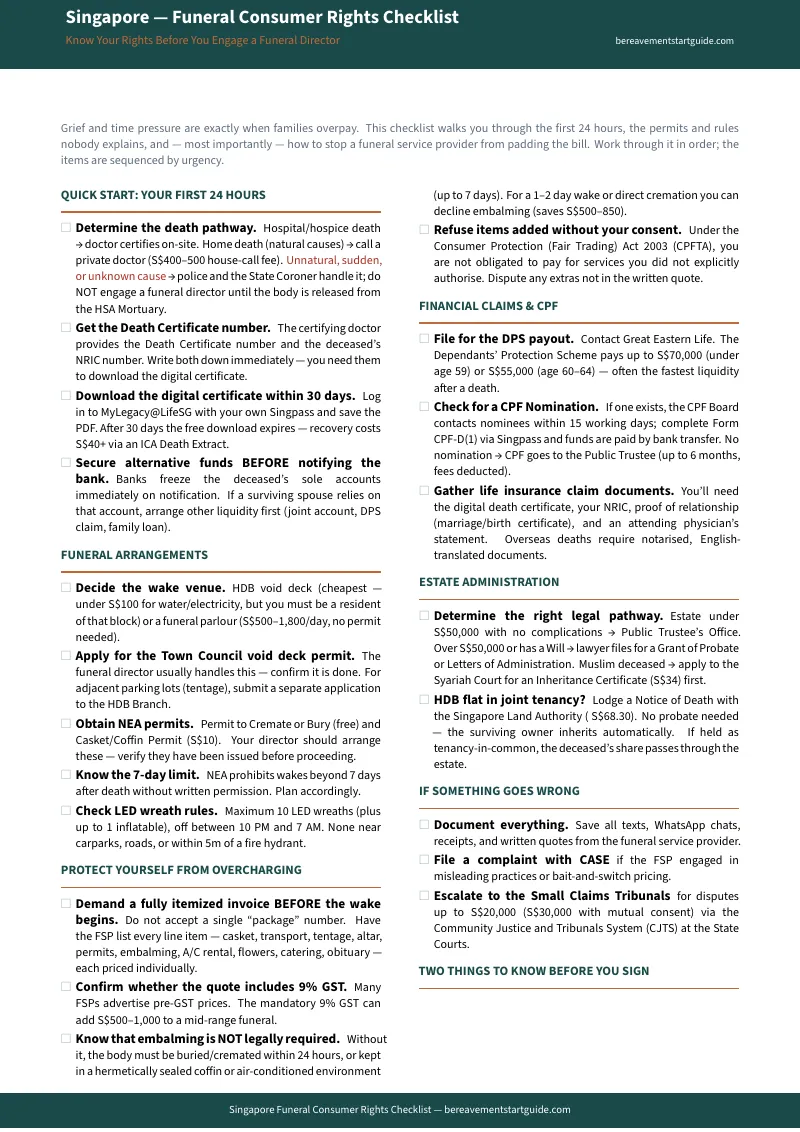
A 17-chapter guide with decision trees, cost tables, and negotiation scripts, plus a printable 20-item consumer rights checklist — covering every funeral regulation, consumer protection mechanism, and financial trap specific to Singapore law:
Chapter 1: The First 24 Hours — Death Certification and Registration
The three certification pathways: hospital death (doctor certifies on-site), home death from natural causes (private doctor house call at S$400–S$500), or unnatural/sudden death (police and State Coroner via HSA Mortuary). The critical MyLegacy@LifeSG portal and the strict 30-day window for downloading the digital death certificate — after which you pay S$40 for a death extract from ICA. Why this PDF is the master key for every step that follows.
Chapter 2: Funeral Logistics — Venue, Permits, and Municipal Rules
HDB void deck rules: residency requirements, Town Council permits, and the separate HDB application for adjacent parking. Funeral parlour costs (S$500–S$1,800 per day). The NEA's hard 7-day wake limit. LED wreath and inflatable restrictions — exactly 10 maximum, powered down between 10 PM and 7 AM, no placement within 5 metres of a fire hydrant. Road money regulations. The environmental restrictions that most funeral directors present as optional when they are mandatory.
Chapter 3: Burial and Cremation — The Only Cemetery in Singapore
Why home burial is illegal in Singapore. The Choa Chu Kang Cemetery Complex as the only active burial ground. The 15-year burial lease and the mandatory exhumation notice at expiry. Government cremation fees at Mandai (S$100 for citizens/PR). Ash storage: government columbarium niches (S$500 standard vs. S$30,000+ private), sea burial at designated waters (S$320 for Garden of Peace ash scattering), and the new Choa Chu Kang Green Burial Area. Muslim burial in the Crypt Burial System. Foreigner burial eligibility requirements.
Chapter 4: Embalming — What the Law Actually Requires
The single chapter that can save you S$500 to S$850 in the first conversation with a funeral director. Embalming is not legally required in Singapore. Without embalming, the body must be buried or cremated within 24 hours, or kept in a hermetically sealed coffin (up to 7 days) or air-conditioned environment. The specific scenarios where embalming is genuinely useful versus where the FSP is using cultural pressure to sell an unnecessary service. Islamic prohibition on embalming. The modern embalming and dry ice alternatives.
Chapters 5–6: Consumer Protection and FSP Negotiation
Singapore has no standalone funeral regulation equivalent to the US FTC Funeral Rule. Instead, your protection comes from the Consumer Protection (Fair Trading) Act 2003 and the Competition Act 2004. What these laws actually mean for funeral purchases: your right to itemised billing, your right to refuse services added without consent, and the specific unfair practices the CPFTA prohibits. The A.S.K. checklist from the CCCS — what it covers and what it does not. The Association of Funeral Directors Code of Conduct: what members must follow and why non-members are not bound by it. Negotiation scripts for demanding line-item pricing, confirming GST inclusion, identifying subcontractor markups in "one-stop" packages, and declining culturally pressured upsells without causing family conflict.
Chapter 7: Financial Containment — Costs, Benchmarks, and Budget Defence
The complete cost breakdown by funeral type: direct cremation (S$1,300–S$2,500), Muslim funeral (S$1,500–S$2,000), Christian (S$3,800–S$8,500), Buddhist (S$6,000–S$8,000), Taoist (S$8,000–S$10,000+). The hidden costs that inflate bills beyond the family budget: newspaper obituaries (S$200–S$1,000+), designer urns (up to S$2,000), private columbarium niches (up to S$30,000). Government fee benchmarks that prove most funeral expenses represent private margins. Emergency funding options when the bank account is frozen.
Chapters 8–9: The Public Trustee, Probate, and Intestacy
The decision tree for choosing between the Public Trustee's Office (estates under S$50,000), Grant of Probate (will exists), and Letters of Administration (no will). The Intestate Succession Act distribution table — the exact fractions that determine who gets what when there is no will. Syariah Court Inheritance Certificate requirements for Muslim estates. The Wills Registry search at the Singapore Academy of Law (S$10).
Chapter 10: HDB Inheritance and the Property Trap
Joint tenancy versus tenancy-in-common: which passes automatically and which requires probate. The HDB eligibility gauntlet — citizenship, family nucleus, age requirements. The ABSD trap: how inheriting property can trigger a 20%–30% stamp duty bill on your next purchase. The CPF refund requirement when an inherited property is sold.
Chapters 11–12: Islamic Funeral Law and Multi-Faith Requirements
The mandatory 24-hour burial requirement for Muslim funerals. MUIS guidelines and the Syariah Court's role. How Islamic inheritance law (Faraid) interacts with Singapore's civil legal system. Key requirements for Buddhist, Taoist, Hindu, Christian, and Sikh funerals — the cultural timeline pressures that affect every administrative deadline.
Chapters 13–14: Digital Assets, Subscriptions, and Repatriation
The overlooked estate: recurring charges, social media accounts, email access, cloud storage. The complete repatriation roadmap: Coffin Import Permits from the NEA Port Health Office, sealing certificates, embalming certificates, English translation requirements, and the strict limits of what the Ministry of Foreign Affairs will and will not do for you.
Chapters 15–17: Cost Tables, Decision Trees, and Dispute Escalation
The master cost reference table — every government fee, filing cost, and industry benchmark in one place. The complete decision tree for every fork in the funeral planning process. The full dispute resolution pathway: documenting FSP communications, filing with CASE, escalating to the Small Claims Tribunals (up to S$20,000 via the CJTS), and when to involve the police. What the CPIB bribery case and the wrong-body cremation case teach consumers about industry accountability.
Who This Guide Is For
- The family member who just got a "package" quote with a single number and no breakdown — and who needs to know, legally, that they can demand line-item pricing, refuse items they did not authorise, and walk away from an FSP without penalty before any services are rendered.
- The surviving spouse about to approve S$850 for embalming because the funeral director said it was "required" — and who needs a one-page legal reference confirming it is not, so they can decline without guilt or family conflict.
- The adult child coordinating a funeral from overseas — navigating Coffin Import Permits, sealing certificates, MFA limitations, and the NEA Port Health Office requirements that nobody explains until your loved one's remains are stuck in customs.
- The executor who needs to understand what the estate can actually afford — before the funeral director presents a S$10,000 package when the estate has S$3,000 in accessible funds and the bank account is frozen.
- Muslim families navigating the intersection of Shariah requirements and civil regulations — the 24-hour burial pressure, the Crypt Burial System, the Syariah Court Inheritance Certificate, and the MUIS guidelines that affect everything from embalming to ash disposition.
Why Free Resources Do Not Replace a Consumer Defence Guide
Every agency referenced in this guide has a public website. The NEA covers permits. The CCCS published a consumer checklist. MyLegacy handles the death certificate. Here is why the websites alone are not enough:
- No government website covers the full funeral sequence. The NEA handles permits and stops. The CCCS handles consumer advice and stops. The Town Council handles void deck booking and stops. ICA handles death registration and stops. Nobody connects permits to consumer rights to cost benchmarks to dispute pathways. A family that follows one agency's instructions to completion before starting the next misses deadlines and pays unnecessary fees.
- Funeral director websites explain what they sell, not what you can decline. FSP content is commercially biased — designed to position premium services as cultural necessities. No funeral director's website will tell you that embalming is legally optional, that you can refuse items added without consent, or that the government columbarium niche costs S$500 while the private one across the road costs S$30,000. The question is not "what services exist?" but "which ones does the law actually require?"
- Forum advice is legally dangerous. Reddit and HardwareZone threads advise families to "just negotiate hard" without explaining the specific legal protections that make negotiation enforceable. Bad advice on embalming requirements, burial rules, and FSP obligations circulates as fact. The guide gives you the statute citations, not the anecdotes.
- Singapore has funeral hazards that no generic guide covers. The 15-year burial lease. The LED wreath enforcement since 2022. The lack of a dedicated funeral regulation. The CPIB bribery case at Mandai Crematorium. The wrong-body cremation civil suit. The S$10 casket permit that some FSPs bundle into a S$200 "permit processing fee." These are not edge cases — they are the realities that cost Singapore families money every week.
Free resources give you one agency at a time, with no consumer protection context, no cost benchmarks, and no way to verify what the FSP is telling you. The Funeral Consumer Defence System maps every legal right, every government fee, and every dispute pathway into one sequence — so you know what the law requires, what it does not, and exactly how to push back when someone tries to tell you otherwise.
— Less Than the FSP's Markup on One Unnecessary Service
Singapore families overpay for funerals every week — not because the funeral was expensive, but because nobody told them what was optional. A family approves embalming because the funeral director called it "standard" — S$850 for a service the law does not require. Another family pays for 15 LED wreaths and receives a fine because nobody mentioned the limit of 10. An executor accepts a "one-stop package" and discovers three subcontractor invoices with layered markups totalling more than the original quote. A Muslim family books a funeral parlour for three days when Islamic tradition and the law both permit burial within 24 hours. This guide costs less than any of those mistakes.
Your download includes the complete 17-chapter guide, the Singapore Funeral Consumer Rights Checklist (20 priority actions), plus 4 standalone printable tools: the Embalming Law Reference (one page proving embalming is not required), FSP Negotiation Scripts (word-for-word language for your meeting), Cost Reference Tables (government fees versus industry pricing), and a Document Checklist (every paper you need to gather) — 6 PDFs total.
Money-back guarantee, no time limit. If the guide does not give you a clear understanding of every consumer right, every funeral regulation, and every cost benchmark you need to make informed decisions during a Singapore funeral — email us for a full refund. No questions asked.
Not ready for the full guide? Download the free Singapore Funeral Consumer Rights Checklist — a summary of the most urgent actions, consumer protections, and cost traps that most families do not discover until the final invoice arrives.
You did not choose this situation. But you can choose how much you pay, what you accept, and what you refuse. The guide gives you the legal rights, the cost benchmarks, and the negotiation tools — so you make funeral decisions based on what the law requires, not what the funeral director recommends.