Kansas Doesn't Have a Next-of-Kin Law. Your Family Can't Speak for You Without This.
You've told your spouse what you want. You've told your kids. And you've assumed that in an emergency, the hospital will ask them and they'll know what to do.
Kansas doesn't work that way.
House Bill 2720 — the one that would have created an automatic default surrogate hierarchy — died in committee on April 10, 2026. Without a signed Durable Power of Attorney for Health Care, there is no one legally authorized to make treatment decisions for you. Not your husband. Not your wife. Not your oldest child. The hospital's only path is court-ordered guardianship: attorneys, hearings, and weeks of delay while you lie in a bed with no one permitted to say "yes" or "stop."
And that's just the healthcare proxy gap. The documents themselves are full of traps.
Your Living Will Declaration under K.S.A. 65-28,103? It only activates when two physicians certify a "terminal condition." Dementia isn't terminal. Alzheimer's isn't terminal. A persistent vegetative state isn't terminal. If you develop advanced cognitive decline and can't communicate, your Living Will sits in a drawer and the hospital maintains every tube and machine your family begs them to remove — because they have zero legal authority to honor a document that isn't activated.
The witness rules? Kansas imposes separate exclusion lists for each document, and they're different enough to trip anyone who treats them the same. Sign your DPOA-HC with your spouse and daughter as witnesses and the entire document is void — they're related to you by blood and marriage, they're likely estate beneficiaries, and your designated agent probably can't witness either. You won't discover the mistake until the ER calls.
The Kansas Advance Directive Compliance System
This isn't a form download with instructions. It's the complete legal framework that connects your healthcare proxy, your living will, your dementia instructions, your TPOPP/DNR orders, and your asset protection strategy into a single, verified system — one that holds up when a 2 AM ambulance arrives and your family has thirty seconds to prove someone has authority.
Every Kansas-specific trap has been mapped and accounted for: the witness exclusions that differ between documents, the dementia gap that makes standard living wills useless for cognitive decline, the oral revocation rules that require written witness confirmation before they take effect, and the KanCare estate recovery definition that reaches through every non-probate transfer mechanism to claim your home.
What's Inside
- The DPOA-HC Execution System — The Durable Power of Attorney for Health Care under K.S.A. 58-625 through 58-632, with a step-by-step guide to the critical choice between immediate effectiveness and springing activation, the witness validation checklist that prevents the most common invalidation errors, and the custom dementia instruction language that activates when your Living Will cannot
- The Living Will Declaration with Dementia Bridge — The statutory form under K.S.A. 65-28,103 explained in plain English, including the pregnancy invalidation clause, the "two witnesses OR one notary" execution alternative, and — critically — the supplemental DPOA-HC language that bridges the dementia gap the standard Living Will leaves wide open
- The Witness Validation System — Side-by-side comparison tables mapping exactly who cannot witness each document under Kansas law. The DPOA-HC exclusions (no agent, no relatives, no heirs, no care providers) versus the Living Will exclusions (no signing proxies, no blood/marriage relatives, no heirs, no care financiers) — plus the notarization shortcut that eliminates the witness requirement entirely
- TPOPP and DNR Execution Guide — Kansas's Transportable Physician Orders for Patient Preferences (the bright pink form that travels across every care setting) versus the Out-of-Hospital DNR (CPR decisions only). When to request each, how to initiate the physician conversation, what happens when EMS arrives, and why these medical orders do not replace your advance directives
- Organ Donation and Body Disposition Authority — Under the DPOA-HC's General Statement of Authority, your healthcare agent automatically receives power over organ donation, autopsy, and body disposition. The exact restriction language for opting out or limiting donations, coordinated with your Kansas driver's license designation
- The Revocation Protocol — The oral revocation procedure most families get wrong: verbal statement alone is not enough — a witness over 18 must sign written confirmation, and the attending physician must receive and record it before the old directive is actually superseded. Complete revocation checklists and provider notification templates for both documents
- KanCare Estate Recovery Protection — How your advance planning decisions directly affect whether your home survives Medicaid recovery. The expanded estate definition under K.S.A. 39-709 that reaches TOD deeds, joint tenancy, life estates, and trusts. The Caregiver Child and Sibling Equity exemptions that legally shield the home. Why your healthcare agent selection matters for recovery deferral eligibility
- Document Storage and Provider Notification — Where to file originals, who receives copies, and the practical storage system that ensures your documents are accessible during an emergency. Wallet notification cards, physician copies, hospital registry options, and healthcare agent access protocols
Printable Standalone Worksheets
- Witness Validation Checklist — Print and bring to your signing appointment. Side-by-side comparison of the DPOA-HC and Living Will witness exclusion rules, with a fill-in form to verify each witness before they sign
- Revocation Checklist — The four revocation methods, the verbal revocation steps that require witness confirmation and physician notification, and a provider notification tracker to ensure every copy holder is informed
- Document Distribution Tracker — Fillable tracker for every copy of your advance directives: required recipients, personal storage locations, and emergency access information for your healthcare agent
- Document Comparison Chart — One-page reference showing how your four healthcare planning documents work together, which applies in each medical scenario, and the execution requirements for each
- Forms Directory and Key Contacts — Every official Kansas form with its issuing agency and governing statute, plus key state and county contacts for advance planning, vital records, and estate administration
- Fee Schedule Quick Reference — Filing fees, recording costs, and key financial thresholds including the KanCare home equity exemption and prepaid funeral trust cap for 2026
Who This Kit Is For
- Anyone over 50 in Kansas who hasn't signed advance directives — because without them, Kansas law provides zero mechanism for your family to make medical decisions on your behalf. No surrogate law, no automatic hierarchy, no exceptions
- Caregivers of parents with early-stage cognitive decline — the window to establish a valid healthcare proxy closes the moment a physician determines your parent lacks capacity. After that, the only path is court guardianship. This kit gets the documents executed while there's still time
- Married couples who signed forms years ago without checking witness rules — if your spouse witnessed your DPOA-HC (the most common scenario), the document is void under K.S.A. 58-632. You need to re-execute with qualified witnesses or a notary
- Blended families navigating stepchild-versus-spouse dynamics — Kansas intestate law splits the estate 50/50 between surviving spouse and children. Without coordinated advance directives, medical decision authority and asset distribution become a battlefield between biological children and stepparents
- Homeowners worried about KanCare Medicaid recovery — if you assumed a TOD deed or living trust would protect your home, Kansas's expanded estate definition reaches through both. The advance planning decisions in this kit connect directly to the asset protection strategies that actually work
Why Free Forms Create a False Sense of Security
The Kansas Judicial Council publishes the statutory forms. Hospitals hand them out at admission. You can download them right now for free. So why would anyone need this kit?
Because the forms are the easy part. The execution rules are the hard part.
A free DPOA-HC form doesn't tell you that your spouse can't witness it. A free Living Will form doesn't mention that it won't activate for dementia. A hospital admission packet doesn't warn you about the KanCare estate recovery trap that reaches through your Transfer on Death deed to claim your home. And none of them — not one — provides the custom dementia instruction language that bridges the gap between a standard Living Will and the Durable Power of Attorney for Health Care.
The people who discover these gaps discover them at the worst possible moment: when the hospital calls, when the diagnosis arrives, when HMS/Gainwell sends the recovery notice. At that point, the cost of correction isn't a consultation fee — it's a guardianship petition, a contested medical decision, or a home your family assumed was protected.
Your Advance Directives Are Protected
If this kit doesn't give you absolute clarity on every Kansas advance directive requirement, every witness rule, every execution step, and every asset protection connection — email hello@bereavementstartguide.com and we'll make it right.
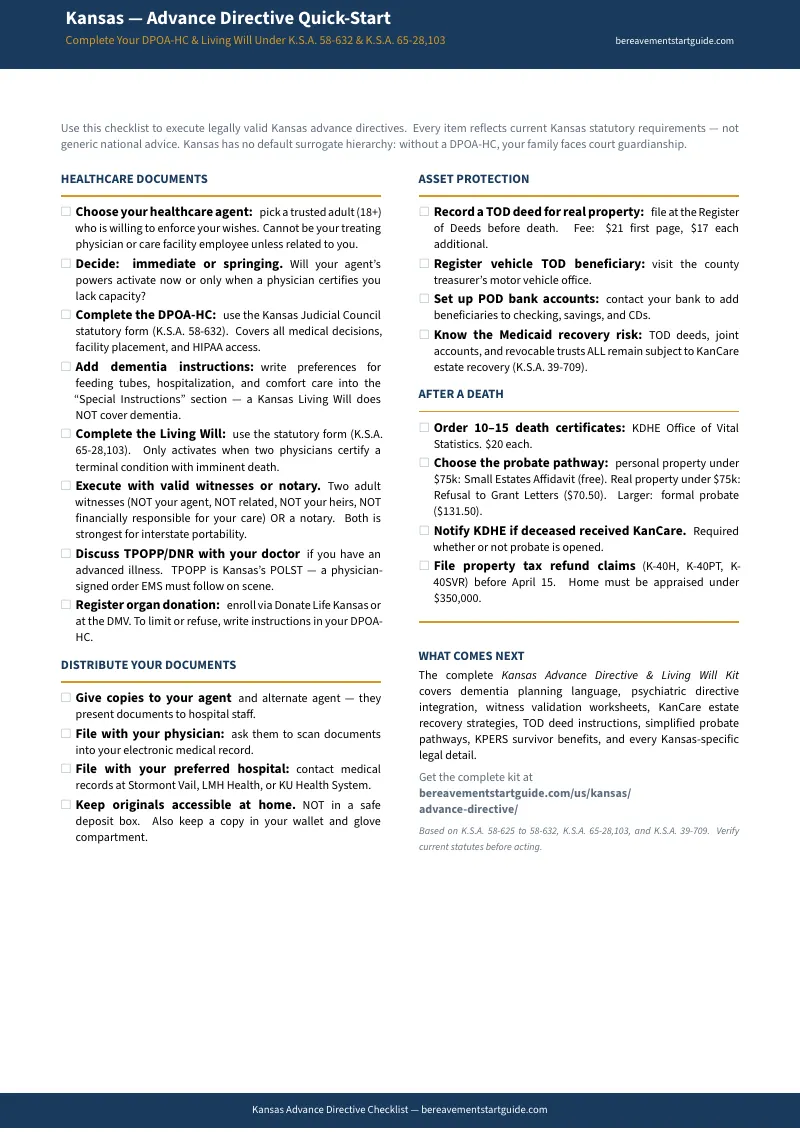
The free Quick-Start Checklist covers the five documents you need and the witness rules for each. The full kit gives you the execution system, the dementia bridge language, and the asset protection strategy — everything a Kansas family needs to ensure their advance directives are legally binding and actually honored when they matter most.
Get the Full Kansas Advance Directive Kit →
Frequently Asked Questions
What if the rules change after I buy?
We update the guide when the rules change. Email us any time, even years later, and we'll send you the current edition free.