Your Father Had a Stroke. The Hospital Said Nobody in the Family Has Authority to Make Medical Decisions. The Next Step Is a Public Court Proceeding That Costs Thousands and Takes Weeks.
You assumed you could speak for him — you are his daughter, his only child. The ER nurse said no. In Louisiana, without a signed "durable mandate for healthcare," no family member has automatic authority to make medical decisions for an incapacitated adult. The hospital told you to file for interdiction — a public court proceeding under Civil Code Articles 389 through 399, where a judge appoints a "curator" to manage your father's care. The process costs $2,500 to $5,000 in attorney fees, takes weeks, and puts your family's private medical situation into the public court record. All because a single document was never signed.
Meanwhile, your father lies in a hospital bed while you navigate a legal system that most states don't have — because Louisiana is the only U.S. state built on a civil law framework derived from French and Spanish traditions. What other states call a "power of attorney for healthcare," Louisiana calls a "durable mandate." What other states call a "holographic will," Louisiana calls an "olographic testament." The national form-builder sites use common-law terms your Louisiana providers don't recognize, and the free state forms come as bare PDFs with zero guidance on the execution rules that can invalidate everything if you get one detail wrong.
The Louisiana Advance Directive & Living Will Kit is a Civil Law Execution System — a step-by-step guide through every healthcare planning document Louisiana law provides, written entirely in the civil-law terminology your hospitals, notaries, and courts expect, with the signing protocols, witness exclusions, and filing procedures that prevent the execution errors generic templates introduce.
What's Inside the Civil Law Execution System
A comprehensive guide, a filing-readiness checklist, and standalone reference sheets — covering every healthcare planning document in Louisiana from the durable healthcare mandate through the LaPOST physician order, built on the Louisiana Civil Code, La. R.S. 40:1151, and the parish-level procedures that make this process different from any other state:
The Durable Mandate for Healthcare: Your Agent's Legal Authority
Under Civil Code Article 2989, a "mandate" is what Louisiana calls the document that appoints someone to act on your behalf. A "durable" mandate survives your incapacity — meaning your designated "mandatary" can make medical decisions for you even after you lose the capacity to make them yourself. But durability is not automatic. The mandate must contain specific language stating that the authority survives or is triggered by incapacity. Without that clause, the mandate terminates the moment you become incapacitated — the exact moment you need it most. The guide provides the precise durability language, explains when notarization is required versus recommended, and walks you through the two-witness signing protocol that hospitals accept without challenge.
The Living Will: When Two Physicians Must Certify Your Condition
Louisiana's Declaration Concerning Life-Sustaining Procedures under La. R.S. 40:1151 is narrow by design. It only activates when two physicians certify that you have an "incurable injury, disease, or illness" or are in a "continual profound comatose state" with no reasonable expectation of recovery. If you are temporarily incapacitated from a stroke or surgery, your living will does not grant anyone authority to do anything. For those situations, you need the durable healthcare mandate. Most families don't know the living will has this limitation until the crisis arrives and the hospital explains that the document they thought covered everything actually covers almost nothing. The guide explains both triggers, both documents, and exactly how they coordinate.
The Witness Exclusion Trap: One Wrong Witness Nullifies Everything
Louisiana imposes some of the strictest witness exclusion rules in the country. For a living will: no blood relatives, no relatives by marriage, no one who stands to inherit any portion of your estate, no attending physician, and no employee of the healthcare facility where you are being treated. If your daughter witnesses the document, the entire declaration can be declared null. If the notary's employee witnesses the healthcare mandate and also happens to be your cousin, that creates a challenge. The guide includes a witness screening checklist — a yes/no decision tool that disqualifies ineligible witnesses before the signing, not after a hospital refuses to honor the document.
LaPOST: The Gold-Form Physician Order That Paramedics Actually Follow
A living will tells your family what you want. A LaPOST (Louisiana Physician Orders for Scope of Treatment) tells paramedics and ER doctors what to do — right now, without calling anyone, without checking a registry, without interpretation. The LaPOST is a physician-signed medical order on a distinctive gold-colored form that covers CPR, mechanical ventilation, IV fluids, antibiotics, and artificial nutrition. It is appropriate for patients with serious illness, advanced frailty, or a life expectancy of less than a year. The guide explains when to request a LaPOST from your physician, how it relates to your living will and DNR, and the current status of the state's electronic registry.
The DNR: What It Covers and What It Does Not
A Do Not Resuscitate Order under La. R.S. 40:1155.3 instructs emergency personnel not to perform CPR during cardiac or respiratory arrest. It must be signed by a licensed physician and the patient or their authorized representative. A DNR does not cover mechanical ventilation, IV fluids, pain management, or transfer to a hospital. It is narrower than most families realize. The guide explains the scope, the signing requirements, and how the DNR interacts with your living will, LaPOST, and healthcare mandate to create a coordinated system of medical decision-making authority.
The HIPAA Release: Unlocking Medical Records During a Crisis
Federal privacy law prevents hospitals from sharing your medical information with anyone — including your spouse, your children, and your designated mandatary — unless you have signed a HIPAA authorization. Without it, your mandatary has legal authority to make decisions but cannot access the medical records needed to make informed ones. The guide includes an integrated HIPAA release that works alongside your healthcare mandate so your agent has both the authority and the information they need from the first phone call.
Forced Heirship and Succession Coordination
Louisiana is the only U.S. state with forced heirship. Under Civil Code Article 1493, children aged 23 or younger — and children of any age with a permanent physical or mental disability — are "forced heirs" who cannot be fully disinherited. The surviving spouse receives a usufruct over the deceased's share of community property under Article 890, while children hold "naked ownership." These property dynamics create tensions in blended families that spill over into healthcare decisions. When a stepparent and stepchildren disagree about a parent's care, the healthcare mandate is what prevents the dispute from ending up in court. The guide explains how your healthcare planning documents must coordinate with your succession plan.
Medicaid Estate Recovery: What the State Can and Cannot Seize
The Louisiana Department of Health can file claims against a deceased Medicaid recipient's estate to recover long-term care costs. But Louisiana applies a "probate-only" definition — meaning the state can only recover from assets that pass through formal succession. Assets with named beneficiaries, properly structured trusts, and joint tenancy with survivorship rights generally fall outside the recovery reach. The guide explains which assets are vulnerable, which are protected, when recovery is deferred (surviving spouse, child under 21, disabled child), and how hardship waivers work for families whose income falls at or below 300% of the federal poverty level.
Secretary of State Registration
Louisiana allows you to register your advance directive with the Secretary of State's office in Baton Rouge for a $20 filing fee. Registration creates a centralized record that healthcare providers can access during an emergency. The guide includes the filing instructions, the required forms, and practical advice on physical storage — where to keep originals, who should receive copies, and how to ensure your documents are accessible when a crisis happens at 2 AM on a Saturday.
Who This Guide Is For
- The adult child whose parent was just diagnosed with early-stage dementia — who needs to understand that the window to sign a valid healthcare mandate closes the moment a court determines the parent lacks capacity, and that waiting means an interdiction proceeding that costs thousands, takes weeks, and puts the family's private situation into the public record
- The pre-surgery patient who received a hospital pre-admission packet and realized nothing is in order — who needs both a living will and a healthcare mandate completed before the procedure, because the living will alone does not authorize anyone to make decisions during temporary surgical incapacity
- The family navigating Medicaid long-term care planning — who needs healthcare documents that coordinate with asset protection strategies before nursing home admission, because the healthcare mandate can authorize the mandatary to execute protective transfers if the principal becomes incapacitated
- The blended family where stepchildren and a surviving spouse cannot agree on anything — who needs the healthcare mandate to establish clear lines of medical decision-making authority before the usufruct-versus-naked-ownership property tension spills over into an end-of-life crisis
- The self-planning senior who wants to prevent interdiction — who has watched a friend's family go through the public, expensive curator appointment process and refuses to let that happen to their own family
- The person who downloaded free state forms and cannot figure out the execution requirements — who has a stack of blank statutory PDFs with no guidance on which witnesses qualify, whether notarization is required, or how the documents work together as a coordinated system
Why Free Resources Will Not Get You Through This
Louisiana advance directive forms exist. The Governor's Office of Elderly Affairs publishes statutory templates, legal aid organizations offer free interactive form builders, and national platforms like Rocket Lawyer and eForms generate state-specific documents. Here is what you actually encounter when you try to plan using free sources:
- The state provides the forms — in separate, unconnected PDFs with no execution instructions. The Governor's Office of Elderly Affairs hosts the statutory templates. They do not explain the witness exclusion rules, the difference between a living will and a healthcare mandate, when notarization is required versus optional, or how the documents work together. You get blank forms and a legal citation.
- National form-builder sites use the wrong terminology. Rocket Lawyer, LegalZoom, and eForms generate "Powers of Attorney for Healthcare." Louisiana calls it a "durable mandate." They reference "holographic wills" — Louisiana calls them "olographic testaments." They sometimes mention "tenancy by the entirety" — a concept that does not exist in Louisiana law. These terminology mismatches create confusion with local providers who expect Civil Code terms.
- Several national sites still reference the LaPOST electronic registry that was disabled in June 2024. The statewide registry was shut down after a vendor contract termination. Sites that still advise users to register their LaPOST forms electronically are providing guidance that has been incorrect for over two years.
- Louisiana Legal Navigator provides free interactive forms — but each document is a separate tool with no integration. You can build a living will. Separately, you can build a healthcare mandate. Neither tool explains how the two documents coordinate, when each one activates, or what happens in the gap between them.
- Elder-law attorneys provide expert guidance — at $750 to $2,000 for a basic planning package. For contested family situations and complex trust structures, that investment is warranted. For the healthy adult who wants to document basic healthcare preferences and prevent interdiction, the attorney's fee exceeds the value of the simple mandate and living will they need.
Free resources give you disconnected forms with common-law terminology, outdated registry instructions, and no execution guidance. The Civil Law Execution System puts every Louisiana healthcare planning document into one coordinated package, in the civil-law terminology your providers expect, with the signing protocols that prevent the errors generic templates introduce.
— Less Than One Hour of an Interdiction Attorney's Time
An interdiction proceeding in Louisiana costs $2,500 to $5,000 in attorney fees, takes weeks, and creates a public court record. A basic healthcare planning package from an elder-law attorney runs $750 to $2,000. This kit costs less than one hour of legal consultation and gives you the complete Louisiana-specific healthcare planning system — the durable healthcare mandate with proper durability language, the living will with witness screening protocols, the integrated HIPAA release, the LaPOST physician roadmap, the Medicaid estate recovery navigator, and the Secretary of State filing packet.
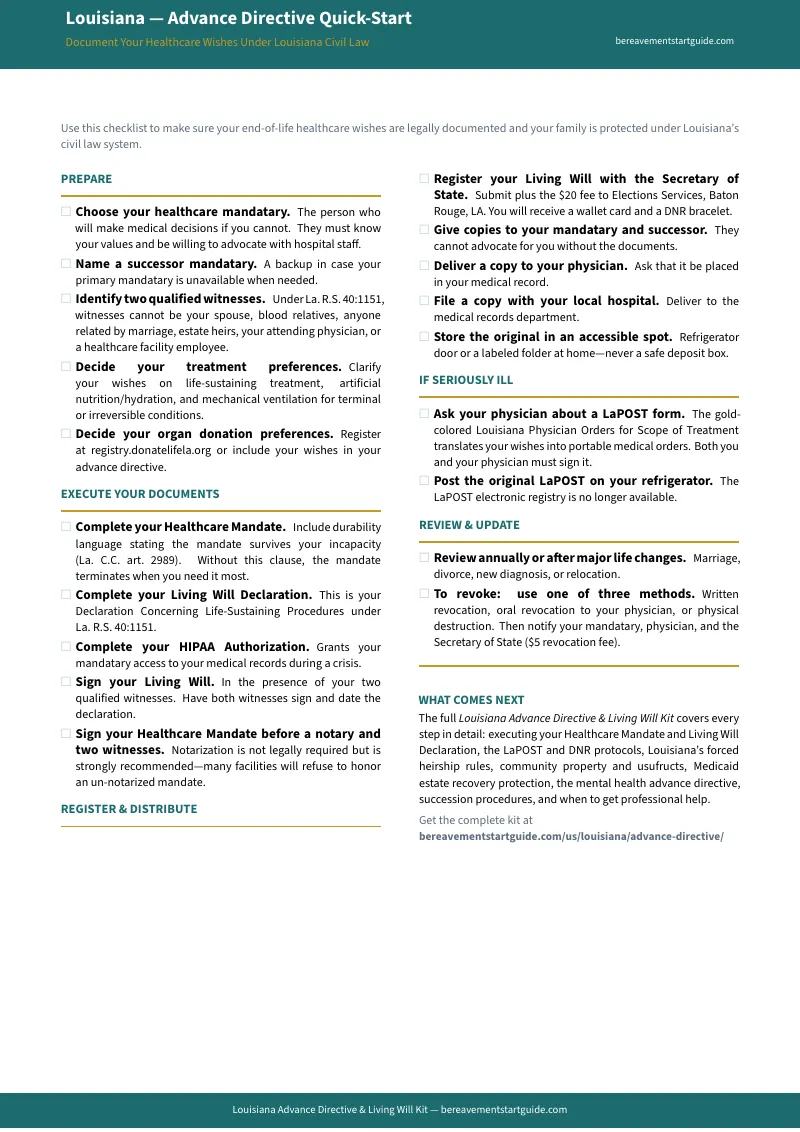
Your download includes the comprehensive step-by-step guide covering every healthcare planning document under Louisiana law, the standalone Louisiana — Advance Directive Quick-Start Checklist, and printable reference sheets: the Witness Screening Checklist, the Healthcare Mandate vs. Living Will Decision Guide, the Document Signing Protocol, Emergency Wallet Cards, the LaPOST Physician Request Sheet, the Medicaid Estate Recovery Quick Reference, and the Secretary of State Registration Instructions. Instant download, no account required.
Money-back guarantee, no time limit. If the kit does not give you clarity on which documents you need, how to execute them correctly under Louisiana's civil law rules, and where to file them — email us for a full refund. No questions asked.
Not ready for the full kit? Download the free Louisiana — Advance Directive Quick-Start — an overview of Louisiana's healthcare planning documents, the key execution requirements, the witness exclusion rules, and the steps you need to understand before signing anything. Enough to see what the civil law framework requires and whether you need the full kit.
Advance directive planning is not something you were trained for. But Louisiana law provides the documents to let capable adults protect themselves and their families without a lawyer. The kit gives you the execution instructions the state forms don't — one civil-law document at a time.
Frequently Asked Questions
What if the rules change after I buy?
We update the guide when the rules change. Email us any time, even years later, and we'll send you the current edition free.