Planning a Funeral in a Tradition You Don't Fully Understand?
The pastor is calling to schedule the service. Your family expects a homegoing celebration that honors decades of faithful worship. But you're not sure what "Spirit-led" means for a funeral program, whether the choir needs a formal invitation or just shows up, why your cousin's playlist was rejected by the music director, or how to tell the pastor — diplomatically — that your secular colleagues should not be subjected to a high-pressure altar call.
Church handbooks exist, but they're written by ministers for ministers. Funeral home websites treat every Protestant service as the same generic template. Online forums give you contradictory advice buried under theological arguments. None of them tell you how to actually coordinate a charismatic funeral when you're the one holding the clipboard.
The Coordinator's Diplomatic Shield
The Evangelical & Pentecostal Funeral Guide is not a devotional or a grief book. It's an administrative toolkit built specifically for the person managing the funeral — whether you're a lifelong church member, an adult child who left the faith, an interfaith spouse, or a funeral professional serving a charismatic family for the first time.
While the pastor serves the church's spiritual mission and the funeral director handles physical logistics, neither one represents your interests as the coordinator. This guide does. It gives you the cultural literacy, the communication scripts, and the planning worksheets to manage every conversation — from the first pastoral phone call to the last dish at the repass — without guessing, without offending, and without losing control of the budget.
What's Inside
- Complete Homegoing Service Blueprints — step-by-step order of service templates for Classical Pentecostal, Holiness, Charismatic, Assemblies of God, Church of God, and independent Apostolic traditions, so you're never guessing which structure fits your family's church
- Clergy Negotiation Scripts — word-for-word language for setting boundaries on altar calls, evangelistic sermons, and speaker time limits, using respectful, church-approved terminology that preserves the relationship
- Music Selection Toolkit — a curated list of emotionally resonant gospel and hymn alternatives that satisfy strict sanctuary rules, plus guidance on where secular tributes can be incorporated without causing a conflict with the music director
- Cremation Conversation Templates — non-judgmental diplomatic scripts for discussing cremation with traditional family elders who hold literalist bodily-resurrection views, backed by current denominational position statements
- Diaspora Logistics Chapters — dedicated guidance for West African and Afro-Caribbean families coordinating cross-border services, including body repatriation, burial transit permits, aso ebi coordination, and adapting extended mourning customs like the Nigerian second burial and Jamaican Nine-Night to Western constraints
- Budget and Honorarium Worksheets — printable templates for tracking every cost: funeral director fees, clergy love offerings, musician honorariums, repass catering, floral arrangements, and community condolence contributions
- Guest Etiquette Sheets — shareable one-page guides explaining what to wear, when to stand, and how to navigate spontaneous worship for interfaith and secular attendees who have never been inside a Pentecostal sanctuary
- Funeral Director Question Cards — pre-written questions to ask both the pastor and the funeral home, so you walk into every meeting prepared instead of reactive
Who This Guide Is For
- Adult children planning a devout parent's homegoing who may have distanced themselves from the faith — the guide gives you the theological vocabulary to communicate with the pastor without affirming or debating beliefs
- Non-believing or interfaith spouses coordinating with a congregation they don't belong to — the scripts protect your personal boundaries while showing genuine respect for the deceased's tradition
- Diaspora families balancing traditional West African or Caribbean mourning customs with Western municipal rules, apartment leases, work schedules, and international logistics
- Funeral professionals and independent celebrants who need rapid cultural competency for charismatic services — the guide provides the denominational nuances that generic Protestant training doesn't cover
Why Free Resources Fall Short
Assemblies of God policy manuals and church handbooks assume you're a pastor who shares every theological commitment. They don't address the coordinator who needs to politely decline an altar call, navigate a music conflict, or explain a cremation decision to disapproving relatives.
Funeral home websites treat Pentecostal, Baptist, and Anglican services as interchangeable. They won't tell you about sanctuary music bans, the social expectations around aso ebi, or the difference between a Service of Songs and a homegoing celebration.
Reddit threads and forum posts give you emotional support and scattered anecdotes — but no printable timeline, no communication scripts, and no budget worksheet. When you're making decisions under time pressure with the entire congregation watching, you need a single, organized resource you can trust.
Satisfaction Guarantee
If the guide doesn't help you plan with more confidence and less stress, email us and we'll refund your purchase — no questions, no forms, no waiting period.
Get Started Now
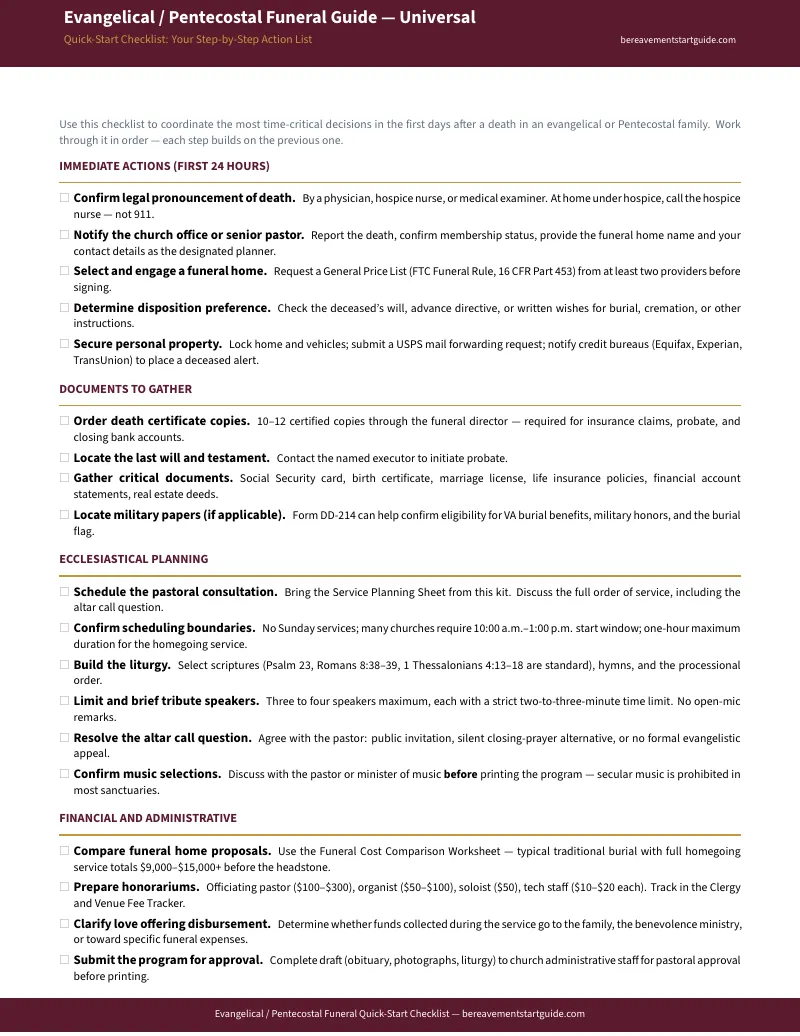
Download the free checklist for a one-page overview of the planning timeline, or get the complete guide for the full set of scripts, worksheets, denominational comparisons, and diaspora logistics chapters — everything the coordinator needs from the first phone call to the last prayer.
Frequently Asked Questions
What if the rules change after I buy?
We update the guide when the rules change. Email us any time, even years later, and we'll send you the current edition free.