
The Bank Rejected the POA. The Notary Said It Was Missing Something. The Registry of Deeds Sent It Back for Wrong Margins. And MaineCare Is Asking About Transfers Your Mother Made Three Years Ago.
Your father had the stroke on a Wednesday. By Friday you were standing at the bank with a power of attorney you printed from a legal forms website, and the branch manager told you they could not accept it. The document did not contain the mandatory statutory notices required by 18-C M.R.S. § 5-905. Without those notices, the financial POA has no legal effect in Maine — and the bank knew it before you walked in.
You called a local elder law attorney. The consultation fee was $250. A basic durable POA package started at $500 — more if you needed real estate authority, gifting powers, or MaineCare planning. The attorney could see you in two weeks. Your father's mortgage payment was due in six days.
The Maine Statutory Compliance System is a complete power of attorney kit built entirely around the Maine Uniform Probate Code (Title 18-C) and the Uniform Health Care Decisions Act — mapping every mandatory notice, every execution requirement, every Registry of Deeds formatting rule, and every MaineCare asset protection strategy into one downloadable package. It gives you the documents, the instructions, and the institutional acceptance tools to handle this yourself, correctly, the first time.
What's Inside the Statutory Compliance System
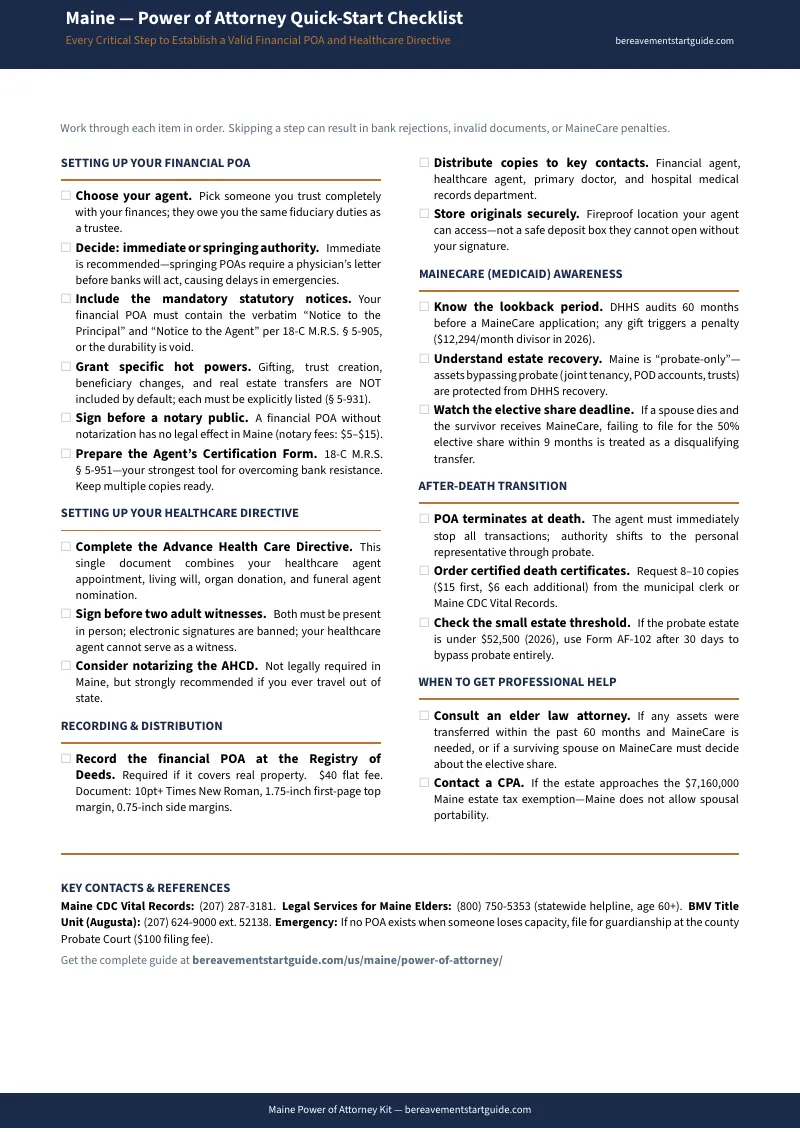
A 17-chapter guide with appendices, a printable 20-item action checklist, and 10 standalone worksheets and reference cards — covering every execution requirement, institutional acceptance tactic, and asset protection strategy available under Maine law:
Chapters 1–3: Execution Requirements That Trip Up Generic Templates
What makes Maine different from most states: every POA is durable by default under 18-C M.R.S. § 5-904 — you do not need special "durable" language. But you do need two mandatory statutory notices (to the principal and to the agent) embedded verbatim in the document under § 5-905, or the durability is void. Why springing POAs cause institutional delays — banks require a physician's written determination of incapacity before allowing access — and why most professionals recommend immediate authority stored securely instead. The notarization requirement that kills free templates: an unnotarized financial POA has no legal effect in Maine.
Chapters 4–5: Hot Powers and the Authority Gap
The authority your agent does not have unless you explicitly grant it. Under 18-C M.R.S. § 5-931, gifting, trust creation, beneficiary changes, and real estate transfers are classified as "hot powers" that are completely excluded by default. A generic POA that says "manage my finances" gives your agent zero authority to make the exact transfers needed for MaineCare planning, probate avoidance, or real estate transactions. The kit covers each hot power individually — what it authorizes, when to include it, and how granting it interacts with Medicaid lookback rules.
Chapters 6–7: Healthcare Directive and End-of-Life Planning
Maine combines the healthcare power of attorney and living will into one document: the Advance Health Care Directive. Different execution rules than the financial POA — two adult witnesses required (who cannot be your agent, related to you, or entitled to your estate), notarization optional but recommended for out-of-state recognition. How to structure POLST orders alongside the directive. What the Death with Dignity Act (22 M.R.S.A. § 2140) allows and what it does not — your healthcare agent cannot request medical aid in dying on your behalf, regardless of what the directive says.
Chapters 8–10: Overcoming Institutional Resistance
The Agent's Certification Form (18-C M.R.S. § 5-951) — Maine's statutory weapon against bank rejection. When your agent presents this notarized certification alongside the POA, financial institutions are legally protected in relying on it and face statutory liability plus attorney's fees if they refuse without reasonable cause. Why banks reject POAs (stale documents, broad language, unfamiliar formatting) and how to prevent every common rejection scenario. The complete Registry of Deeds recording process: the 2026 flat $40 fee, the strict formatting requirements (10-point Times New Roman minimum, 1.75-inch first-page top margin, 0.75-inch side margins), and county-specific filing procedures.
Chapters 11–13: MaineCare Asset Protection
Maine's probate-only estate recovery rule is the single most important asset protection fact in the state: DHHS can only recover from assets that pass through probate court. Assets structured to bypass probate — joint tenancy, payable-on-death accounts, transfer-on-death designations, properly funded trusts — are completely insulated from recovery after death. But restructuring title requires a POA with explicit real estate and gifting authority, and the 60-month lookback window means timing matters. The 2026 asset limits ($10,000 individual, $162,660 community spouse resource allowance), the $12,294 monthly penalty divisor, and the home equity exclusion up to $1,130,000.
Chapters 14–17: Estate Planning Integration
How the POA fits into the broader estate plan: the 2026 Maine estate tax exemption ($7,160,000, no spousal portability), the elective share system (50% of the augmented estate for marriages of 15+ years), the $52,500 small estate affidavit threshold, and the post-death transition when all POA authority terminates instantly. When to use the POA versus when a revocable trust, beneficiary designation, or transfer-on-death deed is the better tool. The guardianship/conservatorship process you avoid by having valid documents in place — and the process you face if you do not.
Who This Kit Is For
- The adult child managing aging parents who realizes that a dementia diagnosis does not mean it is too late — Maine uses a functional capacity standard, and the kit shows how to document lucid signing moments to protect against later "undue influence" challenges.
- The senior protecting the family home from MaineCare recovery who wants to use Maine's probate-only rule to insulate the property but needs a POA with the right hot powers to restructure title before capacity is lost — and needs to understand the 60-month lookback window before making transfers.
- The patient facing surgery who needs legally valid financial and healthcare documents executed and distributed to the hospital, bank, and agent within 48 hours — not a two-week wait for an attorney consultation.
- The family selling real property through an agent who needs a POA that explicitly authorizes real estate transactions and meets the Registry of Deeds formatting standards that cause generic documents to be returned.
- Anyone who tried a free online template and discovered it was missing the mandatory statutory notices, lacked the hot powers needed for real transactions, or was rejected by a bank that knew the difference between a compliant Maine POA and a generic multi-state form.
Why Free Templates Do Not Work in Maine
Every statutory requirement referenced in this kit is public law. The relevant statutes are on the Maine Legislature website. The Agent's Certification Form language is codified at 18-C M.R.S. § 5-951. The notary acknowledgment standards are published. Here is why the raw requirements alone are not enough:
- Maine does not publish a fill-in-the-blank statutory financial POA form. Unlike states that provide an official template, Maine only publishes the Agent's Certification Form. Every financial POA must be drafted from scratch to include the mandatory notices, the specific powers you need, and the correct formatting. Free templates from national sites are built for states with statutory forms — they do not work here.
- Free templates omit hot powers. Under § 5-931, gifting, trust creation, beneficiary changes, and retirement account authority are excluded unless explicitly granted. A generic form that says "handle my financial affairs" gives your agent no authority to make the exact transfers needed for MaineCare planning or probate avoidance. The family discovers this gap at the worst possible moment — when the parent has already lost capacity.
- Execution rules differ between financial and healthcare documents. Financial POAs require notarization but not witnesses. Healthcare directives require two witnesses but not notarization. Using the wrong execution method invalidates the document. Free templates rarely distinguish between these requirements, and many include incorrect instructions copied from other states.
- Law firm websites explain the complexity. They withhold the solution. Maine elder law attorneys publish thorough articles about POA requirements, MaineCare lookback rules, and bank acceptance challenges. The content is accurate. It is also deliberately incomplete — designed to drive a $500 consultation, not to empower you to handle it yourself. The question is not "how complicated is this?" but "does my situation actually require an attorney?" For most Maine families creating standard POA documents, the answer is no.
Free resources give you statutes without instructions, forms without formatting rules, and generic powers without Maine-specific compliance. The Statutory Compliance System maps every requirement into one package — so your documents are accepted the first time you present them, at the bank, the hospital, and the Registry of Deeds.
— Less Than One Hour of an Attorney's Time
A local elder law attorney charges $250 or more for a basic POA consultation — before drafting starts. A national legal subscription runs $40 to $50 per month for documents that may not include the Maine-specific statutory notices or hot powers your agent needs.
The Maine Power of Attorney Kit is a one-time purchase with no subscription. You get the complete guide, the action checklist, the Agent's Certification Form guidance, and the institutional acceptance tools — everything needed to create legally valid documents that work in Maine, structured for the people who actually need them.
Frequently Asked Questions
What if the rules change after I buy?
We update the guide when the rules change. Email us any time, even years later, and we'll send you the current edition free.