Maryland Is the Only State With Both Taxes — and Most Families Don't Know
Maryland levies a state estate tax on estates above $5 million and a separate inheritance tax of 10% on every dollar a non-lineal heir receives — nieces, nephews, cousins, friends, unmarried partners. No other state imposes both. Families plan for one and get blindsided by the other.
And because Maryland is a common law property state, your spouse does not automatically own half of everything. Assets titled solely in your name become probate property when you die. Without a will, your spouse may receive as little as half — while the rest goes to children, parents, or siblings, even if that forces your widow to share the family home with stepchildren from a prior marriage.
The Maryland Basic Estate Planning Kit is a Dual-Tax Navigation System — a plain-language guide that walks you through every step of estate planning under Maryland's unique tax regime, common law titling rules, and the brand-new Transfer-on-Death Deed Act. Not generic advice adapted from a 50-state template. Not a stack of blank forms. A step-by-step system built around the specific Maryland statutes, Orphans' Court procedures, and Register of Wills requirements that govern how property actually transfers in this state.
What's Inside the Kit
- Last Will & Testament Guide — Maryland requires two credible witnesses and allows a Self-Proving Affidavit so the Orphans' Court accepts your will immediately, without calling witnesses to testify years later. The guide covers exactly what to include, what language to avoid, and how to execute the document so it holds up under Maryland Estates and Trusts Article.
- Dual-Tax Strategy Planner — the estate tax ($5M exemption, graduated rates to 16%) and the inheritance tax (flat 10% on non-lineal heirs) are two separate taxes with different rules. The guide explains how the inheritance tax credit prevents double taxation, which heirs are exempt, and how to structure bequests so no beneficiary gets a surprise bill.
- Transfer-on-Death Deed Walkthrough — Maryland's new TOD Deed Act takes effect October 1, 2026. It lets homeowners pass real estate directly to heirs outside probate, exempt from transfer and recordation taxes. The guide covers recording requirements, revocation rules, and why a TOD deed is safer than adding your child to the title.
- Power of Attorney & Advance Directive Kit — covers the financial Durable POA and the Maryland Advance Directive for healthcare decisions, including the specific statutory language Maryland courts require for each document to be legally effective.
- Probate Avoidance Roadmap — JTWROS deeds, Tenants by the Entirety, POD/TOD bank accounts, revocable living trusts, and the new TOD deed — each strategy mapped out with plain-language instructions. Plus the critical warning about why adding a child to your deed creates immediate legal and tax risks.
- Medicaid Asset Protection Planner — Maryland limits estate recovery to probate assets only. Assets that transfer outside probate — TOD deeds, JTWROS property, POD accounts, life insurance, living trust assets — are completely shielded from nursing home clawbacks. The guide shows you how to restructure ownership before the 60-month look-back period becomes an issue.
- Small Estate & Modified Administration Shortcut — if the net probate estate is $50,000 or less ($100,000 if the surviving spouse is sole heir), your family can skip formal probate entirely. For larger estates, Modified Administration eliminates formal inventories and accounts — replacing them with a simple Final Report. The guide maps out who qualifies for each pathway.
- Elective Share Defense Strategy — Maryland's augmented estate rule lets a surviving spouse reach into revocable trusts, joint accounts, and life insurance to claim their statutory share. If you're in a blended family trying to protect children from a prior marriage, the guide explains how to structure assets so the elective share doesn't accidentally disinherit them.
- Beneficiary Designation & Digital Asset Audit — retirement accounts, life insurance, POD/TOD financial accounts, online accounts. The guide ensures nothing falls through the cracks and every designation coordinates with your will — because beneficiary designations override your will, and a mismatch can undo your entire plan.
Who This Kit Is Built For
- Unmarried couples — Maryland treats you as legal strangers. Your partner inherits nothing under intestacy, and anything you leave them triggers a 10% inheritance tax. This kit builds the legal framework you don't get automatically.
- Blended families — a second spouse's elective share can override your will and reach into trusts, joint accounts, and insurance policies. The kit shows you how to balance spousal protection with inheritance for children from a prior marriage.
- Homeowners — whether you're using the new TOD deed or restructuring title to avoid probate, the guide walks you through every option and warns you about the ones that backfire.
- Retirees — protecting the family home from Medicaid estate recovery after a nursing home stay requires restructuring before the 60-month look-back period. This kit shows you exactly what to move and when.
- Young parents — naming guardians for minor children, setting up financial management in case of tragedy, and making sure a first home doesn't become a probate headache for your family.
- Anyone leaving assets to non-lineal heirs — friends, nieces, nephews, cousins, unmarried partners — who will owe 10% inheritance tax on every dollar unless you plan around it.
Why Free Tools Won't Protect Your Maryland Estate
Maryland's Register of Wills provides blank probate administration forms — petition for probate, inventory forms, accounting forms. But they do not provide the documents that actually protect your family: no Last Will template, no Power of Attorney form, no Advance Directive. And the Register's staff is legally prohibited from giving legal advice or helping you complete any of these documents.
National template builders like LegalZoom and Nolo sell generic documents that miss Maryland's unique complications. They don't address the dual-tax trap — the intersection of the estate tax and the inheritance tax that catches families who planned for one but never heard of the other. They won't tell you that the new TOD Deed Act changes the calculus on probate avoidance. And they gloss over the elective share's reach into non-probate assets, which can unravel a blended family's carefully written will.
Free legal aid through Maryland Legal Aid and Pro Bono Resource Center is excellent — but limited to families who meet strict income guidelines. If you earn a middle-class income, you don't qualify for free representation.
The Maryland Basic Estate Planning Kit fills the gap between a $1,500 attorney and a stack of blank court forms. Every template, walkthrough, and checklist is built specifically for Maryland Estates and Trusts Article — not adapted from a generic template after the fact.
The Cost of Not Planning
A Maryland estate planning attorney charges $700–$1,200 for a basic will and POA package, $1,700–$3,000 if you need a trust. Probate administration — which your family pays for after you're gone — includes Register of Wills fees up to $10,000, attorney fees, and personal representative commissions. And if your nephew inherits $100,000 without proper planning, he'll owe $10,000 in Maryland inheritance tax.
This kit costs less than a single hour with most Maryland attorneys. And the free checklist is yours to keep either way.
— Complete Maryland Estate Planning Kit
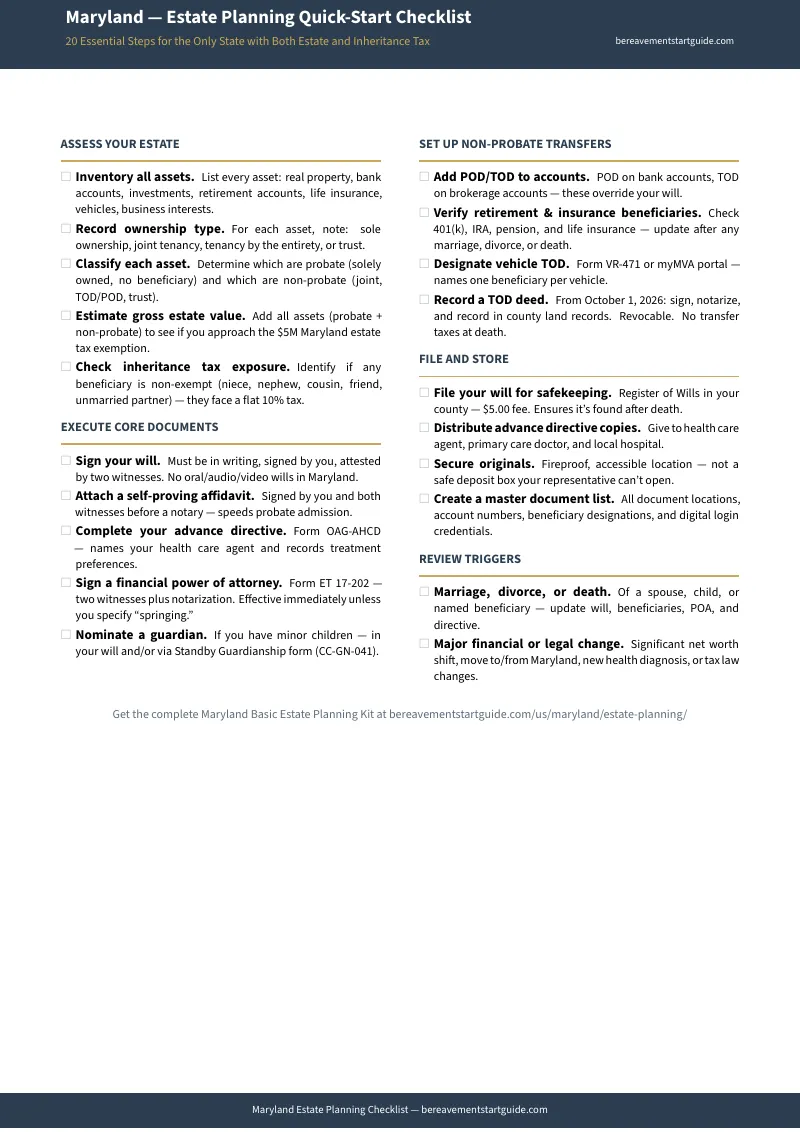
Includes the full 32-page guide, the estate planning checklist, and 10 standalone printable worksheets and reference cards — Asset Inventory Worksheet, Beneficiary Audit Worksheet, Dual-Tax Reference Card, TOD Deed Checklist, Probate Pathway Flowchart, Probate Timeline, Forms and Contacts Reference, Medicaid Protection Planner, Intestacy Distribution Chart, and Elective Share Worksheet — all built for Maryland law.
Not ready for the full kit? Download the free Estate Planning Checklist first. It covers what to do. The full guide covers how.
Satisfaction guarantee, no time limit. If the kit doesn't give you a clear, actionable plan for your Maryland estate, email us for a full refund. No questions, no hassle.
Frequently Asked Questions
What if the rules change after I buy?
We update the guide when the rules change. Email us any time, even years later, and we'll send you the current edition free.