The Bank Says No. The Hospital Wants Answers. And You Have No Legal Authority.
Your mother is in the hospital after a stroke. You call her bank to pay the mortgage — they refuse. The nursing home intake coordinator asks about Medicaid, but you can't move a single asset without court approval. The hospital social worker wants to know who makes healthcare decisions. Nobody does.
Without a valid power of attorney, you're filing for court-supervised guardianship through the Orphans' Court. That means hiring an attorney at $300+ per hour, waiting months for a hearing, submitting to continuous auditing by the Register of Wills, and watching a judge declare your parent legally incapacitated — all while the bills pile up and the house sits unmanaged.
A generic form from the internet won't fix this. Maryland's Statutory Power of Attorney Act of 2010 requires specific execution protocols that most free templates don't explain. The 2023 amendments (SB 851/HB 18) expanded default agent powers for Medicaid planning — but only if you know to include them. And Maryland is the only state in the nation that imposes both a state estate tax and a separate inheritance tax on non-lineal heirs. A power of attorney without tax-aware authority language is only half a plan.
The Maryland Legal Authority System
This isn't a stack of blank forms with a cover page. The Maryland Power of Attorney Kit is a complete legal authority system — every document, every execution requirement, every institutional acceptance strategy, built specifically for Maryland's statutory framework as updated through 2026.
It covers both sides of the authority equation: financial control (who manages the money) and healthcare decisions (who speaks to the doctors). And it connects both to the estate planning realities that most POA products ignore — because in Maryland, a power of attorney without dual death tax planning and Medicaid strategy is setting your family up for preventable losses.
What's Inside
Durable Financial Power of Attorney
Step-by-step instructions for creating a financial POA that takes effect immediately and survives incapacity. Covers the mandatory two-witness plus notary requirement under ET § 17-110 — and the notary-as-witness shortcut that lets you execute legally with just three people in the room instead of four.
Bank Acceptance Toolkit
A pre-drafted demand letter citing ET § 17-104 — the provision that makes banks liable for damages and attorney's fees when they wrongfully reject a properly executed statutory POA. Includes the 2017 written-notification mandate: if a bank refuses your document, they must give you their reasons in writing. Most branch managers back down when they see you know the statute.
Advance Directive (Healthcare Agent + Living Will)
Maryland combines healthcare agent designation and end-of-life treatment preferences into a single Advance Directive. The kit walks you through both Part I (healthcare agent appointment) and Part II (living will), including witness restrictions — your designated agent cannot witness, and at least one witness must not benefit from your estate. One disqualified witness invalidates the entire document.
Hot Powers Checklist
Gifting, self-dealing, trust funding, beneficiary changes, Medicaid spend-down — Maryland's default rules grant some of these powers automatically since the 2023 amendments, but others must be expressly stated. The checklist maps every hot power against the current statute so you include exactly what your agent needs and nothing you don't intend.
Real Estate Recording Guide
If your agent needs to sell, refinance, or transfer real property, the POA must be recorded in the county Land Records under Real Property § 4-107. That means a Certificate of Preparation from a Maryland attorney or party to the deed, a completed Land Instrument Intake Sheet, a notarized deed, and a Lien Certificate proving all county taxes and utility charges are paid. The kit walks through every county requirement so nothing gets rejected at the Circuit Court clerk's window.
Dual Death Tax Planning Guide
Maryland charges a state estate tax with a $5 million exemption — unchanged even after the 2025 federal increase to $15 million. On top of that, transfers to non-lineal heirs (stepchildren, nieces, nephews, unmarried partners, friends) trigger a flat 10% inheritance tax. The guide shows your agent how to use beneficiary designations, joint titling, and strategic transfers to minimize exposure to both taxes.
Medicaid Long-Term Care Section
Maryland's $2,500 asset limit for single Medicaid applicants means most families need aggressive planning. The kit covers the 60-month look-back period, the caregiver child exception (transfer the home penalty-free if your adult child provided live-in care for 2+ years), Lady Bird deeds, Medicaid Asset Protection Trusts, and the 2023 expanded self-dealing powers that let your agent execute spend-down strategies without court involvement.
Elective Share and Spousal Protections
Maryland law guarantees a surviving spouse at least one-third (or one-half if no descendants) of the augmented estate — including non-probate assets. Your POA agent needs to understand these limits before making any lifetime transfers. The kit explains the augmented estate calculation and the fiduciary guardrails that prevent well-meaning agents from accidentally triggering breach-of-duty claims.
Probate Avoidance Roadmap
If the probate estate is under $50,000 ($100,000 if the spouse is the sole heir), it qualifies as a small estate with zero Register of Wills fees. Above that threshold, you're looking at graduated fees up to $10,000+ and formal audits by the Orphans' Court. The kit shows how to structure asset titling, POD designations, and joint accounts to keep as much as possible out of probate — and how to use Modified Administration if regular probate is unavoidable.
Who This Is For
- Adult children managing aging parents — especially after a dementia diagnosis, stroke, or nursing home admission when legal authority becomes urgent overnight
- Married couples planning ahead — creating mutual POAs before retirement, surgery, or extended travel so neither spouse is locked out during a crisis
- Unmarried and domestic partners — without a POA, Maryland's default laws give your partner zero authority over your finances or medical care. Your biological relatives get everything.
- Blended families — stepchildren, nieces, nephews, and friends face a 10% inheritance tax that spouses and lineal descendants don't. Tax-aware planning through the POA avoids preventable losses.
- Families planning for Medicaid — the 2023 self-dealing powers must be in place before the five-year look-back starts, not during the crisis. Waiting costs families their most valuable asset.
- Anyone whose POA was rejected by a bank — because a rejected POA is worse than no POA at all. It costs you time you don't have.
Why Not Just Use a Free Form?
The People's Law Library and the Maryland Attorney General's office provide free statutory POA and Advance Directive forms. LegalZoom sells generic templates starting at $39. So why does this kit exist?
Because free forms don't come with instructions. They don't explain the notary-as-witness shortcut. They don't include the bank demand letter that forces compliance under ET § 17-104. They don't connect your POA to Medicaid planning, dual tax exposure, or the county Land Records process that determines whether your agent can actually sell the house. And LegalZoom's national templates don't reflect the 2023 Maryland amendments that expanded self-dealing authority for Medicaid planning — meaning your agent hits a wall the first time they try to execute a spend-down strategy.
The cost of getting it wrong isn't an inconvenience. It's a guardianship proceeding through the Orphans' Court. It's frozen bank accounts during a medical crisis. It's your parent's home lost to Medicaid Estate Recovery because the POA didn't include the right authority clauses. It's a 10% inheritance tax bill on transfers you could have structured differently.
The kit costs less than 15 minutes of an elder-law attorney's time — and it covers the same Maryland-specific requirements they'd address in a $1,500–$5,000 estate planning engagement.
100% Satisfaction Guarantee
If the kit doesn't give you everything you need to set up legally valid power of attorney documents in Maryland, email us and we'll refund your purchase. No conditions, no time limit.
Get Started Now
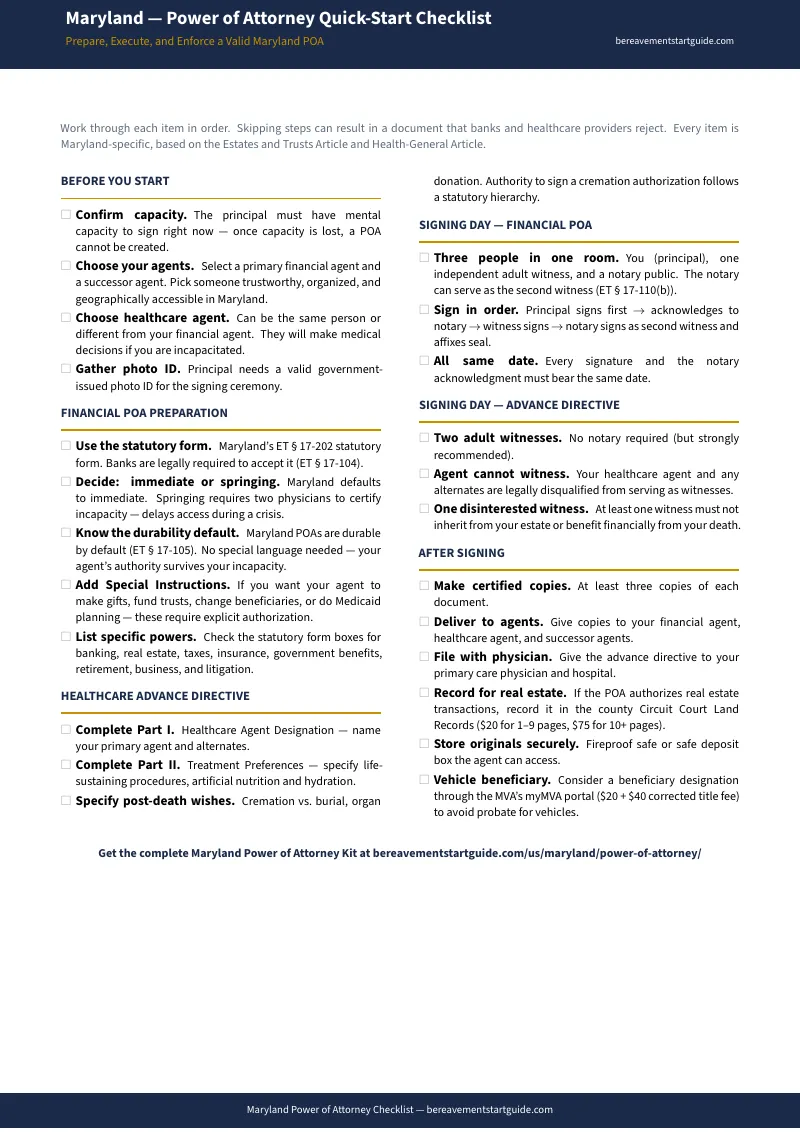
Download the free checklist for a quick overview of Maryland's POA requirements — or get the full kit for the complete system with every document, every strategy, and every institutional acceptance tool.
The free checklist gives you a one-page overview of what Maryland law requires. The full kit gives you the 20-chapter guide plus 9 standalone printable tools — bank acceptance demand letter, signing ceremony protocol, hot powers decision checklist, dual tax planning worksheet, Medicaid planning worksheet, real estate recording checklist, forms directory, estate planning action plan, and POA vs. guardianship comparison.
Frequently Asked Questions
What if the rules change after I buy?
We update the guide when the rules change. Email us any time, even years later, and we'll send you the current edition free.