Michigan Has No Living Will Statute. Your Family Will Discover This in an Emergency.
Every other state either recognizes a living will by statute or provides a clear statutory form. Michigan does neither. The only legal instrument that gives someone the authority to make medical decisions on your behalf is the Patient Advocate Designation under MCL 700.5506 — and it requires two qualified witnesses, a mandatory 10-statement written acceptance from your advocate, and execution while you are still "of sound mind."
Most families discover these requirements in a hospital hallway, after a parent's stroke, during pre-surgery paperwork, or in the days following a dementia diagnosis — when the window to execute the documents is already closing.
The Michigan Advance Directive & Living Will Kit is a Document Execution System — it takes you from blank form to legally valid, registry-filed, hospital-distributed directive using the exact witness screening protocol, acceptance language, and registration steps that Michigan law requires. No attorney retainer. No subscription. No invalid documents discovered during a crisis.
— Less Than 10 Minutes of an Attorney's Clock
Michigan elder law attorneys charge $1,500–$2,500 for a basic will-based estate plan. A standalone advance directive consultation runs $150–$300. The engagement takes weeks to schedule, and many firms bundle the directive into a larger package you may not need yet.
The kit covers everything the consultation would — and several Michigan-specific issues most general practitioners skip (Lady Bird deeds, the 2024 MUPA overhaul, MERP avoidance) — for a one-time download that costs less than a single billable quarter-hour.
What the Kit Covers
- The Patient Advocate Designation Framework — Michigan's only statutory healthcare proxy (MCL 700.5506–700.5520) explained in plain English. Who can serve, the scope of their authority, how capacity determinations work under MCL 700.5508, and the critical distinction between a PAD that authorizes life-sustaining treatment decisions and one that does not
- 10-Statement Written Acceptance — the mandatory document your advocate must sign under MCL 700.5507 before they have any legal authority. All ten statements laid out with the exact statutory language. Most free forms omit this entirely — leaving families with a designated advocate who legally cannot act
- Witness Eligibility Protocol — Michigan's MCL 700.5506(4) disqualifies more people than any other state. Your spouse, children, siblings, heirs, physicians, and employees of your insurance company, hospital, nursing home, or mental health program are all barred. The kit includes a step-by-step screening checklist that prevents the single most common execution error
- Living Will Drafting Guide — Michigan has no living will statute, but courts enforce written preferences that meet the "clear and convincing evidence" standard. The kit shows you how to document specific, legally defensible instructions for mechanical ventilation, CPR, artificial nutrition, dialysis, pain management, and organ donation
- Updated for the April 2026 Pregnancy Exclusion Ruling — in Koskenoja v. Whitmer, the Court of Claims declared the Pregnancy Exclusion unconstitutional. Most legacy templates — hospital PDFs, state bar booklets, national platforms — still contain the now-void language. This kit reflects the current law
- MI-POST and DNR Coordination — your PAD is a legal document, but paramedics follow medical orders. The kit explains how the PAD, living will, and Michigan Physician Orders for Scope of Treatment (MI-POST) work together, when you need a separate DNR, and how to ensure your legal instructions and clinical orders align
- 2024 MUPA Financial Power of Attorney — Michigan's July 2024 Uniform Power of Attorney Act (MCL 556.201 et seq.) replaced the old financial POA framework with new agent acknowledgment requirements and gifting restrictions. The kit covers both the EPIC-governed PAD and the MUPA-governed financial POA — so your healthcare and financial planning are coordinated under current law
- Lady Bird Deed and MERP Analysis — Michigan's Medicaid Estate Recovery Program claims your home from probate assets after death. A Lady Bird deed under Land Title Standard 9.3 bypasses probate entirely, shielding your home from MERP, preserving the stepped-up tax basis, and preventing property tax uncapping for close relatives
- Peace of Mind Registry Filing — the Secretary of State's voluntary advance directive registry makes your documents accessible to healthcare providers statewide. Form RI-072, required identifiers, and the complete filing process
- Post-Death Estate Overview — the $53,000 small estate threshold (2026-adjusted), spousal priority allowances under MCL 700.2402 and 700.2404, and Michigan's intestacy rules — so your family knows what happens after, not just during
- Professional Escalation Framework — clear criteria for when self-service planning is sufficient and when you need an attorney: blended families, complex trusts, Medicaid spend-down, real estate in multiple states
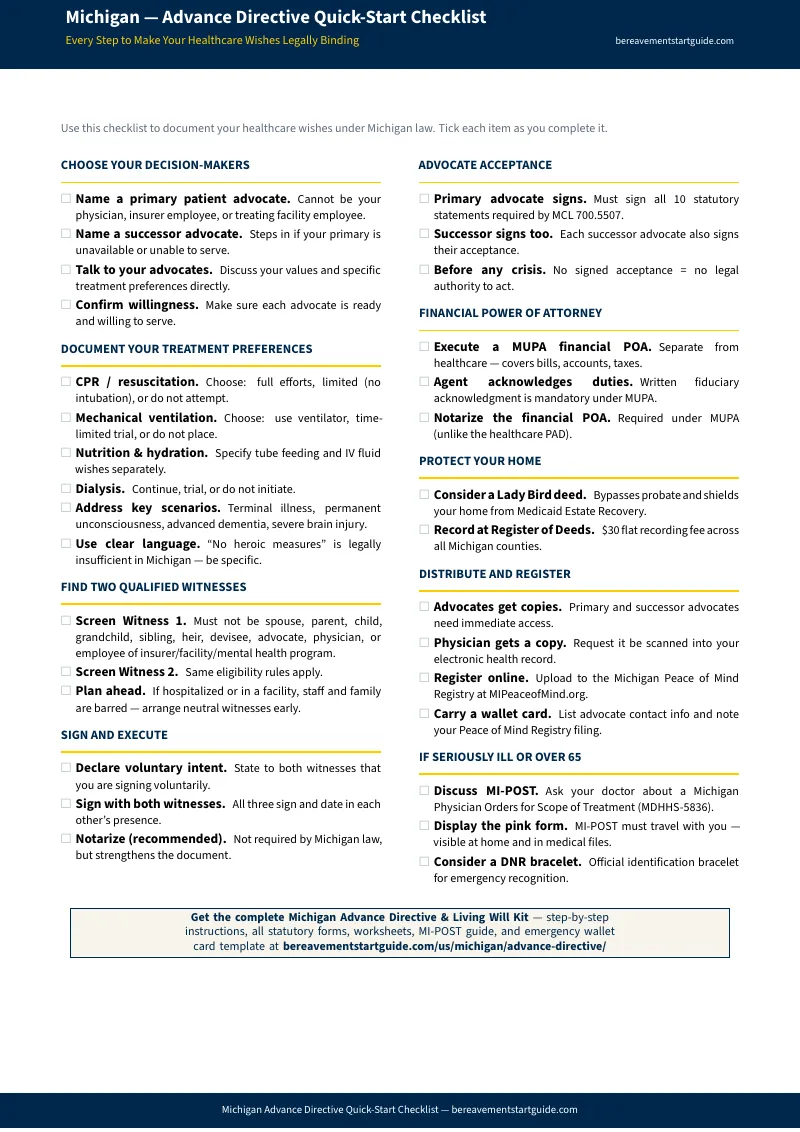
- 20-Item Quick-Start Checklist — a printable one-page reference that walks you through every step from clarifying your values through filing with the Peace of Mind Registry
- 6 Standalone Printable Tools — ready to print and bring to your signing ceremony, physician appointment, or planning session: Witness Eligibility Checklist, Patient Advocate Acceptance Form, Treatment Preferences Worksheet, MI-POST & DNR Quick Reference, Signing Ceremony Steps, and Document Distribution Checklist
Who This Is For
- Adult children who just got the diagnosis call — your parent has early cognitive decline and you need a Patient Advocate Designation executed before capacity is lost. There is no grace period
- Anyone facing scheduled surgery — the pre-admission paperwork asks for an advance directive and you need one completed and distributed before your procedure date
- Retirees protecting assets from Medicaid recovery — you want to understand how a PAD, Lady Bird deed, and MUPA-compliant financial POA work together to shield your home and assets
- Unmarried partners with no legal standing — Michigan's default surrogate hierarchy puts family members ahead of any unmarried partner. A PAD is the only document that changes this
- Anyone who downloaded the free form and got stuck — you found a Patient Advocate Designation PDF online but cannot figure out the witness rules, the 10-statement acceptance, or whether your living will language is specific enough to hold up
- Families updating documents after the 2024 MUPA overhaul — your existing financial power of attorney may not comply with the new agent acknowledgment and gifting rules. You need to check and coordinate with your healthcare directive
Why Not the Free Form?
The state provides blank Patient Advocate Designation PDFs. They include none of the operational guidance that determines whether the document actually works: no witness screening protocol, no 10-statement acceptance template, no explanation of how the living will's "clear and convincing evidence" standard is met, and no instructions for the Peace of Mind Registry.
National platforms like LegalZoom and Rocket Lawyer charge $39–$79 per document and use multi-state templates that miss Michigan's specific witness disqualifications, the 10-statement acceptance mandate, the Lady Bird deed framework, and the 2024 MUPA requirements. Michigan Legal Help offers a free interactive builder, but requires completing multiple standalone interviews with no integrated planning framework.
Free forms give you the blanks. The kit gives you the Michigan-specific execution system that makes the documents legally valid and operationally functional.
The Guarantee
If your physician, hospital, or notary public identifies a compliance issue with the instructions in this kit, email us for an immediate, no-questions-asked refund.
Start Today
Download the free Michigan Advance Directive Quick-Start Checklist to see every critical step at a glance — witness eligibility rules, the 10-statement acceptance requirement, and the Peace of Mind Registry filing process. When you are ready for the full execution system — the 16-chapter guide plus standalone printable tools — the complete kit is available for .
Disclaimer: Bereavement Start Guide is a publisher of self-help educational templates and resource guides. The materials in this kit are designed to comply with Michigan law but do not constitute legal or medical advice. For complex estate planning, contested family dynamics, or specific medical instructions, consult a licensed Michigan attorney or healthcare provider.
Frequently Asked Questions
What if the rules change after I buy?
We update the guide when the rules change. Email us any time, even years later, and we'll send you the current edition free.