Your Family Deserves a Funeral That Honors the Tradition — Without the Panic, the Upsells, or the Guesswork
Someone you love has died. Or someone you love is dying, and you know the phone call is coming.
Within hours, you will need to coordinate between a parish priest who speaks in liturgical terms you may not fully understand, a funeral director whose default package includes expensive services Orthodox theology explicitly discourages, and a family where one uncle insists on three days of open casket and a cousin is quietly wondering about cremation.
The priest handles the spiritual rites. The funeral director handles the body. Nobody handles the gap between them — the scheduling logic around forbidden days, the embalming conversation, the mercy meal menu, the memorial dates, the budget. That gap is where families lose thousands of dollars, miss canonical requirements, and end up grieving under a cloud of anxiety about whether they did it right.
The Liturgical Bridge System — Byzantine Tradition Meets Modern Logistics
The Eastern Orthodox Funeral Guide — Universal is a complete planning system that bridges the ancient liturgical core of Eastern Orthodoxy with the civil, commercial, and family realities of modern funeral planning. It covers every canonical jurisdiction — Greek, Russian, Serbian, Antiochian, Romanian, OCA, and Ethiopian — by separating the unchanging theological requirements from the cultural customs that vary by heritage.
You get the theological understanding to communicate confidently with your priest, the administrative checklists to manage the funeral home, and the negotiation scripts to protect your family's budget — all in one resource you can use the moment you need it.
What's Inside
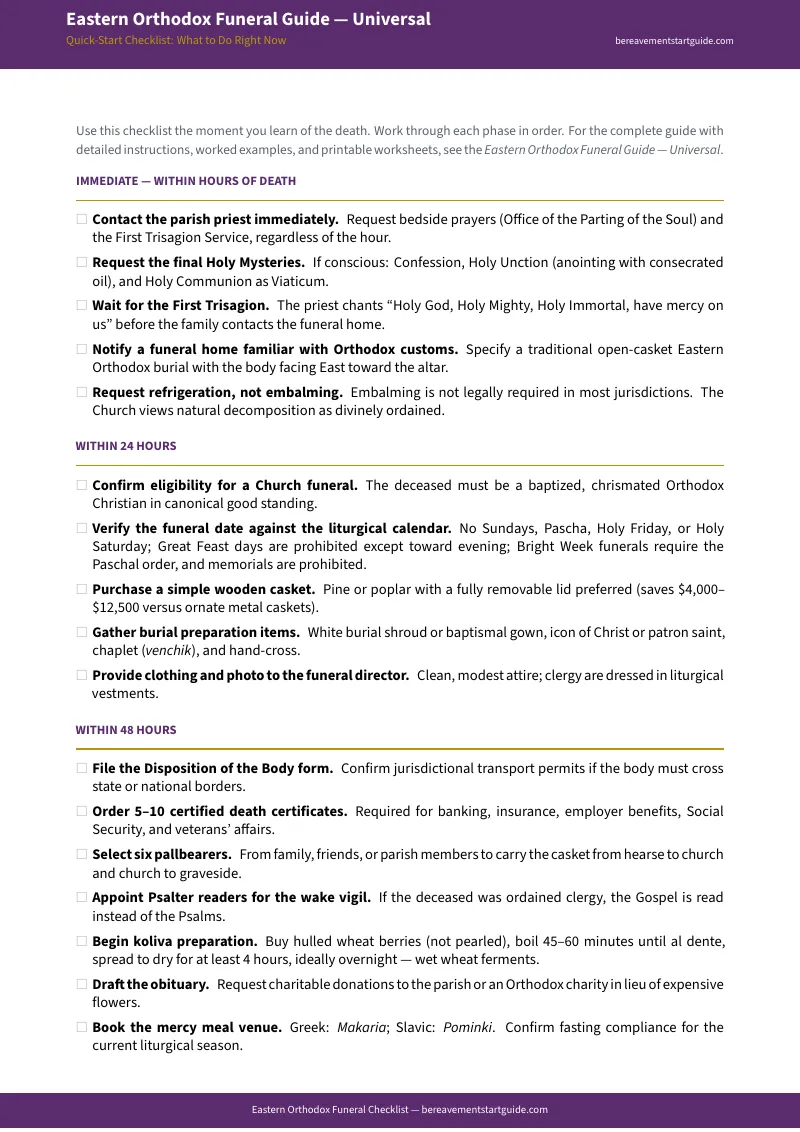
- 72-Hour Coordination Sequence — the exact order of calls, filings, and decisions from the moment of repose through the burial, with built-in scheduling logic for Sundays, Pascha, Holy Friday, Holy Saturday, and feast-day restrictions so you never accidentally book a forbidden date
- Mortuary Directive Sheet — a print-ready form you hand directly to the funeral home, specifying traditional body preparation requirements (washing, white burial garments, forehead band placement, icon positioning) so the mortuary follows Orthodox protocols without you having to explain each one verbally under stress
- Funeral-Home Negotiation Scripts — because the FTC Funeral Rule gives you the legal right to decline unnecessary upgrades, but exercising that right requires knowing what to say and when. These scripts help you request refrigeration over chemical embalming, select the simple wooden casket Orthodox theology actually prefers, and hold the vigil in the church sanctuary instead of paying for a commercial viewing room — choices that can save thousands compared to the funeral home's default package
- Memorial Timeline Calculator — shows you how to correctly count the 3rd, 9th, and 40th days (always including the day of repose itself), with the full annual memorial and Soul Saturday schedule and every prohibited date clearly flagged
- Liturgical Roadmap — walks you through each service in plain language: the Trisagion wake, the funeral liturgy sequence (Psalm 118, the Kontakion of the Departed, Memory Eternal), the graveside committal, and why personal eulogies happen at the mercy meal rather than inside the sanctuary
- Open-Casket Coordination Guide — prepares you and your non-Orthodox guests for the vigil, the "Last Kiss" approach, and the physical reality of standing for a 60-minute service, with a printable Guest Etiquette Sheet you can email or text to attendees ahead of time
- Fasting-Compliant Mercy Meal Menus — complete Makaria planning for Greek, Russian, Serbian, and Romanian traditions, with shopping lists, per-head cost estimates, and coordination guides for the parish hall or an outside caterer
- Canonical Boundary Reference — clear, compassionate explanations of the cremation prohibition, the non-communicant and non-Orthodox restrictions, the suicide provision, and how economia (pastoral compassion) works when a family member's situation requires the bishop's involvement
- Cross-Jurisdiction Comparison Tables — quickly identify whether a practice is a canonical requirement (identical everywhere) or a regional custom (Greek vs. Russian vs. Serbian vs. Antiochian vs. Romanian), so you can adapt confidently without crossing a theological line
Who This Is For
- Diaspora descendants who grew up hearing the liturgy in a language they no longer speak — you want to honor your parents' heritage without committing a social error that invites judgment from the parish community
- Interfaith spouses and executors who have never planned an Orthodox funeral and need to coordinate with a priest, a funeral home, and an extended family simultaneously
- Budget-conscious coordinators who know the funeral industry profits from emotional overspending and want concrete tools to make traditional, cost-effective choices without guessing
- Funeral directors and deathcare professionals who serve Orthodox clients in multicultural markets and need a reference for the liturgical requirements, prohibitions, and scheduling rules that differ from standard Western mortuary practice
Why the Free Resources Fall Short
Parish websites publish canonical rules using dense liturgical vocabulary — panikhida, otpevanie, prosphoron, typicon — without translation or modern context, and they cover only the spiritual side. They say nothing about mortuary negotiations, budget management, or what to do when the funeral director insists on chemical embalming you do not need.
Funeral home blogs write "Attending a Greek Orthodox Funeral" articles to attract local search traffic, but they routinely treat Orthodoxy as a minor variation of Roman Catholicism — suggesting personal eulogies during the sanctuary service or playing recorded secular music, both of which are strictly forbidden. These sites exist to sell the funeral home's own services, not to help you decline them.
Reddit threads offer real cost breakdowns and peer support, but advice is anecdotal, jurisdiction-specific, and sometimes dominated by rigorous theological debates that increase your anxiety rather than resolving it.
None of these resources give you the operational bridge between the spiritual and the administrative — the scheduling logic, the negotiation scripts, the budget framework, the canonical boundary reference — that you actually need to coordinate a funeral without expensive mistakes.
Peace of Mind, Not Perfection
You are not going to become a liturgical scholar overnight, and this guide does not expect you to. What it does is give you enough understanding to ask the right questions, make informed decisions, and coordinate the practical side of the funeral without crossing a canonical line or overpaying for services Orthodox theology discourages.
Every family's situation is unique. The guide does not replace your priest — it equips you to work with him more effectively, so the spiritual rites are handled with full canonical integrity and the logistics do not fall through the cracks.
Start with the free checklist to see the planning sequence at a glance. When you are ready for the full system — the negotiation scripts, the memorial calculator, the mercy meal menus, and the canonical reference — get the complete toolkit.
Get the Complete Eastern Orthodox Funeral Toolkit →
Frequently Asked Questions
What if the rules change after I buy?
We update the guide when the rules change. Email us any time, even years later, and we'll send you the current edition free.