Your Parent Is in the Hospital. The Bank Says Your POA "Needs Review."
You're at the branch with a power of attorney your mother signed last year. The teller disappears into the back office. Twenty minutes later, the compliance officer says they need to "run it by legal" and asks you to come back next week. Your mother's mortgage payment is past due. The utility company has already sent a shutoff notice. And her surgeon needs a deposit for the procedure scheduled Thursday.
This happens constantly in Michigan. Banks reject valid POAs because the document wasn't notarized (so it doesn't trigger the statutory presumption of genuineness), or because it was signed before the UPOAA took effect on July 1, 2024, and the compliance department isn't sure whether it's still valid, or simply because the branch insists on its own proprietary form. Meanwhile, every day of delay is a day the bills don't get paid and the care decisions don't get made.
The Michigan Dual-Authority System
Michigan splits legal authority into two separate tracks that most families don't realize are independent. Financial decisions are governed by the Uniform Power of Attorney Act (UPOAA), which took effect July 1, 2024. Healthcare decisions are governed by a completely separate document called a Patient Advocate Designation (PAD), under Michigan's Estates and Protected Individuals Code (EPIC). Each has its own execution rules, its own witness requirements, and its own institutional acceptance procedures.
Getting one right while neglecting the other leaves a gap that only the Probate Court can fill — at $175 per petition and 4 to 8 weeks of waiting during which nobody has legal authority to act. This kit walks you through both tracks in the order that matters: understanding which document covers what, executing each one correctly under current Michigan law, and then presenting your paperwork at the bank or hospital in a way that gets compliance approval on the first visit.
What's Inside the Kit
The kit includes a comprehensive 13-chapter guide, a quick-start checklist, and 10 standalone printable worksheets and reference sheets — 12 PDFs total. Everything you need to establish legal authority, protect your home from Medicaid recovery, and handle the transition when POA authority ends at death.
- Durable financial POA with granular authority selection — Michigan's UPOAA statutory form lets you customize exactly which powers your agent receives across 15 financial authority categories: real property, banking, investments, insurance, taxes, government benefits, and more. The guide walks you through each category so you don't accidentally leave gaps. Includes a printable Authority Categories Worksheet so you can plan your selections before the notary appointment. Covers the immediate vs. springing decision and why springing POAs can leave families waiting weeks for a physician's written incapacity determination.
- Patient Advocate Designation with witness screening — Michigan has some of the strictest witness rules in the country. Your spouse, parents, children, grandchildren, siblings, presumptive heirs, healthcare providers, and health insurance employees are all barred from witnessing your PAD signature. Includes a printable Witness Screening Checklist so you can verify each witness is qualified before signing. Covers end-of-life treatment decisions, organ donation, and the 30-day mental health treatment waiver that preserves your advocate's authority even during a psychiatric crisis.
- Bank acceptance defense under MCL 556.220 — Under the UPOAA, banks must accept a notarized POA within seven business days or request a certification, translation, or legal opinion. Once you provide it, they have five more business days. Includes a printable Bank Acceptance Timeline reference card you can bring to the branch. Covers the exact statutory language, the enforcement mechanism, and the pre-filing strategy that eliminates rejection entirely.
- Lady Bird Deed instructions — Michigan's Enhanced Life Estate Deed lets you keep full control of your home during your lifetime — including the right to sell, lease, or mortgage — while setting up an automatic, non-probate transfer to your heirs at death. Includes a printable Lady Bird Deed Checklist covering execution requirements, Register of Deeds recording, and Form L-4156 filing.
- Death transition and small estate settlement — A POA terminates instantly at death. Includes a printable Small Estate Settlement Paths reference covering the three simplified paths: vehicle transfers at the Secretary of State, Transfer by Affidavit for estates under $53,000 with no real property, and Petition for Court Assignment for estates with real property.
- Emergency POA execution checklists — Two printable checklists for getting authority established under time pressure: the Emergency Financial POA Checklist and the Emergency PAD Checklist. Step-by-step timelines for before surgery, hospitalization, or travel.
- Printable reference sheets — A Forms Reference listing every official Michigan form you need (with form numbers and issuing agencies), a 2026 Fees Reference with every cost from notarization to court filings, and an Estate Plan Coordination Checklist showing how all your documents work together.
- Guardianship and conservatorship avoidance — If your parent loses capacity without a POA, someone must petition the Probate Court for guardianship (medical decisions) or conservatorship (financial decisions). These are public proceedings that cost $3,000 to $10,000 or more in attorney fees, take months, and impose ongoing court supervision. The guide explains exactly why setting up a POA now prevents this.
Who This Kit Is For
- Adult children managing an aging parent's finances after a dementia diagnosis, stroke, or fall — and running out of time to get documents signed before capacity is permanently lost
- Spouses preparing for a partner's cognitive decline, a scheduled surgery, or extended travel — and need both financial and healthcare authority established before the event
- Caregivers turned away at the bank — you have a POA but the branch rejected it, and you need to understand the UPOAA enforcement mechanism that makes banks legally liable for wrongful refusal
- Michigan homeowners looking to shield their property from Medicaid estate recovery and probate through a Lady Bird Deed
- Anyone in Michigan who wants legally sound financial and healthcare authority documents without a $2,000-$5,000 attorney bill for a full estate planning package
Why Free Forms and National Templates Fall Short
The Michigan Secretary of State's website and Michigan Legal Help publish free POA forms. These are legally compliant bare templates — no instructions, no execution guidance, no bank acceptance strategy, no coordination between financial and healthcare documents.
Here's what goes wrong with free and generic templates:
- No bank compliance guidance. Free forms don't explain MCL 556.220, don't cover the 7-day mandatory acceptance timeline, and don't include the pre-filing strategy that prevents bank rejection entirely. Families show up at the branch with a valid POA and get turned away because compliance "needs to review it."
- No witness screening for the PAD. Michigan bars spouses, children, grandchildren, siblings, presumptive heirs, healthcare providers, and insurance employees from witnessing a Patient Advocate Designation. Free forms list the witness lines but don't explain the exclusion rules. One wrong witness invalidates the entire document.
- No Lady Bird Deed guidance. Free forms cover financial POA or healthcare directives only. Nothing about Michigan's most powerful probate-avoidance tool — the Enhanced Life Estate Deed that shields your home from MERP while letting you keep full control.
- No UPOAA awareness. National template services like LegalZoom and Nolo use generalized state modules. They often miss the nuances of Michigan's 2024 UPOAA changes: default durability, granular authority checkboxes, mandatory agent acknowledgments, and the strict bank acceptance enforcement mechanism.
What About Hiring an Attorney?
For complex trust structures, high-value estates, or contested family situations, a Michigan elder law attorney is the right choice. But most families facing an immediate caregiving crisis cannot wait weeks for an appointment or spend $2,000 to $5,000 on a full estate planning package when they need financial authority established by Friday.
This kit gives you the same statutory forms and execution guidance that local attorneys use, at a fraction of the cost. And if your situation turns out to need professional help, the guide tells you exactly when and why to escalate — including specific triggers for consulting an estate planning attorney, a CPA, or a Medicaid planning specialist.
100% Acceptance Guarantee
If any Michigan bank, hospital, or state agency refuses to accept documents prepared using this kit's instructions, email us and we'll issue a full refund — no questions asked.
— Less Than One Hour of an Attorney's Time
The full kit is a one-time purchase. No subscription, no hidden fees. You get the complete 13-chapter guide plus the quick-start checklist as an immediate download.
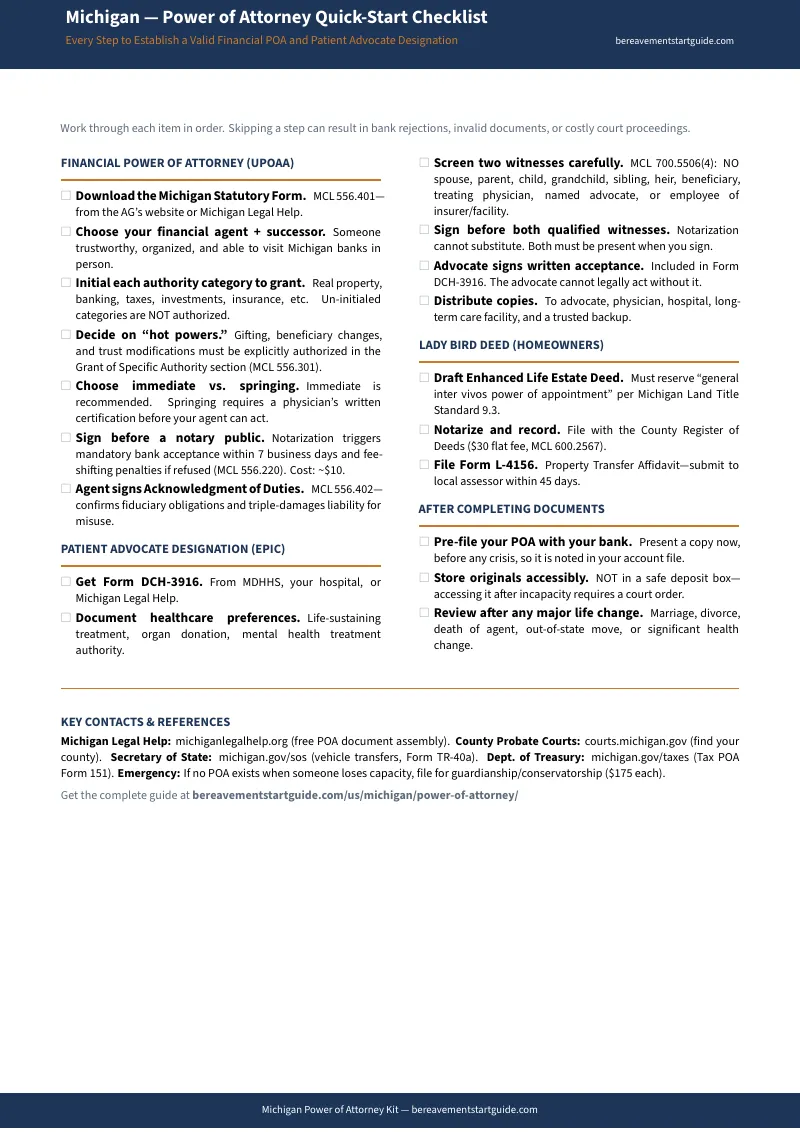
Or start with the free Michigan POA Quick-Start Checklist — a one-page overview of the execution requirements, witness rules, and notarization basics for both the financial POA and Patient Advocate Designation. It covers the essentials. The full guide goes deeper into every chapter, every statutory requirement, and every institutional acceptance strategy.
Frequently Asked Questions
What if the rules change after I buy?
We update the guide when the rules change. Email us any time, even years later, and we'll send you the current edition free.