Minnesota's Estate Tax Catches Families Who Don't Think They're Wealthy
The federal estate tax exemption is roughly $15 million. Minnesota's is $3 million. That gap means a family with a $450,000 home in Edina, a $1.2 million 401(k), a $500,000 life insurance policy, and $900,000 in savings has a $3.05 million estate — exempt from federal taxes but taxable in Minnesota at rates between 13% and 16%.
And until mid-2025, Minnesota didn't allow spousal portability at all. Even now, portability requires the executor to file Form M706 within nine months of the first death and actively elect it. Miss that deadline and the surviving spouse's protection drops from $6 million to $3 million — permanently.
Meanwhile, any real property held solely in one person's name triggers mandatory probate, regardless of value. A $180,000 cabin in Brainerd creates the same probate obligation as a $900,000 house in Minnetonka.
Most people know they should "do something about estate planning." The problem isn't motivation — it's knowing exactly which Minnesota-specific documents are required, how they interact, and which mistakes silently invalidate them.
The Minnesota Estate Protection System
The Minnesota Basic Estate Planning Kit is a complete, plain-English walkthrough of every document and decision that stands between your family and Minnesota's probate courts and estate tax system.
This isn't a stack of blank forms with a "good luck" sticker. It's a step-by-step system that shows you which documents to complete, in what order, and exactly how they work together — so nothing falls through the cracks when it matters most.
The kit covers the full spectrum of Minnesota estate planning: wills with self-proving affidavits, durable powers of attorney, Chapter 145C health care directives, Transfer-on-Death Deeds, credit shelter trust strategies, probate avoidance under the $75,000 threshold, Medical Assistance estate recovery protection, and the specific county-level recording rules that trip up most do-it-yourself planners.
What You Get
- Complete Estate Planning Guide — 14 chapters covering Minnesota wills, powers of attorney, health care directives, Transfer-on-Death Deeds, trust options, probate avoidance, estate tax planning, Medical Assistance recovery, digital assets, and special situations. Plain-English walkthrough of every document with the Minnesota statutes and thresholds that apply.
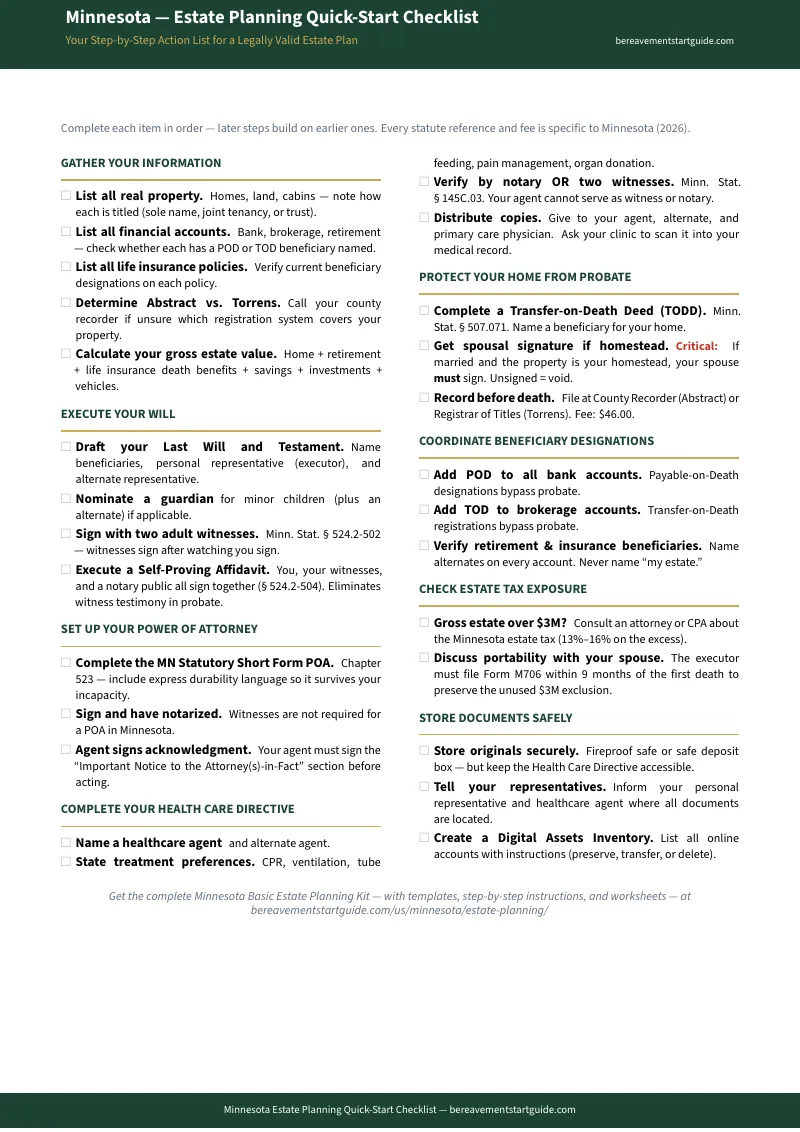
- Quick-Start Checklist — every document and deadline in priority order, with the Minnesota-specific thresholds that determine which steps apply to your situation.
- Estate Tax Planning Worksheet — calculate your estate's exposure to the $3 million state threshold. Maps every asset category (home equity, retirement accounts, life insurance, investments) to help couples determine whether a credit shelter trust or portability election is the right strategy.
- TODD Filing Checklist — step-by-step walkthrough of the Transfer-on-Death Deed process under Minn. Stat. § 507.071. Covers the pre-death recording requirement, notarization, spousal consent, and the county recorder filing that must happen before the grantor's death.
- Probate Avoidance Checklist — the $75,000 personal property threshold, real property rules, Affidavit of Collection (§ 524.3-1201), Summary Proceedings (§ 524.3-1203), beneficiary designations, and joint tenancy strategies mapped to your specific asset mix.
- Health Care Directive Signing Checklist — Chapter 145C execution requirements, witness eligibility rules, notarization alternative, and the hospital network acceptance steps that ensure your directive is recognized when it matters.
- Digital Asset Inventory — fillable worksheet organized by account type (financial, communication, subscriptions). Catalog every digital account to prevent access lockout and escheatment.
- Annual Review Checklist — yearly review protocol covering assets, beneficiary designations, people and roles, life events, and legal threshold changes. Print and complete once per year.
Who This Is Built For
- Homeowners and retirees whose combined estate (home equity + retirement + life insurance) approaches or exceeds $3 million — many don't realize they're in the taxable range until they add it up
- Married couples who need to preserve both spouses' $3 million exemptions before the first death, or who need to understand the new portability election and its filing deadline
- Blended families who need to protect biological children from accidental disinheritance under Minnesota's elective share and augmented estate rules
- Adult children helping aging parents get documents signed while they still have decision-making capacity — because once capacity is gone, the only option is a court-supervised conservatorship
- Recently divorced individuals who need to update wills, beneficiaries, and ERISA-governed accounts before the automatic revocation statute leaves federal retirement plan gaps
- Lake cabin owners who need to transfer recreational property without triggering probate for a property that's often miles from the family's primary county
Why Not Just Use the Free State Forms?
The Minnesota Judicial Branch and county courts offer free statutory forms for wills, powers of attorney, and health care directives. They're legitimate legal documents.
The problem is what they don't include. The free will form doesn't explain how a will coordinates with beneficiary designations on retirement accounts. The court's TODD form doesn't warn you about the spousal consent requirement that invalidates the transfer if your spouse doesn't sign. The health care directive form doesn't specify which witnesses are disqualified under Chapter 145C. And none of these forms address the estate tax exposure that's unique to Minnesota's $3 million threshold.
The state gives you the pieces. The kit shows you how they fit together — and which filing mistakes to avoid.
Why Not LegalZoom or Trust & Will?
Those platforms charge $149 to $499+ for initial document creation, then bill your credit card annually — $49 to $299 per year — just to maintain the ability to edit or re-download your own files. Cancel the subscription and you lose access to the documents you already paid to create.
Many use generic templates that miss Minnesota-specific rules — like the 3-year lookback on gifts for estate tax purposes, the expanded estate definition for Medical Assistance recovery claims, or the TODD pre-death recording requirement.
The Minnesota Basic Estate Planning Kit is a one-time purchase. No subscriptions, no annual renewal, no paywall between you and your own estate plan.
— Less Than One Hour of Attorney Time
Estate planning attorneys in Minnesota typically charge $1,500 to $5,000+ for a basic will and trust package. Even a simple will review starts at $200 to $500 per hour.
The kit doesn't replace an attorney for complex situations — and it tells you exactly when you need one. But for the majority of Minnesota families who need clear, legally compliant documents and a structured plan, the kit provides immediate protection at a fraction of professional fees.
And if you do decide to hire an attorney later, the asset inventory, beneficiary audit, and decision worksheets you've completed become your intake package — saving hours of billable time.
Money-Back Guarantee, No Time Limit
Download the kit, review the checklists and guides. If the plain-English instructions don't clarify the exact steps needed to protect your family — or if you decide to hire a local attorney for a custom trust instead — email us at any time for an immediate, full refund. No questions asked.
Important notice: Bereavement Start Guide is a publisher of educational resources and legal templates. This kit assists individuals in organizing their estate affairs and completing standard statutory forms. It does not provide personalized legal, financial, or tax advice, does not act as a law firm, and does not establish an attorney-client relationship. For complex assets, multi-state property, or custom trust structures, consultation with a licensed Minnesota attorney is strongly recommended.
Frequently Asked Questions
What if the rules change after I buy?
We update the guide when the rules change. Email us any time, even years later, and we'll send you the current edition free.