Your Parent Is in the ICU. The Doctor Needs to Know Who Has Authority to Make Medical Decisions. Nobody Does. And You Just Learned That Mississippi's Default Surrogate Law Requires Your Siblings to Agree by Majority Vote — While Your Mother Is on a Ventilator.
This is how most Mississippi families discover advance care planning. Not during a calm conversation over Sunday dinner. During a crisis — when a parent is hospitalized, a spouse is diagnosed, or a neighbor calls to say your father collapsed at the grocery store and the ambulance is already on the way. And you realize nobody wrote anything down.
You start searching online. You find the state statutory form. You download it. It is a blank PDF with signature lines and legal language that references Mississippi Code § 41-41-205. Nobody explains what the "Instructions for Health Care" section actually controls, or that leaving the artificial nutrition line blank has consequences, or that the neighbor you planned to ask as a witness is disqualified because she works part-time at the local clinic. You are staring at a form that looks simple but is loaded with execution traps that families do not discover until the ICU — when it is too late to fix them.
The Mississippi Advance Directive & Living Will Kit is a Hospital-Ready Execution System — not a blank form, but a structured walkthrough of every decision, every witness requirement, and every statutory trap between downloading the Mississippi directive form and having a legally binding, hospital-ready document that actually works when your family needs it.
What's Inside the Hospital-Ready Execution System
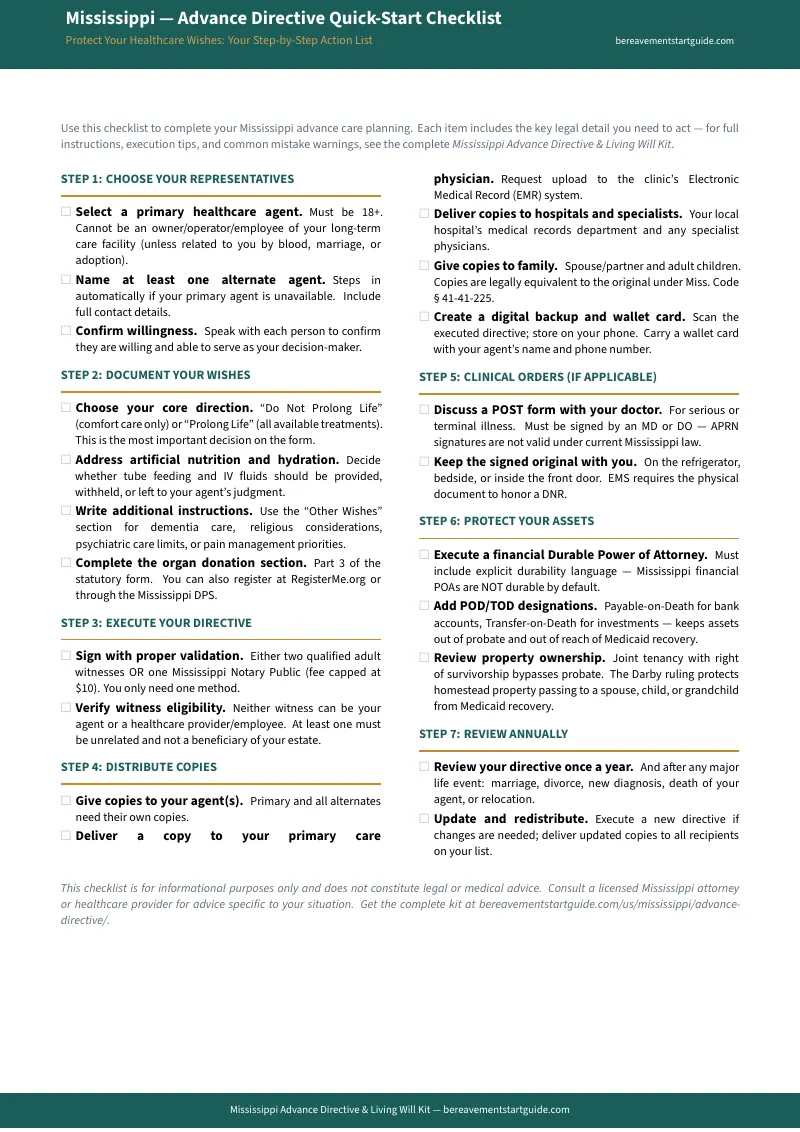
A comprehensive 15-chapter guide, a Quick-Start Checklist, and 8 standalone printable worksheets and reference cards — 10 PDFs covering every step from understanding your rights under Mississippi law through distributing your completed documents, built specifically for the Uniform Health Care Decisions Act and the state-specific rules that make advance care planning in Mississippi different from any other state:
Your Rights Under Mississippi Law
Mississippi Code § 41-41-209 specifically grants you the right to create your own advance directive without an attorney. The state provides an optional statutory form, and any document that substantially complies with the Uniform Health Care Decisions Act is legally valid when properly executed. But the statute does not explain the practical consequences of each section. The guide translates every provision into plain language — what each choice means clinically, what happens if you skip a section, and why Mississippi's lack of a state directive registry means storage and distribution are entirely your responsibility.
Choosing Your Healthcare Agent: Getting the Authority Right
Naming a healthcare agent is not as simple as picking someone you trust. The guide walks you through who can legally serve as your agent in Mississippi — and who cannot. It explains the two activation modes: the default rule where your agent's authority begins only when your primary physician determines you lack decision-making capacity, versus the optional immediate-activation provision that gives your agent authority from the moment the document is signed. It covers the decision-making worksheet, how to choose an alternate agent, and how to brief your agent so they are prepared for the intense clinical conversations that happen in ICU hallways at 2 a.m.
Writing Your Living Will Instructions
In Mississippi, a "living will" is technically called "Instructions for Health Care" and it activates only under specific triggering conditions: terminal illness, permanent unconsciousness, or when the burdens of treatment outweigh the benefits. The guide explains what each triggering condition means in practice, walks you through the two core clinical choices (life-sustaining treatment and artificial nutrition/hydration), and covers the additional instructions most families never think about — mental health care preferences, organ donation coordination, and religious or cultural considerations that override standard clinical defaults.
Executing Your Directive: The Signing Table Guide
Most advance directive failures happen at the signing table. Under Mississippi Code § 41-41-205, your directive must be signed and either notarized or witnessed by two qualified adults. The witness rules are strict and specific: neither witness can be your healthcare agent, neither can be a healthcare provider or facility employee, and at least one must be completely unrelated to you by blood, marriage, or adoption and cannot be entitled to any portion of your estate. The kit includes a witness selection worksheet that screens candidates against every disqualification category before you assemble everyone for signing — so you do not discover an invalid witness after the document is complete.
DNR vs. POST: Understanding Mississippi's Clinical Directives
Mississippi uses the term POST (Physician Orders for Sustaining Treatment) — not POLST. A DNR only addresses CPR when breathing and heartbeat stop. A POST is a comprehensive medical order signed by a physician for seriously ill or frail patients that covers intubation, antibiotics, feeding tubes, and hospital transfer protocols. The guide explains when each order is appropriate, who can sign them, how they interact with your advance directive, and the annual review requirement that most families do not know exists.
The Statutory Surrogate Trap — What Happens Without a Directive
When someone lacks capacity and has no advance directive, Mississippi law assigns medical decision-making authority to family members in a strict statutory order: spouse first, then adult children by majority vote, then parents, then siblings. The "majority rules" requirement among adult children is where families fracture. Two siblings want to continue treatment; one does not. The hospital cannot proceed without consensus. The family ends up in Chancery Court filing for a conservatorship — a public, expensive process with ongoing judicial supervision that can drain a modest estate. The guide shows you exactly how to avoid this scenario with a single, properly executed document.
Organ Donation, Revocation, and Portability
The guide covers how Mississippi's anatomical gift laws interact with your advance directive, the four methods for revoking a directive at any time without witnesses or notarization, how out-of-state directives are treated in Mississippi hospitals, and the revocation-by-new-document trap that catches families who execute updated directives without properly notifying every holder of the old one.
Coordinating with Financial Powers of Attorney
Your healthcare directive controls medical decisions. A Durable Power of Attorney for finances controls money. These are separate documents with separate execution requirements, and the gap between them is where families lose control. The guide explains the critical differences, the "durability" provision that keeps financial authority active after incapacity, and the recording requirements for real property transactions.
Protecting Your Home from Medicaid Estate Recovery
One of the most profound fears among Mississippi families is that the state will seize the family home to recoup nursing home costs. The guide walks you through Mississippi's "probate-only" estate recovery rule — meaning the Division of Medicaid can only recover from assets that pass through formal probate. It explains the landmark Estate of Darby v. Stinson ruling that shields homestead property passing to a surviving spouse, child, or grandchild. And it details the non-probate transfer mechanisms — Transfer-on-Death deeds, Pay-on-Death designations, joint tenancy — that can completely protect your home and savings from state recovery.
Simplified Estate Settlement: Avoiding the Chancery Court
Mississippi estates under $75,000 in personal property can use the Small Estate Successor Affidavit to bypass probate entirely. Estates with real property, a valid will, and personal property under $10,000 qualify for Muniment of Title — a streamlined Chancery Court procedure that clears real estate title without full administration. The guide covers both paths, the qualifying criteria, and the widow's allotment that protects surviving spouses regardless of estate size.
Your Complete Advance Directive Action Plan
A five-phase timeline that turns the entire 15-chapter guide into a sequenced checklist: Phase 1 creates your directive now, Phase 2 distributes and secures copies within two weeks, Phase 3 coordinates with your physician within 30 days, Phase 4 completes your financial planning within 60 days, and Phase 5 establishes the annual review cycle that keeps your documents current as your health, family, and wishes evolve.
Who This Kit Is For
- The adult child managing a parent's declining health — who needs clear legal authority to communicate with doctors, access medical records, and make treatment decisions without waiting for a Chancery Court conservatorship
- The retiree arranging their affairs — who wants their children spared the emotional burden of guessing medical wishes or fighting over whether to continue life support during a family crisis
- The caregiver of someone with early cognitive decline — who knows there is a narrowing window to execute planning documents while the person still has legal capacity to sign, and needs to get it done correctly the first time
- The patient preparing for surgery or hospitalization — who will be asked by clinical staff whether they have an advance directive under the federal Patient Self-Determination Act, and wants to arrive with a completed, legally binding document
- The spouse in a second marriage or blended family — who needs explicit documentation to prevent disputes between a current partner and children from a previous marriage over end-of-life treatment decisions
- The Mississippi resident with property and savings to protect — who wants to coordinate advance directives with estate planning to avoid probate and shield assets from Medicaid recovery
Why Free Mississippi Forms Leave Families Exposed
The Mississippi Department of Health and local hospital networks distribute the statutory advance directive form at no cost. The legal skeleton is there. Here is what is missing:
- No execution guidance. The form gives you blank signature lines but does not explain the witness disqualification categories that can invalidate the entire document. Families discover their witnesses were ineligible after the declarant has lost capacity — when it is too late to re-execute.
- No clinical context. Free forms present the artificial nutrition and life-sustaining treatment choices as checkboxes without explaining what each option means in an ICU, or that a "living will" only activates under three specific triggering conditions that do not cover many common medical scenarios.
- No POST coordination. Standard hospital PDFs do not explain how a POST (Physician Orders for Sustaining Treatment) differs from an advance directive, when a POST is appropriate, or how the two documents interact during a medical emergency. Families end up with conflicting clinical orders.
- No surrogate hierarchy warning. Free forms do not explain what happens by default without a directive — the majority-vote rule among adult children, the family conflicts it triggers, and the expensive Chancery Court conservatorship that becomes the only alternative.
- No estate protection guidance. A blank form does not explain how advance directives coordinate with financial powers of attorney, how to avoid probate through non-probate transfers, or how Mississippi's "probate-only" Medicaid recovery rule can protect the family home — if you know how to use it.
Generic online platforms like Rocket Lawyer and LegalZoom charge monthly subscription fees and generate documents using multi-state templates. They build the form. They do not help you survive the signing table, navigate Mississippi's specific witness rules, prepare your agent for ICU decisions, or coordinate your directive with the state's unique Chancery Court and Medicaid recovery landscape.
Your Purchase Is Protected
If the kit does not help you complete a legally sound Mississippi advance directive, email hello@bereavementstartguide.com for a full refund. No time limit, no questions, no hassle.
Frequently Asked Questions
What if the rules change after I buy?
We update the guide when the rules change. Email us any time, even years later, and we'll send you the current edition free.