Your Parent Has Early Dementia. The Bank Just Told You They Cannot Speak to You About the Account. The Attorney Wants $250 Just for a Single Power of Attorney. You Are Running Out of Time to Act.
Maybe your mother's doctor used the word "cognitive decline" for the first time last month, and you realized with a jolt that nobody in the family has any legal authority to manage her money, her house, or her medical decisions. Maybe your father is going in for surgery next week, and the hospital's pre-admission packet includes a question about healthcare proxies that nobody in your family can answer. Maybe you just inherited family land in the Delta and discovered that selling it requires a power of attorney you do not have — and that the title has been muddied by three generations of intestate transfers that nobody thought to fix.
You went online and found LegalZoom, Rocket Lawyer, and a dozen other sites offering instant power of attorney forms. But then you started reading the fine print. Mississippi has not adopted the modern 2006 Uniform Power of Attorney Act. The state still runs on the older Uniform Durable Power of Attorney Act — Mississippi Code §§ 87-3-101 through 87-3-113 — and that creates traps so specific that a generic form pulled from a national template can fail at the exact moment your family needs it most.
The Mississippi Power of Attorney Kit is a Statutory Compliance System built for the three laws that make Mississippi different from every other state: the non-automatic durability rule that silently kills your POA when incapacity strikes, the spousal homestead trap that blocks your own spouse from managing your marital home, and the absence of modern bank-acceptance penalties that lets financial institutions reject your documents without consequence. This is not a form. It is the complete framework for creating, executing, and defending legally valid power of attorney documents under Mississippi law.
What's Inside the Statutory Compliance System
An 18-chapter guide, 10 standalone printable tools, and the Mississippi POA Quick-Start Checklist — covering every stage from choosing the right document type through bank acceptance and estate settlement, built specifically for Mississippi statutes, Chancery Court practices, and the state-specific rules that national form builders miss:
The Non-Automatic Durability Rule — Mississippi's Most Dangerous Trap
In most states, a power of attorney survives the principal's incapacity automatically. Mississippi is the opposite. Under Mississippi Code § 87-3-105, if your financial POA does not contain specific statutory durability language, it terminates the instant you become incapacitated — exactly when your family needs it most. The guide gives you the exact phrases that activate durability, explains the difference between immediate and springing powers, and shows you how to define the incapacity trigger so there is no ambiguity when the moment arrives. A single missing sentence turns a valid document into a worthless piece of paper.
The Spousal Homestead Trap — Section 89-1-29
If you are married and you name your spouse as your sole agent, your spouse is legally prohibited from selling, mortgaging, or refinancing your primary home if you become incapacitated. That is not a technicality — it is a strict statutory prohibition under Mississippi Code § 89-1-29. The law requires that a power of attorney for homestead transactions must designate an agent other than the spouse. A child, a sibling, a trusted friend — anyone but the person you most naturally want to name. National form builders do not flag this. The guide walks you through structuring a dual-agent arrangement that protects your home without removing your spouse from every other financial decision.
Financial vs. Healthcare — Two Separate Frameworks
Mississippi splits the authority to manage someone's life across two entirely different statutes. Financial and property decisions run under the Uniform Durable Power of Attorney Act. Healthcare and end-of-life decisions fall under the Uniform Health-Care Decisions Act at Mississippi Code §§ 41-41-201 through 41-41-229 — a combined document that merges the healthcare proxy and the living will into a single "Advance Health-Care Directive." Each framework has its own signing rules, witness requirements, and legal limitations. The guide covers both, explains where they overlap, and tells you exactly which document each bank, hospital, and court will demand to see.
The Signing Ceremony — Getting It Right the First Time
A power of attorney that is signed incorrectly is not a "fixable" mistake — it is an invalid document. The guide provides a complete signing ceremony sequence: what to prepare before the appointment, the order of signatures, where the notary stamp goes on the financial POA, why the healthcare directive accepts either notarization or two qualifying witnesses (but not just any witnesses — Mississippi law excludes healthcare providers, facility employees, and anyone with an interest in your estate), and how to handle the situation when a family member who is also a caregiver wants to serve as a witness but is legally disqualified.
Getting Banks to Accept Your POA
Mississippi banks reject valid power of attorney documents more often than families expect, and the state offers no statutory remedy. Because Mississippi did not adopt the modern Uniform Power of Attorney Act, there are no penalties for banks that refuse to honor an acknowledged POA. The guide covers the three most common rejection reasons — documents older than five years, missing explicit banking authority, and absent durability language — and provides a step-by-step escalation strategy: requesting the compliance department, providing certified copies, recording with the Chancery Clerk, and documenting the rejection for potential legal action.
Dementia and Capacity — The Lucid Interval Window
A clinical dementia diagnosis does not automatically strip someone of the legal right to sign a power of attorney. Under Mississippi law, the standard is "sound mind" at the exact moment of execution — meaning the principal understands who they are naming, what they own, and that they are granting authority. This is the lucid interval rule, and it creates a narrow but legally valid window for families who are racing against progressive cognitive decline. The guide includes a capacity assessment framework that helps you verify competence in compliance with Mississippi court expectations.
What Happens After Death — POA Termination and Estate Pathways
A power of attorney dies with the principal. The guide covers the transition from POA authority into Mississippi's localized estate settlement pathways: the $50,000 small estate affidavit, the muniment of title shortcut for testate estates with minimal personal property, the formal determination of heirship for intestate real estate, and the probate-only Medicaid estate recovery rule that makes proper pre-death planning extraordinarily powerful for asset protection in Mississippi.
The GAP Act — What Happens Without a POA
If no power of attorney exists when a loved one loses capacity, the family must petition the Chancery Court for a formal guardianship or conservatorship under the Mississippi Guardianship and Conservatorship Act (effective January 1, 2020). That process requires filing a petition, obtaining medical evaluations, notifying all interested relatives, and attending a court hearing — costing $2,500 to $4,000 or more and taking months to resolve. The guide includes a cost comparison that shows exactly how much time and money a properly executed POA saves compared to the court-ordered alternative.
Who This Kit Is For
- The adult child whose parent was just diagnosed with cognitive decline — who needs to secure a durable financial POA and healthcare directive before the window of legal capacity closes, and who cannot afford to wait weeks for a law firm appointment that costs $250 for a single document
- The person facing surgery next week — who needs both a healthcare directive and a temporary financial POA executed, witnessed, and delivered to the hospital before admission, and who does not have time for a multi-week attorney consultation
- The married couple who owns a home in Mississippi — who needs to understand why naming each other as sole agent creates a legal trap under Section 89-1-29, and how to structure their documents so their family home is protected if one spouse becomes incapacitated
- The family managing heirs' property — who needs a real estate POA recorded with the Chancery Clerk to clear title on undivided family land that has been passed down intestate for generations
- The out-of-state child of a Mississippi parent — who needs to set up financial management remotely and wants documents that local banks will actually accept, not a generic template that gets rejected at the counter
- The proactive planner in their 40s or 50s — who wants a safety net in case of accident or sudden illness, and who wants to avoid burdening their family with a $4,000 court conservatorship if something goes wrong
Why a Generic Template Will Fail You in Mississippi
The information exists. You can find pieces of it across a dozen sources — Mississippi Bar Association pamphlets, Chancery Court websites, national form builders, elder law firm blog posts. Here is what you actually encounter when you try to build a Mississippi power of attorney from free and generic resources:
- National form builders charge $39 per document (or $39.99/month in subscriptions) and miss Mississippi's most critical requirements. LegalZoom, Rocket Lawyer, and LawDepot use multi-state templates that may not include the specific durability clause required by Mississippi Code § 87-3-105. They do not flag the spousal homestead restriction. They do not explain why Mississippi banks reject POAs at higher rates than states with modern acceptance statutes. You pay subscription prices for a document that may be legally defective.
- The Mississippi Department of Health offers a free Advance Healthcare Directive — but nothing else. The statutory healthcare form is legitimate and hospital-endorsed. But it covers zero financial authority. You cannot use a healthcare directive to access bank accounts, pay mortgages, sell property, or file taxes. A healthcare directive without a financial POA leaves your family locked out of every financial account you own.
- Mississippi attorneys charge $250 for a standalone POA and $750 to $1,500 for estate planning packages. For contested estates, complex trusts, or business interests, that cost is justified. For the majority of families who need straightforward, compliant documents with clear execution instructions, the attorney's value is in the Mississippi-specific knowledge — which is exactly what this kit contains.
- Free online advice does not tell you how to get your documents accepted. Knowing what a durable power of attorney is does not help you when the bank teller rejects your document and you have no escalation strategy. Knowing that a healthcare directive exists does not help you find two qualified witnesses at 6 PM the night before surgery. The execution gap — the space between having a document and having a document that works — is where families fail.
Generic resources give you forms. The Statutory Compliance System gives you forms, the Mississippi-specific language that makes them legally valid, and the execution framework that gets them accepted by the institutions that matter.
— Less Than One Hour With a Mississippi Estate Attorney
A single consultation with a Mississippi probate or elder law attorney costs $150 to $300 per hour. A standalone lawyer-drafted power of attorney runs $250. A full estate planning package costs $750 to $1,500. This kit costs less than one hour of professional legal time and gives you the complete Mississippi-specific framework — every statute, every execution requirement, every bank acceptance strategy, and the step-by-step signing ceremony that ensures your documents are valid the first time.
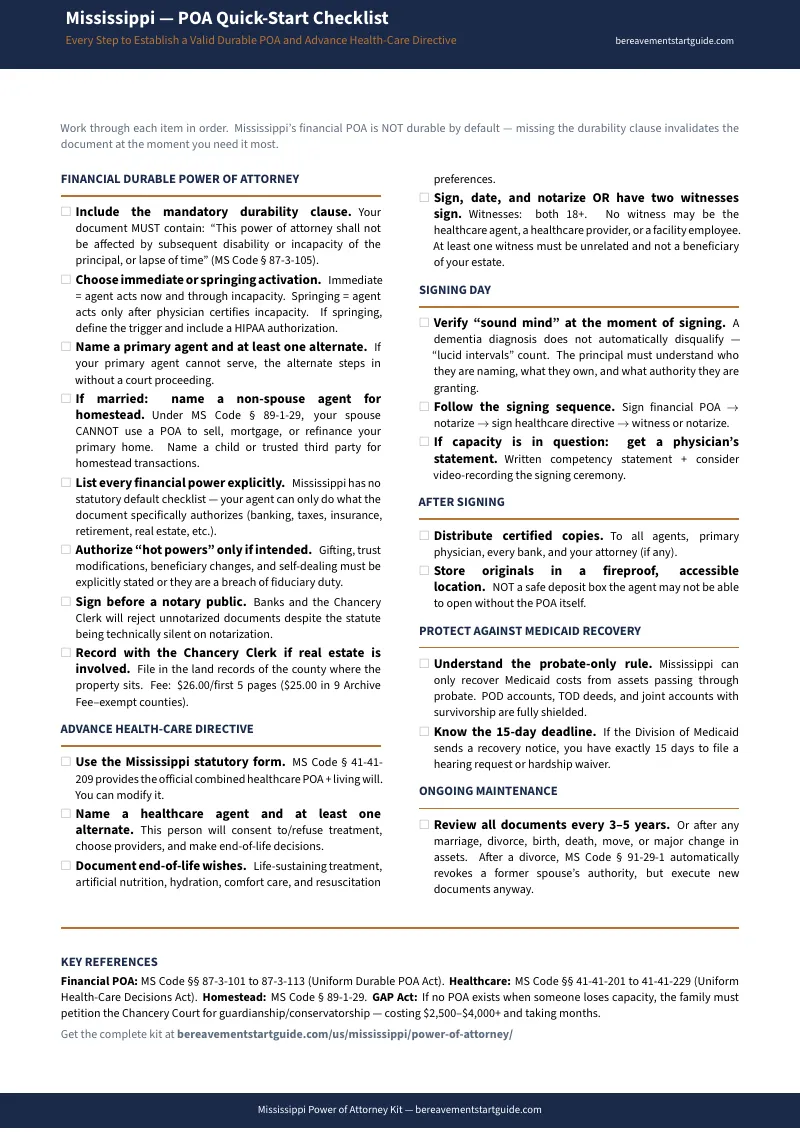
Your download includes the complete 18-chapter guide, 10 standalone printable tools — the Bank Acceptance Checklist, Dementia Capacity Framework, GAP Act Cost Comparison, Signing Ceremony Checklist, Financial Powers Worksheet, Healthcare Directive Worksheet, Real Estate Recording Guide, Emergency Surgery POA Checklist, Forms and Agency Directory, and POA Revocation Checklist — plus the Mississippi POA Quick-Start Checklist with 20 actionable items covering every requirement for both financial and healthcare documents. Instant download, no account required.
Money-back guarantee, no time limit. If the kit does not give you clarity on what documents you need, how to execute them correctly, and how to get them accepted by Mississippi banks and healthcare providers, email us for a full refund. No questions asked.
Not ready for the full kit? Download the free Mississippi POA Quick-Start Checklist — 20 items covering the essential requirements for both financial and healthcare powers of attorney in Mississippi: durability language, spousal homestead rules, notarization, witness eligibility, and Chancery Clerk recording. Enough to understand what you need and what to watch for.
The capacity window does not stay open forever. Every week you wait is another week closer to a Chancery Court conservatorship that costs $4,000 and takes months. The kit gives you the framework to act now.
Frequently Asked Questions
What if the rules change after I buy?
We update the guide when the rules change. Email us any time, even years later, and we'll send you the current edition free.