Montana Doesn't Require Witnesses on a Holographic Will. That's Also How Families End Up in Court for Eighteen Months.
Under MCA 72-2-522, Montana accepts handwritten wills without witnesses — as long as the signature and all material portions are in the testator's handwriting. Attorneys love to mention this as a backup option. What they don't mention: a holographic will is dramatically more vulnerable to challenges. Anyone with standing can argue the handwriting isn't genuine, the testator wasn't competent, or that a phrase was added later.
Without a self-proving affidavit, your family has to prove in court that you actually wrote and signed the document. Track down handwriting experts. Produce extrinsic evidence. Spend months and thousands of dollars on what should have been a ten-minute signing ceremony with two witnesses and a notary.
This is just one of Montana's estate planning traps. The Transfer on Death Deed that bypasses probate but doesn't protect your home from Medicaid estate recovery under MCA 53-6-167. The intestacy rule that forces your surviving spouse to co-own your house with your children from a prior marriage. The Small Estate Affidavit your bank won't process because they don't understand the $100,000 threshold.
Each of these has a specific fix. The problem is finding them all before you need them.
The Montana Estate Protection System
The Montana Basic Estate Planning Kit is a plain-English walkthrough of every document and decision that determines whether your family handles your estate in a weekend or fights through it for a year and a half.
This isn't a stack of blank court forms with instructions to "consult an attorney." It's a structured system: which documents to prepare, in what order, how they interact, and the Montana-specific execution rules that make or break each one. Every chapter connects to the next — your will coordinates with your beneficiary designations, your power of attorney works alongside your advance directive, and your Transfer on Death Deed gets recorded correctly the first time you file it with the county clerk and recorder.
What You Get — 7 PDFs
- Complete Estate Planning Guide (14 chapters) — covers Montana UPC framework, intestacy rules, asset inventory, will execution (attested, holographic, and self-proving), probate avoidance strategies, financial and medical powers of attorney, advance healthcare directives, the full probate process, tax obligations, Medicaid estate recovery, immediate post-death action plan, fiduciary tax administration, special situations, and a step-by-step action plan.
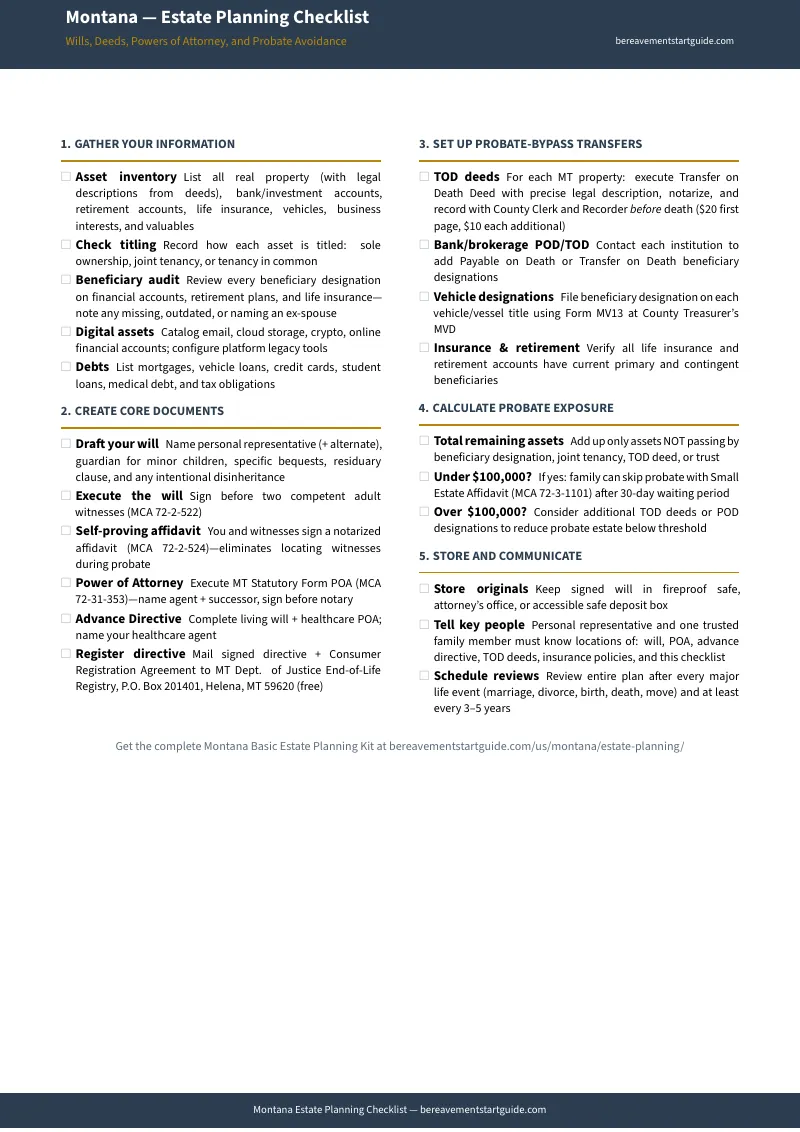
- Quick-Start Checklist — every document and deadline in priority order with the Montana-specific thresholds that determine which steps apply to your situation. Print it, work through it, check things off.
- Asset & Debt Inventory Worksheet — fillable tables for real property, financial accounts, vehicles, insurance, retirement, business interests, personal property, and debts, with a built-in probate exposure calculator and Small Estate Affidavit threshold check.
- 30-Day Post-Death Action Plan — a printable fridge sheet with every step your family needs in the first 30 days, organized by timeline (Days 1–3, 3–14, 14–30) with Montana-specific contacts and deadlines.
- Probate Avoidance Quick Reference — which bypass tool to use for each asset type (TOD Deeds, POD designations, MV13, joint tenancy), with costs, forms, and the four critical warnings most families miss.
- 10-Step Estate Planning Action Plan — the complete execution sequence from Chapter 14 as a standalone printable checklist, from asset inventory through scheduled reviews.
- Montana Contacts & Forms Reference — every agency phone number, website, and essential form in one printable card, plus a fill-in section for your County Clerk and Recorder's office.
Montana-Specific Coverage You Won't Find Elsewhere
- The holographic will trap — why it's valid but dangerous, and exactly how to add the self-proving affidavit under MCA 72-2-524 that keeps your family out of court
- Transfer on Death Deed filing — Montana's Uniform Real Property Transfer on Death Act requirements, county recording rules, and the Realty Transfer Certificate your beneficiary will need after your death
- The blended family trap — MCA 72-2-112's intestacy rules that give your surviving spouse only the first $150,000 plus half when you have children from a prior relationship, and how to prevent forced co-ownership
- Medicaid estate recovery reality — why TOD Deeds and joint tenancy don't protect you under MCA 53-6-167, plus the "Undue Hardship" waiver for working agricultural properties
- Small estate shortcut — the $100,000 threshold under MCA 72-3-1101, how to empty your probate estate below it using nonprobate transfers, and the 30-day waiting period
- Common-law property rules — how Montana's title-based ownership affects everything from bank accounts to farm equipment, and what to update if you moved from a community property state
- Advance directive registry — Montana's DPHHS registry for healthcare directives, how to register, and the Baxter v. Montana ruling on end-of-life rights
- Personal representative fees — compensation caps under MCA 72-3-631 (3% of the first $40,000, 2% above that) and how to choose the right fiduciary
Who This Is Built For
- Homeowners and landowners who want to keep their property out of probate using a Transfer on Death Deed — and need the county recording instructions that actually work on the first filing
- Ranching and agricultural families where the land is worth more than the cash on hand, and a multi-month probate could force a sale just to cover administration costs
- Parents who need to name guardians for minor children and get basic protections in place before the next life milestone
- Blended families navigating Montana's intestacy rules and the elective share — trying to protect both a surviving spouse and biological children without creating a legal time bomb
- Out-of-state transplants who moved to Bozeman, Missoula, or Flathead County and need to know what parts of their existing estate plan still work under Montana law
- Adult children helping aging parents get powers of attorney signed while they still have mental capacity — because once capacity is lost, the path leads through conservatorship court
- Seniors approaching Medicaid eligibility who need to understand what probate avoidance does and doesn't protect against the DPHHS estate recovery program
Why Not Just Use the Free Court Forms?
Montana State University Extension publishes educational guides. Montana Legal Services Association provides free forms for low-income residents. The state court system offers raw filing templates.
Here's the problem: the forms come without instructions. When you call the district court clerk's office and ask how to fill them out, you'll hear the same answer every time: "We're legally prohibited from giving legal advice." You're held to the same filing standards as a licensed attorney, but no one can tell you what the standards are.
The free forms don't explain how a will coordinates with beneficiary designations. They don't warn you about the holographic will trap. They don't cover Transfer on Death Deed recording requirements or the Medicaid recovery gap. And they definitely don't tell you when your estate is simple enough to skip probate entirely using the Small Estate Affidavit.
The state provides the pieces. The kit shows you how they fit together — and which ones you can skip.
Why Not Hire a Local Attorney?
For straightforward estates, there's a real question of whether $2,000 to $3,500 in attorney fees is worth it. Montana estate planning attorneys charge $200 to $350 per hour. A standard will, trust, and powers of attorney package runs $2,000 to $3,500+. That's real money — especially for agricultural families where the wealth is in land, not liquid cash.
The kit doesn't replace an attorney for complex situations — and it tells you exactly when you need one (multi-state real estate, business succession, taxable estates, contested family dynamics, or irrevocable trust planning for Medicaid). But for the vast majority of Montana families with a home, some retirement accounts, and minor children, the kit covers every document and decision point.
And if you do hire an attorney later, the completed worksheets become your intake package — saving hours of billable time.
— Less Than One Hour of Attorney Time
Montana estate planning attorneys bill $200 to $350 per hour. The kit covers what would take multiple consultations to accomplish — document preparation, beneficiary coordination, county recording guidance, and a step-by-step action plan.
One-time purchase. No subscriptions, no annual renewal fees, no paywall between you and your own estate plan.
Money-Back Guarantee, No Time Limit
Download the kit, review the guide and checklists. If the plain-English instructions don't clarify the exact steps needed to protect your family under Montana law, email us at any time for an immediate, full refund. No questions asked.
Important notice: Bereavement Start Guide is a publisher of educational resources. This kit assists individuals in organizing their estate affairs and completing standard statutory forms. It does not provide personalized legal, financial, or tax advice, does not act as a law firm, and does not establish an attorney-client relationship. For complex assets, multi-state property, or custom trust structures, consultation with a licensed Montana attorney is recommended.
Frequently Asked Questions
What if the rules change after I buy?
We update the guide when the rules change. Email us any time, even years later, and we'll send you the current edition free.