
Your Parent's Bank Just Froze the Account. The Hospital Wants a Healthcare Proxy. And Nobody Told You That in Montana, You Have to Get This Done Before They Lose Capacity.
Something just happened -- a diagnosis, a fall, a phone call from a doctor in Billings or Great Falls -- and suddenly you realize that nobody in the family has the legal authority to manage your parent's finances or make their medical decisions. The bank says they need a "durable power of attorney" before they'll talk to you about the account. The hospital wants an advance directive on file. And every elder law attorney from Missoula to Helena is quoting $500 to $1,500 just for the initial consultation -- with a scheduling wait of weeks that you don't have.
You start searching online. Montana State University's Extension site has some forms, but they're fragmented across multiple PDFs -- the financial template doesn't include healthcare, and there's no guidance on how to actually get the documents executed, notarized, and accepted. DPHHS has forms too, but they use outdated language and split the process across three different portals. Rocket Lawyer wants a monthly subscription for a generic template that doesn't explain Montana's "hot powers" rules, the End-of-Life Registry filing process, or why banks keep rejecting external POAs even though state law says they can't.
Meanwhile, your parent's cognitive window is closing. Under Montana law, they must be of "sound mind" to sign a power of attorney. Once that capacity is gone -- from a stroke, advancing dementia, or surgical complications -- the door shuts permanently. Your only option becomes a court-supervised guardianship: a public proceeding that costs thousands, takes months, and strips your parent of their legal autonomy in front of a district judge.
The Montana Acceptance Roadmap
This kit does what no combination of free Montana forms, national form websites, or single attorney consultations does: it puts the entire power of attorney process into one chronological sequence -- from choosing the right type of POA through execution, notarization, bank acceptance, registry filing, and the plan for what happens when the documents are actually needed.
It's built exclusively for Montana. Not a generic national template with "check your state laws" footnotes. Every chapter addresses the exact statutes, filing requirements, and institutional friction points that make Montana different -- the Uniform Power of Attorney Act and its specific "hot powers" initialing rules, the MCA § 72-31-325 bank acceptance mandate with its 7-business-day enforcement window, the End-of-Life Registry filing through the Department of Justice in Helena, the Medicaid estate recovery trap that catches families who think a Transfer on Death deed shields their home, and the Baxter v. Montana implications for end-of-life healthcare planning.
What You Get
The Complete Guide (15 Chapters)
- Financial POA with hot powers control -- step-by-step instructions for creating a durable financial power of attorney under Montana's Uniform Power of Attorney Act, with plain-language explanations of every "hot power" (gifts, beneficiary changes, trust modifications, authority delegation) so you can decide exactly which authorities to grant and which to withhold by initialing only the powers you choose
- Healthcare directive and living will -- how to create a combined advance health care directive that appoints a medical proxy and documents end-of-life wishes, including Montana's unique position on medical aid in dying following Baxter v. Montana, plus the specific witness requirements (two adult witnesses, neither of whom can be a healthcare provider)
- The bank acceptance protocol -- the exact text of MCA § 72-31-325 that requires financial institutions to accept your POA within 7 business days, plus the Agent's Certification form you present to bank managers when they try to push their own internal forms. If they refuse, they're liable for your attorney fees
- End-of-Life Registry filing -- complete filing instructions for Montana's state-run registry through the Department of Justice Office of Consumer Protection in Helena, including how to choose between standard privacy (accessible to any registered healthcare provider) and higher privacy (restricted to providers with your wallet card code), so emergency responders can access your wishes 24/7
- Medicaid estate recovery protection -- how DPHHS pursues recovery claims against both probate and non-probate assets (including TOD deeds and joint accounts), the landmark DPHHS v. Johnson ruling, and the specific planning steps your agent can take under a properly drafted durable financial POA to protect family assets before long-term care becomes necessary
- Real estate recording -- county-by-county requirements for recording a POA with the Clerk and Recorder when your agent needs to handle real property transactions, including the $20 first-page and $10 subsequent-page recording fees under House Bill 192
- Springing vs. immediate powers -- the practical differences, why most Montana elder law attorneys recommend immediate durable powers over springing clauses (doctor certifications are slow and banks fight them), and how to build safeguards without a springing trigger
- Revocation procedures -- how to revoke a POA completely, revoke only specific powers, or replace one agent with another, plus the recording requirements that ensure the revocation reaches every institution that has a copy of the original
- Post-death transitions -- what happens the moment the principal dies (all POAs terminate immediately and irrevocably), who inherits which responsibilities, how the agent's authority differs from an executor's, and the handoff steps that prevent the gap between death and probate from becoming a crisis
- Vehicle, retirement, and tax authority -- how to structure the POA so your agent can handle Montana MVD title transfers, claim retirement account benefits, and represent you before the Montana Department of Revenue using Form POA or the TransAction Portal
8 Standalone Printable References
- Bank Acceptance Protocol -- print-and-bring reference for enforcing MCA § 72-31-325 when a bank refuses your POA, with the Agent's Certification form and responses to common objections
- Emergency Planning Checklist -- 24-hour step-by-step for getting both POAs executed before surgery or a health crisis
- Real Estate Recording Guide -- County Clerk and Recorder requirements, HB 192 recording fees, document formatting specs, and Transfer on Death deed rules
- Medicaid Recovery Reference -- DPHHS estate recovery rules, expanded asset definitions, exemptions, hardship waivers, and the DPHHS v. Johnson ruling
- Forms and Contacts Reference -- one-page card listing every Montana POA form, where to get it, key agency contacts, and statute numbers
- Post-Death Transition Guide -- what happens when a POA terminates at death, small estate affidavit process, probate paths, and statutory family protections
- Vehicle Transfer Guide -- Montana MVD title transfer paths, required forms, fees, and a decision table
- POA vs. Guardianship Comparison -- side-by-side comparison to share with family members who are unsure whether a POA is worth doing
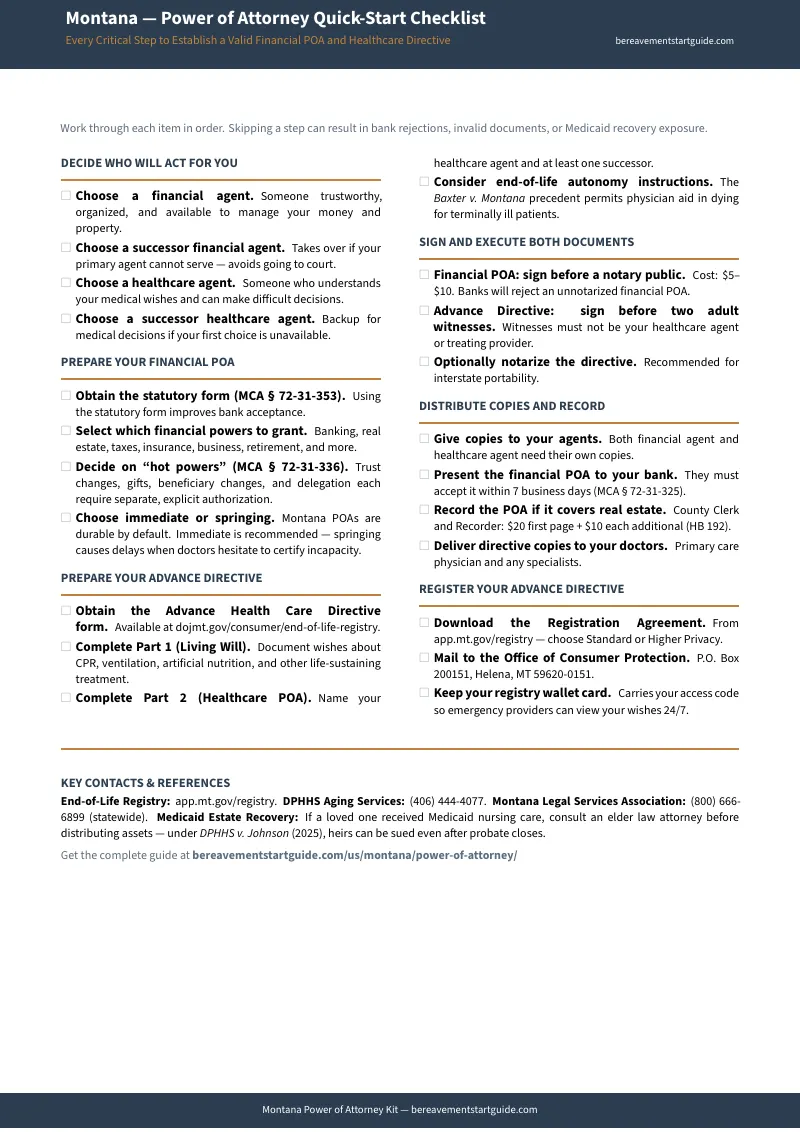
The Free Montana POA Quick-Start Checklist
A printable one-page checklist covering the most urgent decisions -- which type of POA you need, who to choose as your agent, what documents to gather, and the execution requirements (notarization for financial, witnesses for healthcare). Available as a free download so you can start immediately while deciding whether the full kit is right for your situation.
Who This Is For
- Adult children managing aging parents -- especially those dealing with a parent's early cognitive decline (dementia, Alzheimer's) who need to secure financial and medical authority before the legal capacity window closes, and who live hours from the nearest elder law office in Montana's vast rural geography
- Montana seniors planning proactively -- residents who want their affairs in order without the $500-$1,500 attorney fee, who value their independence and want to control exactly which powers they grant and which they withhold, and who want their advance directive filed with the End-of-Life Registry so it's accessible in any medical emergency
- Families facing a medical crisis -- someone is heading into surgery, starting chemotherapy, or entering hospice, and the hospital is asking about advance directives and healthcare proxies. These families need documents they can print, sign, notarize, and hand to the admissions desk today
- Ranch and property owners -- Montana landowners who need a limited financial POA for a specific real estate transaction when they can't be physically present, with the recording requirements and county clerk procedures clearly explained
- Spouses planning for long-term care -- couples who need to understand how Medicaid estate recovery works in Montana, what a durable financial POA allows an agent to do regarding asset protection, and why a Transfer on Death deed alone doesn't shield the family home from state recovery claims
Why Not Just Use the Free State Forms?
Every form referenced in this kit is available for free from a Montana government office. MSU Extension has financial POA templates. DPHHS has healthcare directive forms. The Montana State Bar approved the forms that MSU distributes.
What's not free -- and what no single government website provides -- is the execution roadmap. MSU Extension can give you a financial POA template, but it doesn't explain what happens when you walk into a bank and they refuse to accept it. DPHHS provides healthcare directive forms, but they don't walk you through filing with the End-of-Life Registry or explain the privacy options. No state website connects the financial POA's hot powers to the healthcare directive's witness requirements to the county recorder's filing procedures to the bank acceptance mandate into a single sequence you can follow from start to finish.
Each agency handles its piece. None of them tell you what the next agency in line requires, warn you about institutional pushback, or explain the Medicaid recovery trap hiding beneath your probate-avoidance strategy. This kit connects every step -- so the documents you create actually work when your family needs them.
-- A Fraction of One Attorney Consultation
A single consultation with a Montana elder law attorney runs $500 to $1,500. A flat-fee estate planning package with POA documents starts at $1,000 to $3,000. And scheduling that appointment in rural Montana often means a weeks-long wait plus hours of travel to Billings, Missoula, Helena, or Great Falls. This kit covers the foundational knowledge that would otherwise consume your first several billable hours -- understanding the document types, choosing the right powers, preparing for execution, and knowing your rights when institutions push back. Even if you ultimately hire an attorney for complex trust or Medicaid planning, completing these steps first saves hundreds in intake time and ensures you ask the right questions.
If the kit doesn't save you at least ten hours of scattered research across government websites and legal aid portals, email us at any time for a full refund. No questions asked.
Frequently Asked Questions
What if the rules change after I buy?
We update the guide when the rules change. Email us any time, even years later, and we'll send you the current edition free.