Your Partner Is Lying in a Hospital Bed. The Nurse Asks Who Can Make Medical Decisions. Under Nebraska Law, You Are Not on the List.
You have been together for eleven years. You know their wishes. You were the one who drove them to the emergency room. But Nebraska's default surrogate hierarchy is rigid and specific: spouse, adult children, adult siblings, then parents. Unmarried partners are not on it. Not at the top. Not at the bottom. Not anywhere. The nurse cannot ask you because the law does not recognize you. If their adult children disagree on treatment, the hospital stalls — and you sit in the waiting room with no voice in the decisions that matter most.
Or maybe you are the one lying in the bed. You told your daughter exactly what you wanted — no ventilator, no feeding tube, comfort care only. But you never wrote it down. And your three adult children have to reach a unanimous consensus before the hospital can act on any of them. One son cannot accept the situation. The decision stalls. The machines keep running. The family fractures over something you could have settled with a signature.
The Nebraska Advance Directive & Living Will Kit is a Nebraska Execution-Proof Planning System — a complete, step-by-step guide to documenting your healthcare wishes, appointing your chosen decision-maker, and coordinating your advance directive with the estate protection tools that Nebraska's unusual inheritance tax and Medicaid recovery laws make critical. Not a blank form downloaded from a government website. Not a national template that ignores the witness disqualification rules, the skilled nursing facility ombudsman requirement, and the county-level inheritance tax that make Nebraska different from every other state.
What's Inside the Execution-Proof Planning System
A 20-chapter guide, a quick-start checklist, and companion estate protection tools — covering every step of advance care planning in Nebraska from the initial healthcare agent selection through POLST coordination, organ donation, and the financial protections that most free forms ignore entirely:
Statutory Nebraska Forms with Step-by-Step Execution Instructions
Every instruction in the kit uses the exact language recognized by Nebraska courts and healthcare providers under Neb. Rev. Stat. § 30-3401 (Health Care Power of Attorney) and § 20-404 (Rights of the Terminally Ill Act). Nebraska is one of the few states where you must be at least 19 years old — not 18 — to execute a legally binding advance directive. The kit walks you through every execution requirement, including the choice between dual-witness and notarized verification, so the document holds up the first time a hospital reads it.
The Witness Disqualification Checklist
This is the chapter that prevents the invisible rejection. Under § 30-3405, Nebraska disqualifies an entire class of people from witnessing your Health Care Power of Attorney: spouses, parents, children, siblings, grandchildren, any named beneficiary, any presumptive heir, and the attending physician. Ask your brother to sign as witness and the document is void. Ask someone who stands to inherit and the document is void. The kit includes a point-by-point disqualification checklist so you verify every witness before they sign — not after the hospital rejects the form during a crisis.
The Skilled Nursing Facility Ombudsman Requirement
If the person signing lives in a nursing home or assisted living facility, Nebraska law does not allow standard witnesses at all. The statute requires a state-registered long-term care ombudsman to sign the document. Free hospital forms never mention this. National template services do not flag it. And if the ombudsman's signature is missing, the document can be rejected when the family needs it most. The kit explains exactly who qualifies, how to request an ombudsman visit, and how to prepare the facility for the signing.
Healthcare Agent Selection and Default Surrogate Override
Choosing the right healthcare agent is the single most important decision in the document. But Nebraska imposes its own restrictions: the attending physician, employees of the healthcare facility, and anyone already serving as agent for ten or more unrelated people are all legally disqualified — unless related by blood, marriage, or adoption. The kit walks you through agent selection, successor agent appointments, and the specific instructions that prevent family disputes — including exactly how to override Nebraska's default surrogate hierarchy so your chosen person speaks for you, not the state's predetermined list.
POLST, DNR, and Emergency Responder Coordination
An advance directive alone cannot stop an EMT from attempting resuscitation. If paramedics arrive at your home or a facility, they are trained to intervene — unless a physician-signed POLST (Provider Orders for Life-Sustaining Treatment) or Out-of-Hospital DNR is physically present and visible. The kit explains the legal distinction between these documents, when each is appropriate, and how to coordinate them with your advance directive so every provider — from your primary care doctor to a 2 a.m. ambulance crew — follows the same instructions.
Mental Health Directive and Cognitive Decline Addendum
A standard advance directive covers physical medical crises. But families navigating early-stage dementia or Alzheimer's face a different set of decisions — about psychiatric medications, behavioral interventions, facility placement, and the narrow window between a diagnosis and the loss of legal capacity. The kit includes a mental health directive addendum that documents preferences during progressive cognitive decline, names a mental health proxy, and records treatment wishes before the legal window closes.
Inheritance Tax, Transfer-on-Death Deeds, and Medicaid Estate Recovery
This is what separates a Nebraska planning kit from a generic form. Nebraska is one of only a handful of states that imposes a county-level inheritance tax on non-spouse heirs — 15% on unrelated beneficiaries above a $25,000 exemption under LB 310. Remote relatives face 11% above $40,000. And Nebraska's Medicaid estate recovery program (expanded under LB 268) can pursue non-probate transfers, joint tenancies, transfer-on-death deeds, and life estates. The kit includes companion guides covering Transfer-on-Death deeds, small estate affidavits under the $50,000 threshold, and Medicaid recovery mitigation — because your healthcare wishes protect your body, but your estate plan protects everything you leave behind.
Agricultural Planning Integration
Nebraska farm and ranch families face a specific nightmare scenario: the sole owner of agricultural land becomes incapacitated and nobody has the legal authority to sign the March operating loan, renew cash rent leases, manage USDA FSA program compliance, or transfer NRD water allocations. The bank freezes the account. The farm stalls. Livestock cannot wait for probate. The kit includes an agricultural operations coordination section that bridges the gap between healthcare directives and farm business continuity — so the operation keeps running while the family handles the medical crisis.
Who This Kit Is For
- Nebraska residents completing an advance directive for the first time — who need more than a blank form: step-by-step execution instructions, witness disqualification verification, and the choice between dual-witness and notarized authentication explained clearly
- Unmarried partners who need to override the default surrogate hierarchy — because without a formally executed Health Care Power of Attorney, Nebraska law gives medical decision-making authority to the spouse, then adult children, then adult siblings, then parents, completely excluding unmarried companions
- Adult children transitioning a parent into a skilled nursing facility — who just learned that standard witnesses are not accepted in the facility, that a state-registered ombudsman must sign the document, and that timing the directive before cognitive decline is critical
- Farm and ranch families coordinating healthcare planning with agricultural operations — who cannot afford the operational freeze that occurs when solely-owned land is tied up by incapacity, and who need the healthcare directive to work in parallel with farm business authority structures
- Families managing the inheritance tax exposure of non-spouse heirs — who discovered that Nebraska's county inheritance tax applies to every transfer at death, that unrelated beneficiaries face a 15% rate, and that advance planning with TOD deeds and beneficiary designations can reduce or eliminate the liability
- Caregivers navigating a dementia or Alzheimer's diagnosis — who are in the narrow legal window between diagnosis and loss of capacity, and need to document healthcare preferences, name a mental health proxy, and coordinate with Medicaid long-term care planning before the opportunity closes
Why Free Forms Do Not Cover What Nebraska Requires
Free advance directive forms exist in Nebraska. The Nebraska Judicial Branch publishes them. CaringInfo provides a downloadable state packet. Nebraska Medicine and CHI Health hand them to incoming patients. Here is what actually happens when you try to use them:
- The Nebraska Judicial Branch self-help portal gives you forms and warns you to hire an attorney. The forms are legally valid but include no instructions on who qualifies as a witness, how to avoid disqualification, what happens if the signing takes place in a nursing facility, or how the directive coordinates with a POLST order. The site explicitly states it cannot provide legal advice.
- Hospital-provided advance directive booklets cover medical decisions and nothing else. Nebraska Medicine and CHI Health produce excellent clinical guidance on end-of-life treatment choices. They do not mention the county inheritance tax, Medicaid estate recovery under LB 268, farm operational continuity, or Transfer-on-Death deeds. They address your body. Your estate is on its own.
- CaringInfo provides a free national-brand packet — written for Nebraska's statute but not Nebraska's economy. The CaringInfo advance directive packet covers the statutory forms and basic instructions. It does not address agricultural land protection, NRD water allocations, the SNF ombudsman requirement, or the inheritance tax that affects every non-spouse heir in the state.
- National template platforms charge more and lock you into subscriptions. eForms, FreeWill, and similar services offer fillable templates behind $39-$49/month paywalls. They provide no Nebraska-specific guidance on witness disqualification rules, ombudsman requirements, or estate coordination. You pay more for less.
- Specialty elder law attorneys charge $3,000 or more for bespoke plans. For complex estates, contested families, or significant agricultural holdings, an attorney is the right choice. But for the family that needs a properly executed advance directive with estate coordination — not a full $5,000 estate plan — there is no middle ground between free blank forms and a four-figure retainer. This kit is that middle ground.
Free resources give you blank forms that assume you know the rules. Attorney websites tell you the rules are too complex to learn. The Execution-Proof Planning System gives you the forms, the rules, the step-by-step instructions, and the estate coordination tools — all in one document, built exclusively for Nebraska law.
— Less Than One Hour With an Elder Law Attorney
A consultation with a Nebraska elder law attorney runs $200 to $400 per hour. A full advance directive and estate plan costs $2,000 to $5,000. This kit costs less than a single hour of professional legal time and gives you the complete Nebraska-specific advance directive system — every form, every witness rule, every execution step, and the estate protection tools that free forms leave out entirely.
Your download includes the complete 20-chapter step-by-step guide plus 11 standalone printable PDFs: the Witness Disqualification Checklist, Execution Worksheet, Healthcare Agent Selection Guide, POLST & DNR Coordination Guide, Inheritance Tax Reference, Medicaid Recovery Guide, Small Estate Affidavit Guide, Agricultural Operations Checklist, Key Contacts & Resources card, Document Distribution Tracker, and the Quick-Start Checklist. 12 files total. Instant download, no account required.
Money-back guarantee, no time limit. If the kit does not give you clarity on how to execute a valid Nebraska advance directive, who can and cannot witness it, and how it coordinates with your estate plan — email us for a full refund. No questions asked.
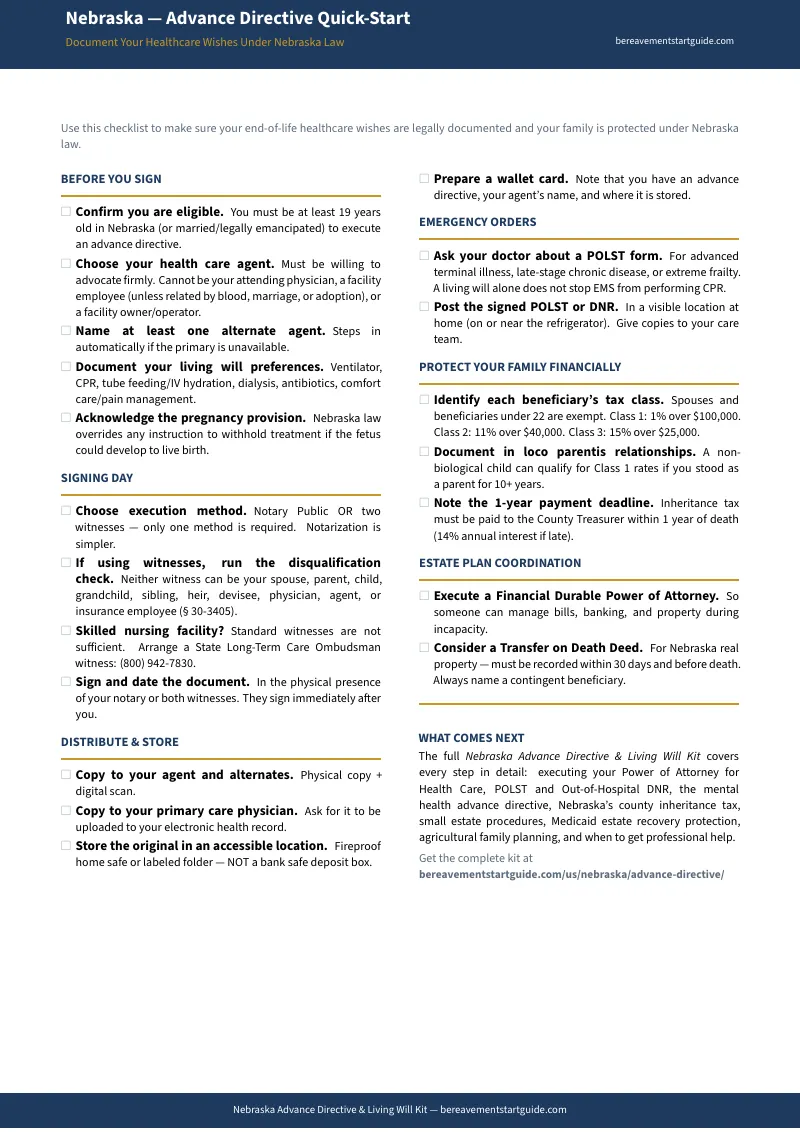
Not ready for the full kit? Download the free Nebraska — Advance Directive Quick-Start — a one-page overview of the advance directive process, the witness rules, the key Nebraska-specific requirements, and the 20 essential steps. Enough to understand what you are facing and whether you need the full guide.
Nobody teaches you this. Nebraska schools do not cover advance directives. Hospitals hand you forms with no instructions. Attorneys charge thousands for plans you may not need. This kit gives you the one thing none of them provide: a clear, step-by-step system for documenting your wishes, naming your advocate, and protecting your estate — built for the state that makes all three harder than they should be.
Frequently Asked Questions
What if the rules change after I buy?
We update the guide when the rules change. Email us any time, even years later, and we'll send you the current edition free.