You Found the State Form Online. It's Eight Pages of Legal Language, No Instructions, and One Witnessing Mistake Away from Being Rejected by the Hospital's Legal Department. Your Agent Doesn't Know They Have POLST Authority Under the 2021 SB 74 Update. And Nobody Told You That New Hampshire's Medicaid Estate Recovery Unit Can Claw Back Nursing Home Costs from Your Revocable Trust After You Die.
You searched "New Hampshire advance directive form" and downloaded the blank PDF from the Foundation for Healthy Communities. You printed it. You read the first page. Then you stopped — because the form asks you to make binding medical decisions using terms like "broadened default authority," "excessively burdensome treatment," and "medically administered nutrition and hydration" without explaining what any of them mean in practice.
You tried to figure out who can witness your signature. Your spouse cannot. Your adult children who might inherit cannot. Your named agent cannot. Your primary care physician cannot. If you sign in a nursing home, only one witness can be a facility employee. You are not sure if your neighbor qualifies or if the notary at the UPS Store is a simpler option. And you have no way to know whether a technical mistake in the execution will surface six years from now — at 2 a.m. in an emergency department — when your family needs the document to work.
The New Hampshire Advance Directive & Living Will Kit is an Execution Safeguard System — it takes you from blank statutory form to legally binding, hospital-uploaded, agent-briefed healthcare directive in a single sitting. No attorney consultation. No subscription. No second attempt because you got the witnessing wrong.
— Less Than 15 Minutes with an Elder Law Attorney
New Hampshire elder law attorneys charge $1,500–$5,000 for a comprehensive advance care planning package. Even a standalone directive consultation runs $300–$500 and takes weeks to schedule. The kit covers everything the attorney would handle for the directive itself — and several operational steps most attorneys skip — for a one-time fee that's a fraction of a single billable hour.
What's Inside the Execution Safeguard System
The RSA 137-J Framework (Chapters 1–3)
New Hampshire's advance directive system explained from the ground up. The two-part structure: the Durable Power of Attorney for Health Care (DPOAH), which names who makes decisions, and the Living Will, which states what decisions you want made. Why the state combines both into a single statutory form. What "broadened default authority" means under the 2021 SB 74 update — your agent now has default power to implement a POLST, consent to or refuse any medical treatment, and access all medical records without a separate HIPAA release. How the agent's real-time decisions legally override the written Living Will when circumstances change.
The Execution Safeguard Checklist (Chapter 4)
The step-by-step signing protocol built around RSA 137-J:14's strict requirements. Every witness disqualification explained in plain English: no agent, no spouse, no heirs, no beneficiaries, no attending physician, and the "one-employee rule" if you sign in a healthcare facility. The notarization alternative — one notary replaces two qualified witnesses, eliminating the most common failure point. A pre-signing verification checklist so you can confirm compliance before ink hits paper, not after a hospital legal department rejects the document during a crisis.
Living Will Treatment Preferences (Chapter 5)
Beyond the checkbox format of the blank state form. How to document your specific medical thresholds — the exact conditions under which you want life-sustaining treatment continued, reduced, or withdrawn. The "Living Will Burdens" addendum: a structured template for listing progressive conditions, interventions, or circumstances you consider "excessively burdensome" under RSA 137-J:20. The critical distinction between refusing medically administered nutrition and hydration (which your Living Will can address) and refusing food and water offered for normal consumption (which it legally cannot).
POLST and DNR Medical Orders (Chapter 6)
The difference that saves lives — or prevents unwanted ones. An advance directive is a legal planning document. A POLST (bright yellow form) and Portable DNR (bright pink form) are active medical orders signed by your physician. If you call 911, emergency responders are legally required to perform CPR unless they see the signed pink Portable DNR form. Your advance directive alone will not stop them. This chapter walks your Health Care Agent through the exact process of converting your advance directive preferences into physician-signed medical orders — the operational bridge between your legal wishes and the clinical reality of an emergency.
The Dartmouth Dementia Directive (Chapter 7)
The specialized supplement that standard advance directive kits miss entirely. Developed in New Hampshire's own medical community, the Dartmouth Dementia Directive addresses what happens when cognitive decline is gradual rather than sudden. Stage-specific treatment preferences for early, middle, and late dementia. How to document the point at which you want comfort-only care. Why this supplement matters: a standard Living Will triggers only when two physicians certify a terminal condition or permanent unconsciousness — it does not activate for the years-long middle stages of Alzheimer's or other progressive dementias where you can no longer communicate preferences but are not "terminally ill" by statutory definition.
Default Medical Surrogacy — What Happens Without a DPOAH (Chapter 8)
If you have not appointed a Health Care Agent, New Hampshire law triggers a default priority hierarchy to choose who speaks for you: spouse first, then adult children, then parents, then siblings. When family members disagree, the statutory process can paralyze care decisions or force a public, costly probate court guardianship proceeding under RSA 464-A. One signed DPOAH eliminates this risk entirely by designating a single, legally recognized decision-maker.
Medicaid Estate Recovery and Asset Protection Timing (Chapter 9)
The financial blind spot most advance directive kits ignore completely. New Hampshire's Medicaid Estate Recovery Unit (ERU) can recover nursing home costs from assets held in revocable trusts, joint tenancies, and life estates established after July 1, 2005. Your "trust-friendly" estate plan may not protect your home if you need long-term care. This chapter explains how your DPOAH agent's authority connects to the five-year Medicaid look-back window — why healthcare directives must be executed long before cognitive or physical decline, so your agent can coordinate protective asset transfers while you still have legal capacity.
Agent Briefing and Distribution (Chapters 10–13)
Naming an agent on paper is step one. Preparing them to actually act is step two — and most kits skip it. The structured agent briefing conversation: core values, specific treatment scenarios, comfort care preferences, and the boundary between "do everything" and "let me go." The distribution and storage protocol: original at home (never in a safe deposit box), copies to your agent, your physician, and your regional clinical network. Step-by-step upload instructions for Dartmouth Hitchcock, Southern NH Health, and MaineHealth electronic medical records portals. How to handle the Granite State "snowbird" problem — ensuring your NH directive is recognized if you spend winters in Florida, Arizona, or South Carolina.
Organ Donation and Anatomical Gifts (Chapter 14)
Beyond the checkmark on your driver's license. New Hampshire's optional statutory Organ Donation Form appended to the advance directive. How to specify full donation, research-only, or specific organ/tissue preferences. When your DPOAH agent or next of kin holds the default authority to decide — and how to ensure your wishes are clear enough to prevent family disagreement during the narrow post-death window when donation is viable.
Review, Revocation, and Life Changes (Chapter 15)
When to update your directive: the Five Ds framework (Death, Divorce, Diagnosis, Decline, Decade). How to revoke under RSA 137-J — written, oral to two witnesses, or by executing a new directive. The common mistake: updating financial documents after a divorce but forgetting to revoke the healthcare directive that still names your ex-spouse as your medical decision-maker.
Who This Kit Is For
- New Hampshire adults who want their medical wishes followed, not guessed at — and need the signing process explained in plain English so the document actually holds up when it matters
- Family caregivers trying to get a parent's directive in place before a health crisis — who need a same-day solution, not a three-week wait for an attorney consultation
- Anyone recently diagnosed with a progressive condition — who needs to document treatment thresholds and execute a Dartmouth Dementia Directive while they still have full legal capacity
- Retirees who moved to New Hampshire for the tax advantages — who need to understand that their revocable trust does not shield their home from Medicaid estate recovery, and that healthcare and financial planning must be coordinated before a long-term care need forces the issue
- Massachusetts transplants in southern New Hampshire — who need to know that NH does not use the term "health care proxy," that the witnessing rules differ from Massachusetts, and that their old Massachusetts documents need a New Hampshire counterpart
- Families where siblings disagree on care decisions — who need to designate one legally binding decision-maker through a DPOAH before a medical crisis triggers the default surrogacy hierarchy and the fighting begins
Why the Free State Form Isn't Enough
The Foundation for Healthy Communities publishes the official New Hampshire advance directive form for free. It is technically complete. Here is what it does not include:
- No witness eligibility walkthrough. The form says you need two witnesses or a notary. It does not explain the nine categories of people who are legally disqualified, the one-employee rule for facility signings, or how to verify that your chosen witnesses actually qualify under RSA 137-J:14.
- No explanation of the 2021 SB 74 changes. The form grants your agent "broadened default authority" — but does not explain what that means in practice. National platforms like Rocket Lawyer and pdfFiller still use templates that predate this update.
- No Dartmouth Dementia Directive. The standard form does not address progressive cognitive decline. It triggers only on terminal condition or permanent unconsciousness — not the years-long middle stages of dementia where you most need your preferences documented.
- No POLST/DNR coordination. The form does not explain that emergency responders will perform CPR regardless of your Living Will unless they see a signed bright pink Portable DNR. Your advance directive alone does not stop 911 from resuscitating you.
- No Medicaid estate recovery warning. The form does not mention that New Hampshire can recover nursing home costs from your revocable trust — or that the timing of your healthcare directive execution has direct implications for asset protection under the five-year look-back window.
- No agent briefing protocol. The form names your agent. It does not prepare them to actually make decisions under pressure, navigate hospital legal departments, or convert your written preferences into physician-signed medical orders.
National form engines charge $39.99/month in recurring subscriptions for generic templates that miss New Hampshire's unique statutory nuances. Local attorneys charge $1,500–$5,000 for a comprehensive package. The kit gives you the complete execution system — every chapter, every checklist, every walkthrough — for a one-time download at .
The Guarantee
If any healthcare provider, hospital network, notary public, or clinical facility in New Hampshire rejects the instructions in this kit for a compliance reason, email us for an immediate, no-questions-asked refund.
Start Today
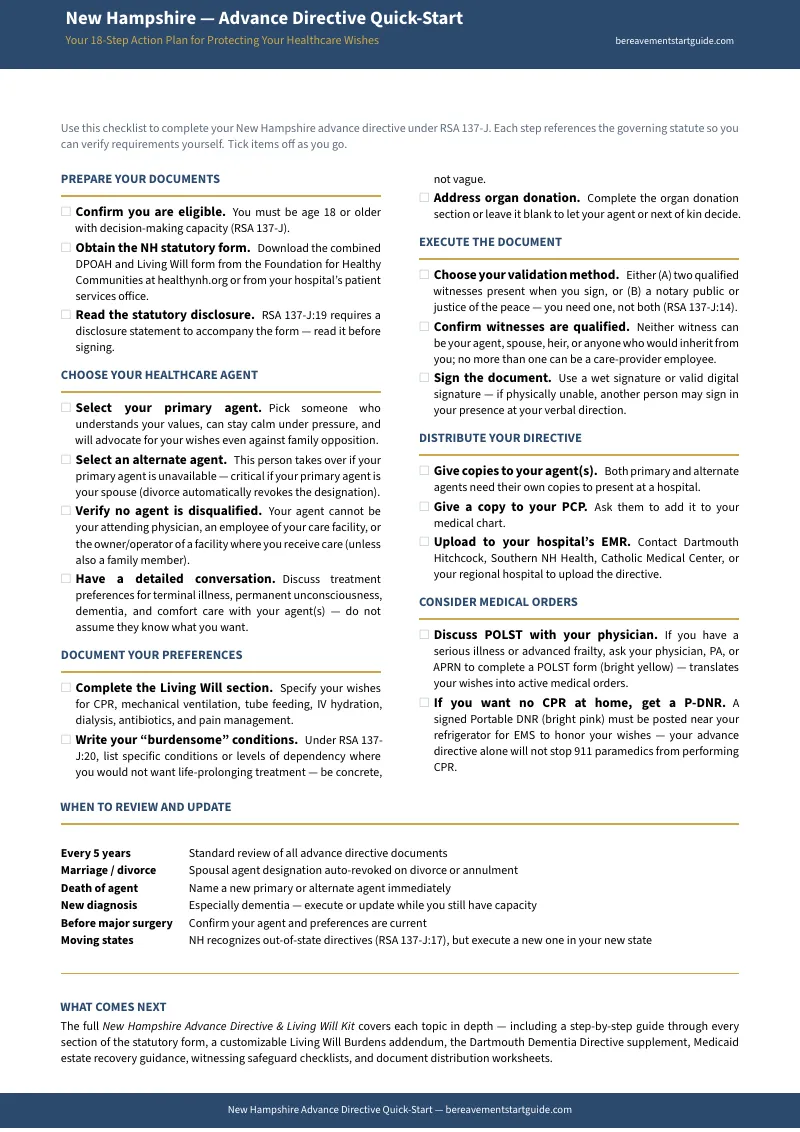
Download the free New Hampshire Advance Directive Quick-Start Checklist to see every step at a glance. When you're ready for the full execution system — the 15-chapter guide covering DPOAH, Living Will, POLST/DNR, Dartmouth Dementia Directive, Medicaid estate recovery, witness execution rules, and agent briefing protocol — the complete kit is available for .
Disclaimer: Bereavement Start Guide is a publisher of self-help educational templates and resource guides. The materials in this kit are designed to comply with New Hampshire RSA 137-J but do not constitute legal or medical advice. For complex estate planning, contested family dynamics, or specific medical instructions, consult a licensed New Hampshire attorney or healthcare provider.
Frequently Asked Questions
What if the rules change after I buy?
We update the guide when the rules change. Email us any time, even years later, and we'll send you the current edition free.