
Someone You Love Just Died in South Africa. The Bank Froze Every Account. The Master's Office Wants Nine Forms Before They Will Appoint an Executor. And the Corporate Trust Company That Offered to "Handle Everything" Will Charge 3.5% Plus VAT on the Gross Estate Value — R120,000 or More on a R3 Million Estate — for a Fee That Is a Cap, Not a Minimum.
You are standing in a place nobody prepared you for. Maybe the bank called this morning to confirm that every account in the deceased's name is frozen — including the joint account you used for groceries, electricity, and the bond repayment. Maybe you are married in community of property and your own debit card was just declined because the joint estate is now locked under the Administration of Estates Act. Maybe you are staring at the DHA-1663 form the undertaker handed you and you are terrified of writing a single digit wrong in the ID number field, because you have been told that an error on this form will cascade through the Death Certificate, the Master's Office, SARS, and every bank — and cost you months.
You are grieving and exhausted, but the deadlines do not wait. The estate must be reported to the Master of the High Court within 14 days. The Master's Office — chronically under-resourced, hit by ransomware in 2021, still running on paper systems in some branches, and subject to load shedding and water outages that close offices without notice — will need a J294 Death Notice, a J190 Acceptance of Trust, a J243 Inventory, a J262 Bond of Security, certified ID copies for every heir, and the original will. If there is no will, add the J192 Next-of-Kin Affidavit and the entire Intestate Succession Act 81 of 1987 to your reading list. If the deceased had a customary marriage, a Muslim marriage, or both, the succession rules change completely. And somewhere in the back of your mind, a question keeps circling: if I get the executor appointment but make a mistake on the Liquidation and Distribution Account, or distribute assets before the SARS Deceased Estate Compliance letter arrives, or miss a creditor during the Section 29 advertising period — am I personally liable?
The short answer: the estate pays its debts, not you. But the long answer — the one that involves a statutory 14-day reporting deadline, a Master's Office that can take three to six months to issue Letters of Executorship in Johannesburg or Pretoria, executor fees that most families do not realise are negotiable, estate duty at 20% above R3.5 million (25% above R30 million), a SARS compliance process the Master will not waive, conveyancing fees on a sliding scale for every property transfer, and a Guardian's Fund that traps minor children's inheritance in bureaucratic red tape — that answer is what separates families who close an estate in twelve months from families who spend two years and tens of thousands of rands fixing mistakes they did not know they were making.
The When Someone Dies in South Africa — Estate Settlement Guide is a Master's Office-to-Distribution Roadmap for every legal, financial, and administrative step between the funeral parlour and final distribution. Not a law textbook. Not a corporate trust company brochure designed to convince you that estate administration is too dangerous to handle without their 3.5% fee. A structured, South Africa-specific manual that separates what must be done in the first 72 hours from what legally cannot happen until the Letters of Executorship arrive and SARS issues the DEC letter — so you stop guessing, stop panicking, and start working through this in the right order.
What's Inside the Master's Office-to-Distribution Roadmap
A comprehensive guide and the First 48 Hours Checklist — covering every stage from the moment of death through final asset distribution, built specifically for South African law, the Master of the High Court, SARS, and the jurisdiction-specific rules that make settling an estate in South Africa different from anywhere else:
The First 72 Hours: Death Certificate, Asset Security, and the Banking Freeze
The moment someone dies in South Africa, the clock starts on a chain of events most families are completely unprepared for. This chapter covers getting the DHA-1663 completed correctly (the single most important form — errors in the deceased's ID number cascade through every institution), the difference between natural and unnatural death procedures (unnatural deaths require SAPS and a state forensic autopsy before the body is released), securing firearms for surrender to SAPS under the Firearms Control Act, and the immediate banking freeze. Under the Administration of Estates Act, all accounts are frozen the moment the bank is notified — including joint accounts and accounts where the surviving spouse was a signatory. For marriages in community of property, the surviving spouse loses access to everything. The guide covers the MBU 12 — the Master's Consent Letter that releases frozen funds directly to the funeral parlour — and how to get it before an executor is even appointed.
Reporting to the Master Within 14 Days: Every Form Explained
The estate must be reported to the Master of the High Court within 14 days. Missing this deadline triggers queries that delay everything by months. The guide walks you through every form — J294 (Death Notice), J190 (Acceptance of Trust as Executor), J192 (Next-of-Kin Affidavit for intestate estates), J243 (Inventory of Assets), J262 (Bond of Security) — with the specific fields that trip people up, the documents that must be apostilled if they come from outside South Africa, and the exact pitfalls that generate query sheets from the Master. It covers the R250,000 threshold that determines whether you go through the simpler Section 18(3) process (Letter of Authority) or the full Letters of Executorship route, and what Chief Master's Directive 9 of 2023 means for layperson executors who now need a professional agent.
The Executor Fee Trap: How Corporate Trust Companies Charge R120,000+ on Routine Estates
This is the chapter that corporate executor websites will never publish. The statutory tariff allows executors to charge a maximum of 3.5% on gross estate value plus 6% on income earned after death, plus 15% VAT. On a R3 million estate, that is R120,750 before income commission. But 3.5% is a cap, not a mandatory minimum. The guide explains three strategies: nominating a family member as executor and hiring an independent attorney as the professional agent on a flat fee (leveraging Directive 9 of 2023), negotiating a reduced percentage before the professional executor accepts the appointment, or accepting the corporate rate when complexity genuinely warrants it. Includes a cost comparison table showing potential savings of R70,000 to R170,000 on estates between R3 million and R5 million.
SARS Tax Compliance and Estate Duty
The executor is the "representative taxpayer" with personal liability for every rand SARS is owed. The guide covers coding the estate with SARS on eFiling, filing all outstanding returns up to date of death, filing the post-death income return, calculating estate duty (20% above R3.5 million, 25% above R30 million), the spousal rollover that can double the R3.5 million exemption, and obtaining the Deceased Estate Compliance (DEC) letter that the Master requires before the estate can be closed. Without the DEC letter, nothing moves — and SARS does not expedite.
The Liquidation and Distribution Account, Creditor Advertising, and Final Distribution
For estates over R250,000, the executor must publish a Section 29 Notice in the Government Gazette and a local newspaper giving creditors 30 days to submit claims. Then comes the L&D Account — the comprehensive financial statement of every asset, liability, cost, and distribution. The Master examines it and may issue queries. Once approved, the Section 35 Notice gives the public 21 days to inspect and object. Only after all of this can distribution begin. The guide covers every step, the cost of gazette advertising (R1,000 to R2,500), the Master's fee schedule (up to R7,000), and the distribution order that determines who gets paid first when the money runs out.
Property Transfers, Intestate Succession, and Edge Cases
The remaining chapters cover transferring immovable property through a conveyancing attorney (sliding scale fees, Deeds Office registration, rates clearance certificates), intestate succession under the Act (including the spousal hierarchy that applies differently depending on whether the marriage was in community or out of community of property), customary marriages under the Recognition of Customary Marriages Act 120 of 1998 (multiple customary wives each inherit as surviving spouses), Muslim marriages and the Moosa judgment, the Guardian's Fund for minor children's inheritance, handling estates with diaspora heirs in the UK, Australia, or the United States (Apostille requirements, exchange control regulations, cross-border tax implications), insolvent estates administered under Section 34, and pre-death planning including wills, living wills, and powers of attorney.
Who This Guide Is For
- The surviving spouse married in community of property whose bank accounts were frozen this morning — who needs to know how to get the MBU 12 to pay the funeral parlour, how to apply for the surviving spouse's maintenance claim against the estate, and how the spousal rollover works for estate duty
- The adult child named as executor who has never dealt with the Master's Office and is terrified of the forms — who needs every J-form walked through field by field, the R250,000 threshold explained, the Directive 9 professional agent requirement demystified, and a timeline that separates what is urgent from what must wait for the Letters of Executorship
- The family choosing between a corporate executor and doing it themselves who just received a quote for 3.5% plus VAT — who needs the fee comparison tables, the flat-fee alternative strategy, and the confidence to know that nominating a family member and hiring professional help on a negotiated fee is legal and often saves R70,000 or more
- The family with no will who just learned that the Intestate Succession Act dictates everything — who needs to understand the spousal hierarchy, the children's shares, what happens when there is a customary marriage alongside a civil marriage, and how the J192 Next-of-Kin Affidavit establishes the line of succession
- The diaspora child in London, Sydney, or Toronto whose parent just died in South Africa — who needs to understand Apostille requirements for foreign documents, exchange control regulations for transferring inheritance out of South Africa, the SARS implications of being a non-resident heir, and whether they can serve as executor from abroad
- The family with minor children who just learned about the Guardian's Fund — who needs to understand how children's inheritance is administered, how to apply for maintenance withdrawals, and how to avoid the red tape that traps funds for years
Why Free Resources Will Not Get You Through This
The information exists. It is scattered across the Master of the High Court website, SARS eFiling guides, the Department of Home Affairs portal, the Government Gazette archives, and a dozen institutional sites that do not reference each other. Here is what you actually encounter when you try to settle an estate using free sources alone:
- Corporate trust company content is lead generation for their 3.5% fee. Every bank and trust company publishes estate administration guides. Standard Bank, FNB Fiduciary, Sanlam Trust, and Absa all explain the process with just enough complexity to convince you it is impossible without them. None of them mention that 3.5% is a cap, not a minimum. None explain how to nominate a family member and hire professional help on a flat fee. Their content is designed to convert grieving families into clients paying R120,000+ on a R3 million estate — not to help you understand your options.
- The Master's Office website explains what forms to file but not how to fill them in. The J294, J190, J192, J243, and J262 are available for download. The instructions assume you already understand the Administration of Estates Act, the marital property regime implications, and the difference between gross and net asset values. The fields that generate query sheets — which cause months of delay — are never flagged. And the Directive 9 professional agent requirement is buried in a circular, not on the main deceased estates page.
- SARS assumes you are a tax professional. The eFiling system for deceased estates is functional but unexplained. Coding a deceased estate, filing the pre-death and post-death returns, calculating estate duty with the spousal rollover, and obtaining the DEC letter are documented in tax practitioner language. No step-by-step guide exists for a family member doing this for the first time.
- Attorney blogs highlight edge cases to justify hourly fees. South African legal blogs are well-written. They explain customary marriage succession, the Guardian's Fund, and cross-border complications in exhaustive detail. All of their content ends with a call-to-action to book a consultation at R1,500 to R3,000 per hour. For contested estates and genuine edge cases, that is appropriate. For the majority of estates, you need the roadmap, not the retainer.
- Nobody covers the process end-to-end. The Master's Office handles estate reporting and executor appointment. SARS handles tax compliance. The Deeds Office handles property transfers. Banks handle account releases. Each institution explains its own piece. No free resource integrates all the pieces into a single sequence with realistic timelines, cost tables, and the forms you actually need in the order you actually need them.
Free resources give you fragments from a dozen institutions that do not reference each other. The Master's Office-to-Distribution Roadmap puts every South African statute, form, deadline, and procedure into one document, in the order you actually need them.
— Less Than Thirty Minutes With a South African Estate Attorney
A single consultation with a South African estate attorney costs R1,500 to R3,000 per hour. A corporate executor charges 3.5% plus VAT on the gross estate value — R40,250 on a R1 million estate, R120,750 on a R3 million estate. Even a flat-fee fiduciary practitioner starts at R25,000 for basic administration. This guide costs less than thirty minutes of professional time and gives you the complete South Africa-specific roadmap — every statute, every Master's Office form, every SARS step, and the fee negotiation strategy that nobody offering their 3.5% rate will ever explain to you.
Your download includes 10 PDFs: the complete guide, the First 48 Hours Checklist, and 8 standalone reference cards — an estate milestone tracker, agency notification tracker, Master's Office document checklist, executor fee comparison card, estate cost summary, estate duty quick reference, intestate succession rules, and cremation forms reference. Print only the ones you need and bring them to the Master's Office, the bank, or SARS. Plus a money-back guarantee, no time limit. If the guide does not give you clarity on what to do next and confidence that you are doing it in the right order, email us for a full refund. No questions asked.
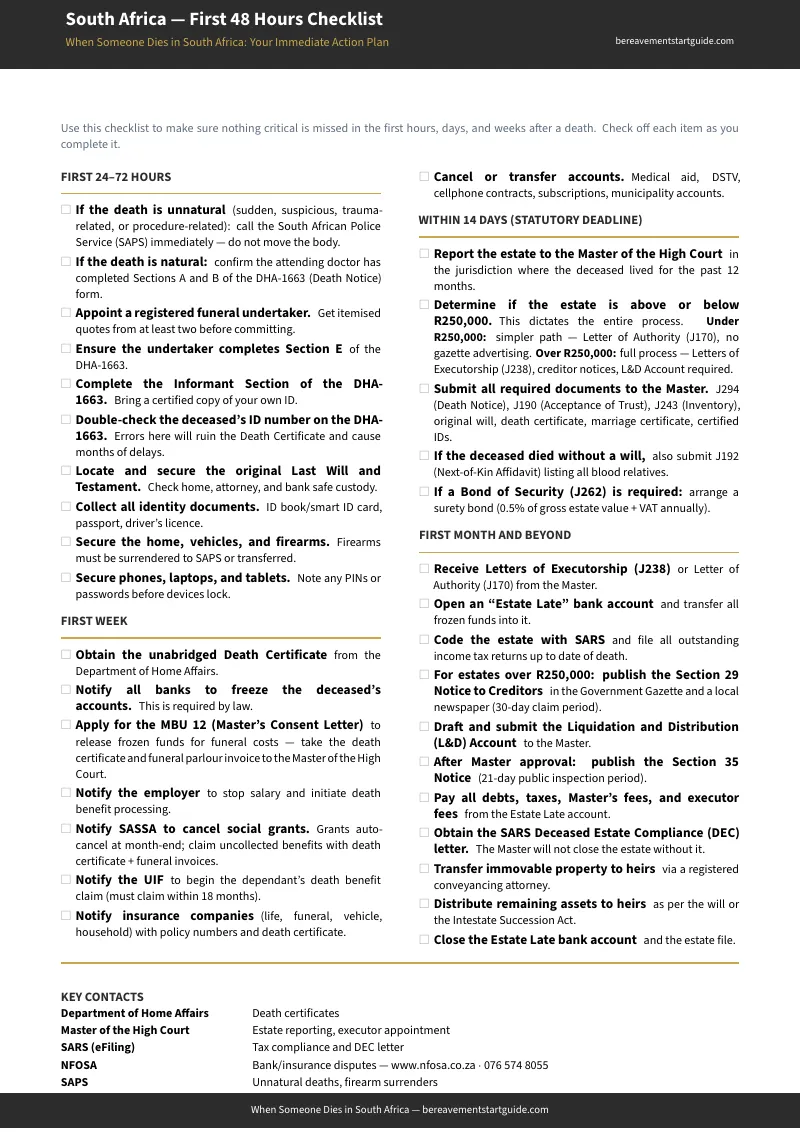
Not ready for the full guide? Download the free South Africa — First 48 Hours Checklist — the most urgent actions covering everything that must happen in the first three days after a death in South Africa: the DHA-1663 form, securing assets and firearms, notifying banks and SASSA, the MBU 12 for funeral funds, and the 14-day reporting deadline to the Master of the High Court. It is enough to get through tonight and tomorrow.
You did not ask for this job. But you can do it. The guide shows you how, one step at a time.