A Funeral Parlour Is Holding Your Mother's Body Until You Pay R5,600 You Do Not Owe. Home Affairs Is Closed Until Monday. The Bank Froze Every Account. And You Have 14 Days to Report the Estate to the Master of the High Court Before the Delays Get Worse.
You are standing in a corridor you were never supposed to be in. Maybe the hospital morgue already released the body to a funeral parlour you never contracted, and now that parlour is demanding a "storage fee" before they will hand over the remains to your actual undertaker. Maybe you drove to Home Affairs with the DHA-1663 only to find the office is offline, and the burial cannot happen without a BI-14 Burial Order that nobody else can issue. Maybe the deceased's FNB account was frozen the moment the death was registered, and you are staring at a R28,000 funeral invoice with no legal way to access the money sitting in the account.
You are grieving, sleep-deprived, and fielding calls from relatives who want answers about whether the burial will happen this weekend or whether the body needs to be embalmed first. Siblings are arguing about cremation versus a traditional burial on ancestral land. Your uncle insists the body can be transported in a family vehicle to the Eastern Cape. Your mother-in-law says the burial society will cover everything, but you have no idea whether the policy is even registered with the Financial Sector Conduct Authority. And somewhere underneath all of it, a terrifying question keeps surfacing: if I miss a form I have never heard of, or sign something I should not have signed at the hospital, or distribute the estate before the Master's Office issues letters — am I personally liable?
The short answer: the executor's liability is real, and it kicks in earlier than most people realise. But the long answer — the one that involves the Consumer Protection Act rights that would force that rogue parlour to release the body immediately, the Section 11 mechanism that gets frozen bank funds released directly to the funeral director, the five-form cremation documentation suite that must be completed before any Medical Referee will grant authority to cremate, the difference between a J170 for estates under R250,000 and a J238 for estates above it, the Section 37C pension fund rules that override your Will entirely, and the 20% estate duty rate that SARS levies above a R3.5 million abatement — that answer is what separates families who bury their loved one with dignity from families who spend months untangling mistakes they did not know they were making.
The South Africa Funeral Laws & Consumer Rights Guide is a Consumer Defence Manual for every legal, financial, and administrative step between the moment of death and the final winding up of the estate. Not a law textbook. Not a generic bereavement planner written for American probate courts. A structured, South Africa-specific manual that follows the exact sequence of DHA forms, NHA regulations, CPA consumer rights, Master's Office procedures, and SARS tax obligations — so you stop guessing, stop being exploited, and start working through this in the right order.
What's Inside the Consumer Defence Manual
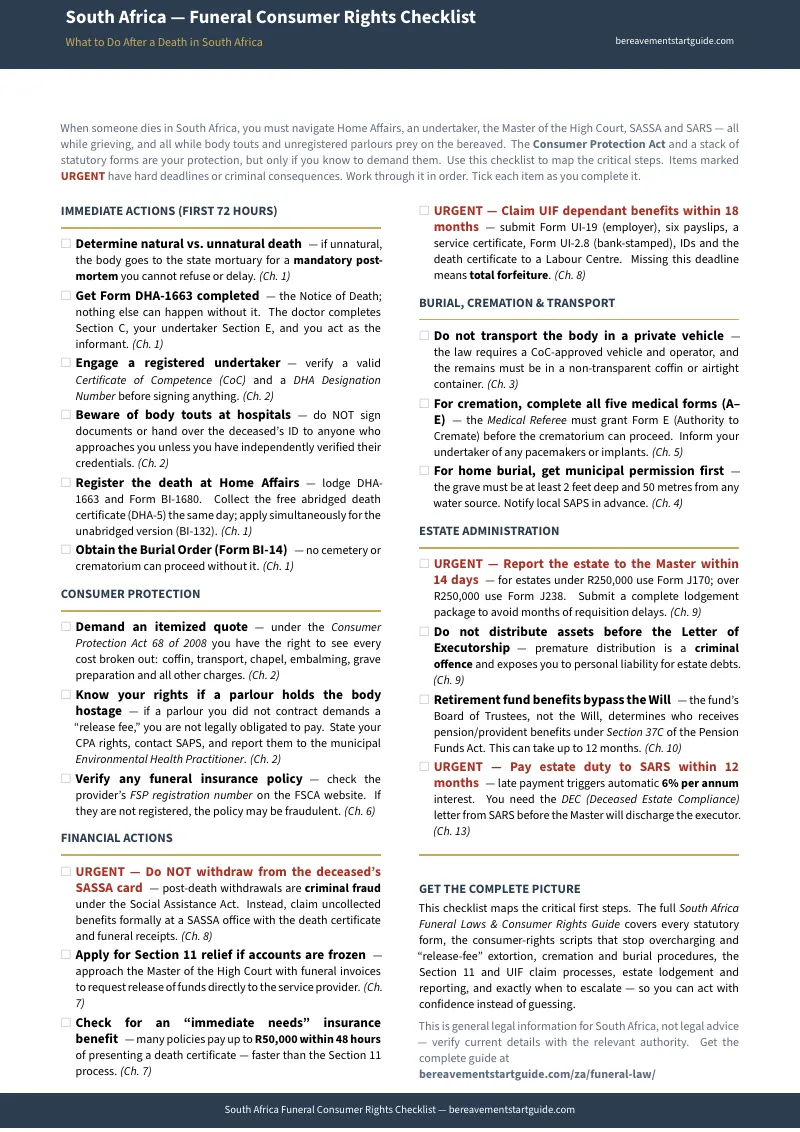
A 17-chapter guide and the Funeral Consumer Rights Checklist — covering every stage from the moment of death through final estate distribution, built specifically for South African statutes and the agencies you will actually deal with:
The First 72 Hours: Death Registration and the DHA-1663
Everything depends on one document: Form DHA-1663, the Notice of Death. Without it, mortuaries cannot release the body, undertakers cannot book a cemetery plot, and the estate cannot begin winding up. This chapter covers who completes each section (the doctor, the undertaker, the informant), the critical fork between natural and unnatural deaths (if unnatural, the body goes to a state mortuary for a mandatory post-mortem you cannot refuse), how to get the abridged death certificate free on the same day, why you must apply for the unabridged version simultaneously using Form BI-132, and how to obtain the Burial Order (Form BI-14) that no cemetery or crematorium will proceed without.
Consumer Defence: Fighting Predatory Funeral Parlours
The South African Law Reform Commission has formally identified the "hostage body" phenomenon through Project 147 — rogue parlours that collude with hospital morgue staff to intercept remains and then demand release fees up to R5,600. This chapter gives you the exact legal script to deploy under the Consumer Protection Act 68 of 2008, the steps to report the parlour to the municipal Environmental Health Practitioner, how to verify any undertaker's Certificate of Competence and DHA Designation Number before signing anything, how to identify body touts loitering at hospital morgues, and your legal right to demand a fully itemized quote that breaks out every cost from coffin to chapel hire to weekend grave digging.
Transport, Home Burial, and Cremation Rules
The National Health Act's Regulation 363 prohibits transporting a body in a private vehicle — you must use a CoC-approved operator. This chapter covers the specific transport requirements (embalming, non-transparent coffin, airtight container), the home burial compliance checklist (municipal permission, 2-foot depth minimum, 50-metre distance from water sources, mandatory SAPS notification), the five-form cremation documentation suite (Forms A through E and the independent Medical Referee process), the pacemaker removal requirement, and what South African law actually says — and fails to say — when extended family members are fighting over cremation versus a traditional ancestral burial.
Insurance Fraud, Frozen Accounts, and Financial Triage
The FSCA verification process for checking whether a funeral policy provider is legitimately registered, the PERSAL deduction scam that targets government employees, the Section 11 mechanism for releasing frozen bank funds to pay the funeral director directly, the "immediate needs" life insurance benefit that can pay up to R50,000 within 48 hours, claiming uncollected SASSA benefits at a regional office, the UIF dependant benefit claim process (18-month hard deadline — miss it and benefits are forfeited entirely), and the municipal ward councillor protocol for securing an indigent burial when no other option exists.
Estate Administration, Taxes, and Hidden Costs
Reporting the estate to the Master of the High Court (Form J294 death notice, J190 acceptance of trust, J192 next-of-kin affidavit, J243 inventory), the difference between the simplified Section 18(3) procedure for estates under R250,000 and formal executorship for larger estates, the Section 37C pension fund rules that give the Board of Trustees — not your Will — complete authority over retirement death benefits for up to 12 months, the executor's 3.5% fee plus 6% income commission plus VAT, Capital Gains Tax on deemed asset disposals, Estate Duty at 20% above the R3.5 million abatement, the SARS DEC letter requirement, property transfer clearances (municipal rates, SARS transfer duty exemption, body corporate levies), customary marriage succession rights and the registration trap that can lock a widow out of the estate, and the "Death Folder" pre-planning checklist that prevents your family from facing this chaos unprepared.
Who This Guide Is For
- The family coordinator who just had a parent or spouse die and is fielding calls from the undertaker, Home Affairs, the bank, and extended family simultaneously — who needs a single document that tells them exactly what to do, which forms to complete, and in what order
- The surviving spouse in an unregistered customary marriage who just learned that the Master of the High Court will not issue Letters of Executorship without a DHA marriage certificate — who needs to understand posthumous registration and the High Court remedy established in Khashane v Minister of Home Affairs
- The executor named in the will who has never dealt with the Master's Office and is terrified of personal liability — who needs the complete lodgement package (J294, J190, J192, J243, J262) explained in plain language with every deadline mapped
- The diaspora relative coordinating a funeral from the UK, Australia, or the UAE — who needs to understand repatriation costs (upwards of R90,000 for a full body versus no import permit needed for cremated ashes), DIRCO's role, and how to manage the process remotely
- The destitute family who cannot afford a private funeral — who needs to know about the SASSA unclaimed benefits claim, the indigent burial application through the municipality, and the ward councillor confirmation letter process
- The proactive planner organising affairs after a terminal diagnosis — who needs to assemble the "Death Folder" (will, policies, SARS eFiling details, title deeds, digital credentials, lobola documentation) and nominate an executor to prevent the family disputes this guide describes
Why Free Resources Will Not Get You Through This
The information exists. It is scattered across the Department of Home Affairs, the National Health Act regulations, the Consumer Protection Act, the Master of the High Court, SARS, SASSA, the FSCA, DIRCO, and municipal bylaws that vary by region. Here is what you actually encounter when you try to navigate a South African funeral using free sources alone:
- Government portals are fragmented and written in bureaucratic language. The DHA publishes death registration forms. The National Department of Health publishes Regulation 363 on the management of remains. The Master's Office publishes estate administration forms. None of these portals reference each other, link to the next step, or explain the process in chronological order. You are expected to already know which agency handles which part of the sequence — and which form feeds into which other form.
- Insurer and bank checklists are biased lead-generation tools. Old Mutual, 1Life, and the major banks publish attractive "what to do when someone dies" checklists. Every one is designed to sell their own funeral policies, executor services, or fiduciary products. They do not teach you how to negotiate against a predatory funeral parlour, verify whether your burial society is legitimately registered, or challenge a denied insurance claim through the FAIS Ombud.
- Law firm blogs hide actionable advice behind R2,800/hour paywalls. South African law firms publish excellent preliminary analyses of estate administration. They deliberately stop short of giving you the forms, the scripts, and the specific procedural steps — because that is what they bill for. One senior attorney consultation costs more than this entire guide.
- Forum and social media advice is legally perilous. Facebook groups and WhatsApp chains are full of empathetic, well-meaning people sharing advice that is anecdotal, outdated, or flatly illegal. "Just transport the body in your bakkie" violates the National Health Act. "Withdraw from their SASSA card to pay the undertaker" is criminal fraud under the Social Assistance Act. The consequences of following bad advice range from municipal fines to prosecution.
- Generic bereavement planners are built for US or UK law. The digital market is dominated by "probate" guides and "FTC Funeral Rule" checklists that hold zero legal weight in South Africa. They have never heard of the DHA-1663, Section 37C, the hostage body phenomenon, or the PERSAL deduction scam. They cannot help you here.
Free resources give you fragments from a dozen agencies that do not reference each other. The Consumer Defence Manual puts every South African statute, form, deadline, and procedure into one document, in the order you actually need them.
— Less Than Twenty Minutes With a South African Estate Attorney
A single consultation with a senior South African attorney costs R2,800 per hour or more. The statutory executor's fee alone is 3.5% of the gross estate value plus VAT. A candidate attorney at a lower-tier firm still charges R1,000 per hour. This guide costs less than twenty minutes of professional legal time and gives you the complete South Africa-specific roadmap — every statute, every DHA form, every Master's Office procedure, every consumer right, and the legal scripts to fight back when a funeral parlour tries to hold your family to ransom.
Your download includes 10 PDFs: the complete 17-chapter guide, the standalone Funeral Consumer Rights Checklist, and eight specialist reference sheets you can print and bring to every appointment — Consumer Defence Scripts for confronting a rogue parlour, an Insurance Fraud Detection Protocol, a Frozen Account Relief and Financial Triage card, the Master's Office Estate Lodgement Guide, a Section 37C Pension Fund and Tax Reference, a Customary Marriage Succession Rights reference, the Death Folder Planner worksheet, and a Quick Reference Card with every form, agency, and deadline at a glance. Plus a money-back guarantee, no time limit. If the guide does not give you clarity on what to do next and confidence that you are doing it in the right order, email us for a full refund. No questions asked.
Not ready for the full guide? Download the free South Africa — Funeral Consumer Rights Checklist — the most critical consumer rights, forms, and deadlines covering everything from the DHA-1663 through estate reporting, SASSA benefit claims, and your legal rights against predatory funeral parlours. It is enough to protect yourself today.
You did not ask for this crisis. But you can navigate it. The guide shows you how, one step at a time.