
Five Documents. Three Different Laws. One Family That Has Never Done This Before.
You know you should have a plan. You may even have a will. But a will only fires after death — and most of what catches New Zealand families off guard happens before that point: a parent who loses mental capacity with no EPA in place, a KiwiSaver balance locked in an estate nobody can access, a property title registered the wrong way that accidentally disinherits the children from a first marriage.
New Zealand's end-of-life framework is not one document. It is five: a will, two Enduring Powers of Attorney, an advance directive, and an advance care plan — each governed by different legislation, activated at different times, and fully capable of contradicting the others if nobody coordinates them.
The New Zealand End-of-Life Planning Guide is a Coordinated Planning Framework — a single reference that walks you through every instrument, every threshold, and every government process in the sequence that actually matters. Not a generic checklist. Not a template. A 53-page roadmap built around the specific statutes, institutions, and thresholds that apply in New Zealand in 2025/2026.
What's Inside the Guide
- Wills under the Wills Act 2007 — the formal requirements most people get right, and the automatic revocation traps most people miss (did you know marriage voids your entire existing will?)
- Both EPAs under the PPPR Act 1988 — property EPA and personal care/welfare EPA, with the exact witnessing and certification requirements that make DIY EPAs legally invalid
- Advance directives vs. advance care plans — the single most misunderstood distinction in NZ planning. One is legally binding under Right 7(5) of the Code. The other is not. The guide explains when each applies and how they interact with your welfare EPA
- The new $40,000 probate threshold — the September 2025 change from $15,000 to $40,000 sounds simple until you learn it applies per institution, not per estate. The guide walks through exactly when simplified release works and when you need a formal High Court grant
- KiwiSaver on death — no beneficiary nomination mechanism exists. The full balance drops into the general estate. With the average KiwiSaver balance at $37,079, a modest savings account at the same provider pushes many estates over the probate threshold
- LINZ property transfers — joint tenancy vs. tenants in common, transmission by survivorship, and why the wrong title registration can override everything your will says
- Māori land succession — the preferred class of alienees under Te Ture Whenua Māori Act 1993, life interests for non-whakapapa partners, whāngai succession, and Māori Land Court applications
- Funeral pre-planning and costs — pre-paid funeral trusts (including the $10,000 residential care asset exemption), the WINZ funeral grant, and the ACC funeral grant for accidental deaths
- Digital legacy planning — how to pass on digital access securely without listing credentials in a will that becomes a public court record after probate
- Family conversations — structured agendas for the family meeting nobody wants to have but everyone needs
Who This Guide Is For
- Adults planning ahead — you want all five instruments in place and coordinated before a health event forces emergency decisions under pressure
- Adult children caring for aging parents — your parent is entering residential care or showing early cognitive decline, and the window for establishing legally valid EPAs is closing
- Named executors — you have been appointed in a will and need a step-by-step playbook for navigating the Wellington High Court Probate Registry, accessing frozen bank accounts, and distributing assets without personal liability
- Families dealing with a sudden death — you need the first-72-hours sequence, including which government grants to apply for and how to access funds when bank accounts are frozen
Why Free Resources Fall Short
Government portals like Te Hokinga ā Wairua and Govt.nz provide basic guidance — but they explain statutory rules without organising them into a practical sequence. They cover what the law says, not what you need to do on Tuesday morning when the bank has frozen your late father's accounts and WINZ wants three forms you have never heard of.
Digital will services like EveryWill and Footprint handle the will itself, but not the EPAs, not the advance directive, not the KiwiSaver problem, not the property title structure, and not the coordination between all five instruments. Appointing Public Trust as executor costs nothing upfront — but their administration fees run to 4–5% of gross estate value. On a $600,000 estate, that is $24,000–$30,000 in executor fees alone.
Law firm articles intentionally omit the procedural detail — the form numbers, the declaration wording, the registry address — because their business model depends on you booking a consultation. This guide gives you the procedural sequence so you arrive at your solicitor's office with every decision already made, reducing your billable time to the minimum.
What You Get
Your purchase includes 10 PDFs — the complete guide, a quick-start checklist, and eight printable planning tools:
- The Complete Guide (53 pages) — 14 chapters covering every instrument, every process, and every threshold, with worked examples and decision trees
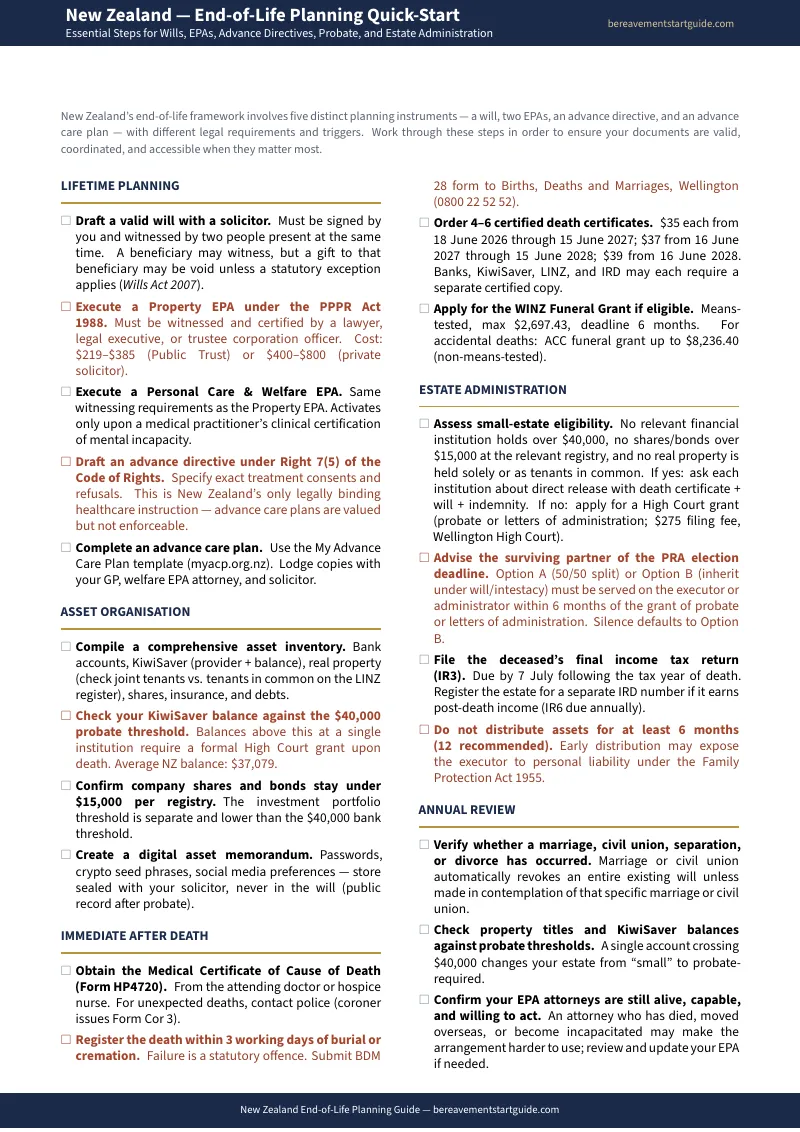
- Quick-Start Checklist (2 pages) — 20 action items in priority order, designed to be worked through in a single sitting
- Estate File Organiser — fillable inventory for every asset class, liability, and key contact your executor will need
- Executor's First-Week Action Log — day-by-day checklist with space for dates, contacts, and reference numbers
- Probate Document Tracker — filing checklist for a High Court probate application, with registry correspondence log
- PRA Election Worksheet — side-by-side Option A vs. Option B calculation for the surviving partner's Property (Relationships) Act election
- Annual Review Checklist — yearly trigger checklist for events that invalidate documents or change probate requirements
- Family Conversation Starters — three structured meeting agendas for talking to aging parents, planning with your partner, and briefing adult children
- Digital Asset Inventory — secure memorandum template for passwords, cryptocurrency, social media, and subscriptions
- Property Title Worksheet — decision flowchart for determining whether each property bypasses probate or requires a formal grant
All files are yours to keep permanently. No subscription, no recurring fees, no upsell to a premium tier.
Satisfaction Guarantee
If the guide does not help you organise your end-of-life plan more clearly, email us at any time for a full refund. No forms, no justification required.
Start Planning Today
Download the free checklist to see the planning sequence at a glance. When you are ready for the full framework — the statute-by-statute guidance, the threshold calculations, the Māori land succession rules, and the step-by-step administrative playbook — the complete guide is waiting for you at .
Frequently Asked Questions
What if the rules change after I buy?
We update the guide when the rules change. Email us any time, even years later, and we'll send you the current edition free.