Your Parent Can't Sign. The Bank Won't Talk to You. The Court Will Take Months.
You thought you had time. Your mother was still sharp, still driving, still managing her own checkbook. Then the fall happened — or the diagnosis — and suddenly you need access to accounts she never added your name to, authority over a house you don't own, and the ability to make decisions she can no longer make for herself.
Without a valid power of attorney, your only option in New Hampshire is guardianship under RSA 464-A. That means filing a petition with the Probate Division of the Circuit Court, hiring an attorney, waiting for a hearing, and accepting whatever the judge decides — including appointing someone your family didn't choose. It's public, adversarial, and routinely costs $3,000 to $5,000 or more.
A durable power of attorney prevents all of this. But only if it's executed correctly — and "correctly" in New Hampshire means navigating the Uniform Power of Attorney Act (RSA 564-E), a statute with mandatory disclosure requirements, agent acknowledgment rules, and execution traps that can void your document before you ever need it.
The New Hampshire Statutory Compliance System
This isn't a blank form with a "fill in the blanks" instruction sheet. The New Hampshire Power of Attorney Kit is a step-by-step compliance system built around the specific requirements of RSA 564-E and RSA 137-J — the two statutes that govern every financial and healthcare POA executed in this state.
National form vendors like Nolo or eForms give you a generic template and call it done. They don't mention that New Hampshire requires a mandatory statutory disclosure statement attached to every general financial POA. They don't explain the separate agent acknowledgment that must be signed before your agent can legally act. And when your bank rejects the document, their help page can't cite the New Hampshire statute that forces acceptance within seven business days.
This kit fills every gap between a downloaded form and a legally airtight document that institutions actually honor.
What You Get
- 39-page guide covering both financial POA and healthcare advance directive — Chapter-by-chapter walkthrough of RSA 564-E and RSA 137-J, written in plain English with the statute references elder law attorneys charge $300+ per hour to explain
- Mandatory disclosure and agent acknowledgment walkthrough — Under RSA 564-E:105, your financial POA must include a signed statutory disclosure statement. Under RSA 564-E:301, your agent must sign a separate acknowledgment before acting. Skip either document and the POA is void. The kit walks you through both, step by step
- Bank acceptance compliance memo (RSA 564-E:120) — Banks routinely refuse POA documents. New Hampshire law gives them only seven business days to accept or request a certification. If they wrongfully reject, they're liable for your court costs and attorney's fees. The kit includes a ready-to-hand compliance memo citing the exact statutory penalties
- Dual-document coverage: financial POA + healthcare advance directive — New Hampshire strictly separates these powers. Your financial agent has no authority over medical decisions; your healthcare proxy has no authority over banking. The kit covers both RSA 564-E and RSA 137-J so you're not left half-protected
- Springing vs. immediate POA analysis (RSA 564-E:109) — A springing POA stays dormant until a triggering event (usually physician certification of incapacity). The guide explains why springing documents create dangerous transaction delays and when an immediate durable POA with built-in safeguards is the better choice
- Multi-county real estate recording guide — New Hampshire land records are maintained at the county level. If your family owns a home in Hillsborough County and a vacation property in Belknap County, the POA must be recorded at each county registry of deeds. The guide covers the recording process, title company requirements, and the no-electronic-signature rule under RSA 477:9
- Medicaid estate recovery protection — New Hampshire's DHHS recovers from both probate and non-probate assets under RSA 167:14-a, including joint tenancies, life estates, and revocable living trusts. The guide covers how a properly drafted financial POA enables protective asset transfers before the 60-month lookback period
- Agent fiduciary duties and accountability — Fiduciary obligations under RSA 564-E:114, the family petition process to compel accounting under RSA 564-E:116, how to disable default gift-making powers, and how to set up reporting requirements that prevent abuse
- Revocation protocol — Executing a new POA doesn't automatically cancel the old one at every institution. The guide covers written revocation requirements, notification procedures for banks and healthcare facilities, and re-recording at county registries
The Free Checklist vs. the Full Kit
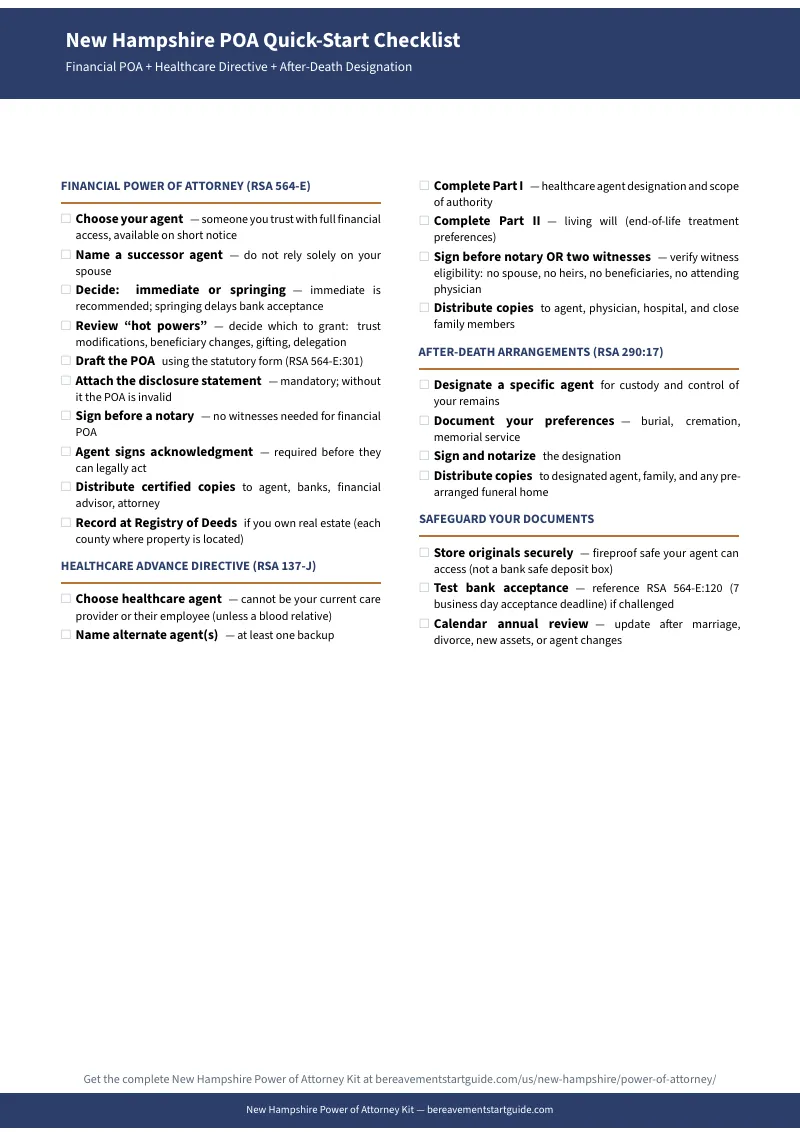
The free New Hampshire POA Quick-Start Checklist gives you a one-page overview of what's required — who can serve as agent, notarization rules, and the basic execution steps. It's a solid starting point if you're just getting oriented.
The full kit includes 9 PDFs: the 39-page guide, the printable bank acceptance compliance memo, a step-by-step execution checklist for all three documents, an agent duties reference card, a Medicaid estate recovery reference, county recording fees, official forms and court filing fees, and a key contacts card. If you're doing this without an attorney, the full kit is where the real protection lives.
Who This Is For
- Retirees who moved to New Hampshire for the tax-friendly environment and need POA documents that Granite State banks and title companies will actually accept
- Adult children managing an aging parent's healthcare or finances — especially families trying to avoid guardianship, which is the only alternative when no POA exists
- Families planning for Medicaid long-term care who need an agent authorized to execute protective trust transfers before the five-year lookback period closes the window
- Real estate investors with properties across multiple New Hampshire counties who need a POA properly recorded at each county registry of deeds
- Anyone who tried the free court forms and discovered that blank PDFs with no instructions — and no mention of the mandatory disclosure statement or agent acknowledgment — are a trap waiting to invalidate their document
Why Not Free Templates?
Free statutory form PDFs from courts.nh.gov and national form sites give you the document itself. What they don't give you:
- The mandatory statutory disclosure statement and agent acknowledgment — required by RSA 564-E:105 and RSA 564-E:301, but not bundled with free forms. Miss either one and the document is void
- A bank acceptance strategy — when TD Bank or a local credit union refuses your POA, a free template has no answer. This kit cites the statute that makes them liable for your attorney's fees
- Multi-county recording instructions — free forms don't explain that title companies require the POA recorded at each county registry where you own property
- Medicaid planning context — free forms don't explain New Hampshire's expanded estate recovery definition or how your POA decisions today affect asset protection five years from now
An elder law attorney in New Hampshire charges $300 to $500 per hour. A basic POA package runs $1,000 or more. This kit gives you the compliance framework attorneys use, at a fraction of the professional fee.
Satisfaction Guarantee
If the kit doesn't give you what you need, email hello@bereavementstartguide.com and we'll make it right.
— Less Than One Hour of Attorney Time
Get the New Hampshire Power of Attorney Kit →
Or start with the free New Hampshire POA Quick-Start Checklist — no payment required.
Frequently Asked Questions
What if the rules change after I buy?
We update the guide when the rules change. Email us any time, even years later, and we'll send you the current edition free.