New Mexico Makes It Easy to Sign. Hospitals Make It Hard to Honor.
Under the Uniform Health-Care Decisions Act (NMSA 1978 § 24-7A-2), your advance directive only needs your signature. No witnesses. No notary. One of the lowest bars in the country.
But try handing that unwitnessed piece of paper to a risk-management desk at Presbyterian, Lovelace, or UNM Health during a crisis admission. Clinical staff routinely reject documents they cannot independently verify — especially when family members disagree and the patient cannot speak. The law says "signature only." The hospital says "prove it."
The New Mexico Advance Directive & Living Will Kit is a Clinical Compliance System — the step-by-step framework that takes you from blank forms to legally valid, clinically bulletproof New Mexico healthcare directives, coordinated with MOST orders, estate transfer tools, and Medicaid recovery protections. No attorney. No subscription. No rejection at the registration desk because your documents were not executed to clinical standards.
— Less Than 10 Minutes with an Albuquerque Elder Law Attorney
New Mexico elder law firms charge $2,000–$4,500 for a comprehensive estate planning package. Even a standalone advance directive runs $300–$750, with weeks of scheduling. And most engagement letters do not include guidance on coordinating your healthcare directive with the TODD that bypasses probate or the Medicaid recovery protections that keep your home in the family.
The kit covers everything the attorney would — plus the clinical coordination, MAID clarification, and tribal sovereignty guidance most firms save for the expensive engagement — for a one-time download.
What the Kit Covers
- Healthcare Agent Designation (UHCDA) — New Mexico's healthcare proxy under the Uniform Health-Care Decisions Act. Who is legally barred from serving as your agent (owners, operators, or employees of a healthcare institution where you receive care — unless related by blood, marriage, or adoption), how to name successor agents, and how to set clear boundaries on your agent's authority
- The Compliance Paradox — why a signature is the legal minimum but not the clinical standard. The kit explains the combined execution approach (signature plus two disinterested witnesses plus notary acknowledgment) that ensures your document is honored at any emergency room, medical desk, or out-of-state facility. It also covers Remote Online Notarization, which New Mexico fully authorizes
- Living Will and Treatment Instructions — how to document specific preferences for terminal conditions, permanent unconsciousness, and progressive cognitive decline. Covers artificial nutrition and hydration, ventilator and CPR decisions, pain management directives, and the critical distinction between comfort care and curative treatment
- Dementia-Specific Provisions — standard advance directives assume competence or unconsciousness. Dementia is neither. The kit walks through documenting your preferences for the long middle — cognitive decline thresholds, residential care preferences, and when your agent should begin making decisions
- MOST and EMS DNR Coordination — New Mexico does not use the term POLST. The state uses the MOST (Medical Orders for Scope of Treatment), a clinical medical order covering CPR, intubation, antibiotics, and tube feeding across all care settings. A separate EMS DNR on green cardstock covers prehospital resuscitation only. Checking "Do Not Resuscitate" in a living will does not stop paramedics. The kit explains when you need each document and how they interact
- Elizabeth Whitefield End-of-Life Options Act (Medical Aid in Dying) — since June 2021, New Mexico allows MAID for terminally ill, mentally capable adults. The critical boundary: MAID cannot be requested through an advance directive or by a healthcare proxy. Only the patient — with full mental capacity — can initiate the process. The kit clarifies this distinction and explains how to plan early conversations with your physician
- Default Surrogate Hierarchy and the Even-Split Trap — without a designated agent, New Mexico assigns a default decision-maker from a rigid statutory list. If multiple members of an equal-priority class (such as three adult children) split evenly, the entire class is disqualified. Every class below them is disqualified too. The hospital makes the call, or a judge does. The kit explains exactly how this deadlock works
- Community Property Coordination — New Mexico is a community property state. The kit explains how community property rules interact with your advance directive, beneficiary designations, and estate transfer tools — including what happens to jointly owned property when one spouse becomes incapacitated
- Transfer on Death Deeds (TODDs) — New Mexico's Uniform Real Property Transfer on Death Act lets you transfer your home outside probate, revocable during your lifetime. But a TODD does not protect your home from Medicaid estate recovery. The kit explains why, and what additional steps are needed
- Medicaid Estate Recovery Protection — New Mexico Medicaid pursues estate recovery against non-probate assets under stepped-up recovery procedures. A TODD alone is not enough. The kit explains how Medicaid recovery works in New Mexico, the limits of TODDs, and when you need specialized elder-law counsel
- Tribal Sovereignty and Jurisdictional Guidance — New Mexico is home to 23 sovereign Native American tribes, pueblos, and nations. Planning on tribal land involves navigating tribal court jurisdictions, federal trust property rules under AIPRA, and cultural considerations. The kit provides guidance and connects you with DNA People's Legal Services and the UNM Southwest Indian Law Clinic
- Revocation and Update System — how to revoke an existing directive under § 24-7A-4, including the critical exception when the principal cannot physically sign (requiring two witnesses who must sign in each other's presence). When to update, how to notify document holders, and how to destroy outdated copies
Who This Is For
- Retirees who just moved to New Mexico and need to replace out-of-state directives with documents that local EMS crews, rural clinics, and hospital systems immediately recognize — even though New Mexico provides reciprocity, unfamiliar formatting creates real friction
- Adult children protecting aging parents whose healthcare decisions will fall to the default surrogate hierarchy — where sibling disagreement triggers the even-split disqualification and strips the entire family of decision-making authority
- Anyone who downloaded a free form and got stuck on execution requirements, witness eligibility rules, and the difference between a legal advance directive and a clinical MOST order
- Unmarried or domestic partners whose relationship may not survive the statutory definition of "long-term" and "indefinite duration" if a family member disputes it at the hospital
- People facing surgery or a serious diagnosis who need a legally valid, clinically accepted New Mexico directive completed before their appointment — not a generic form signed under pressure during intake
- Families trying to protect their home from Medicaid recovery who discovered that a Transfer on Death Deed alone is not enough in New Mexico — the state pursues non-probate assets
Why Not Just Use the Free Form?
The state's optional statutory form is a fill-in-the-blank template with no explanatory context. It does not guide you through witness selection, dementia provisions, MOST coordination, the MAID boundary, or the difference between a legal advance directive and a clinical medical order. CaringInfo's free eight-page packet covers the basics but misses community property rules, Medicaid recovery, TODD limitations, and tribal sovereignty. LegalZoom and Rocket Lawyer charge $39–$149+ with auto-renewing subscriptions and do not cover New Mexico's MOST form (they may call it POLST), the even-split disqualification, or the TODD-Medicaid trap.
Free resources give you the blank form. The kit gives you the Clinical Compliance System — witness eligibility guidance, clinical execution strategy, MOST/DNR coordination, MAID clarification, dementia provisions, community property rules, TODD instructions, Medicaid recovery protection, tribal sovereignty guidance, and a 20-item checklist that tracks every step.
The Guarantee
If your physician, hospital, county clerk, or notary rejects the instructions in this kit for any compliance reason, email us for an immediate, no-questions-asked refund.
Start Today
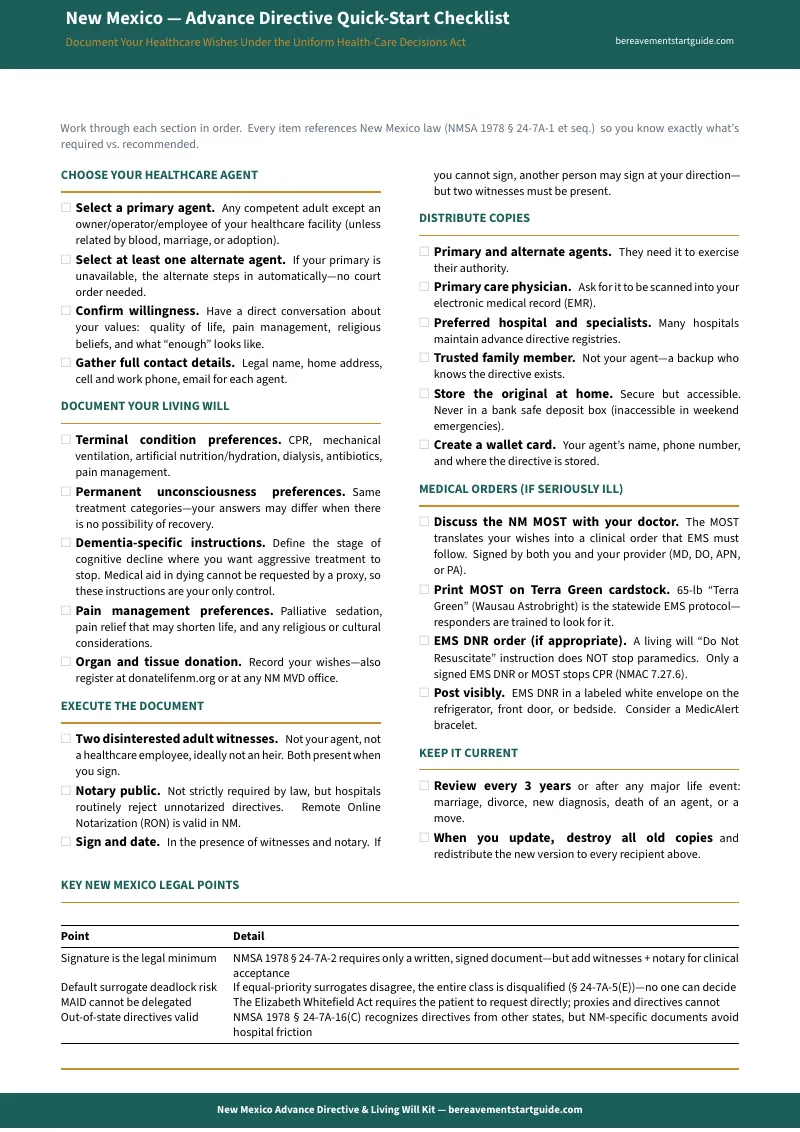
Download the free New Mexico Advance Directive Quick-Start Checklist to see every critical step at a glance. When you are ready for the full Clinical Compliance System — the 12-chapter guide, 7 standalone printable worksheets and reference sheets (treatment preferences, agent selection, witness eligibility, MOST/EMS DNR reference, document distribution tracker, fee/timeline/contacts, Medicaid recovery reference), plus the complete 20-item checklist — the complete kit is available for .
Disclaimer: Bereavement Start Guide is a publisher of self-help educational templates and resource guides. The materials in this kit are designed to comply with New Mexico statutory law but do not constitute legal or medical advice. For complex estate planning, contested family dynamics, or specific medical instructions, consult a licensed New Mexico attorney or healthcare provider.