You Have Days. The Ritual Calendar Has Centuries of Expectations.
A death in Japan triggers a cascade of obligations that move faster than grief allows. Within the first 24 hours, you need a cremation permit, a funeral director, a temple priest, and a chief mourner — and every decision you make in that window determines the cost, the family peace, and the spiritual integrity of the entire process.
The problem is not that information doesn't exist. It is that the information is scattered across sectarian temple websites written in archaic Japanese, commercial funeral portals designed to upsell you, and Reddit threads full of confidently wrong advice about which hand to use for incense.
This guide is a Consolidated Funeral Navigation System — a single, structured workflow that walks you through the entire process from the moment of death to the 33rd-year memorial service, in the order you will actually face each decision.
What the Guide Covers
- First-hours protocol — the exact sequence from matsugo no mizu (water of the last moment) through body preparation, death certificate filing, and cremation permit acquisition, with document timelines and municipal office procedures
- Rokuyō calendar navigation — how the traditional six-day fortune cycle determines when you can schedule the wake, funeral, and cremation, and what to do when tomobiki shuts down the crematorium
- Body preparation and sacred taboos — shinishōzoku dressing (why the kimono folds left-over-right), kitamakura head orientation, kamidana-fūji shrine sealing, and the sakasagoto inversion rules that reverse daily customs for the dead
- Wake and farewell service — otsuya vigil structure, shōkō incense offering step-by-step, kokubetsu-shiki farewell ceremony, and coffin placement procedures
- Kotsuage bone-picking ceremony — the anatomical sequence (feet to skull), the dual-material chopsticks, the nodobotoke placement, and how to prepare family members who have never seen anything beyond fine Western-style ash
- Kaimyō posthumous name system — how the ranking hierarchy works across six major sects (Soto Zen, Rinzai, Jōdo Shū, Jōdo Shinshū, Shingon, Nichiren), what each rank costs, and a framework for negotiating with the temple priest transparently
- Cost control — two fully worked examples (traditional ceremony at ¥1,850,000 and family-only service at ¥740,000), funeral director negotiation scripts, and how to claim the government's funeral subsidy (sōsai-hi, up to ¥70,000 depending on the municipality)
- 49-day memorial cycle — the weekly service schedule from shō-nanoka through shijūkunichi, when to replace the plain wood ihai with the permanent lacquered tablet, and when the ashes are formally interred
- Long-term memorial calendar — Obon/hatsubon protocols, annual hōji services, and the full schedule through the 33rd-year tōiage ceremony that closes the mourning arc
- Diaspora and interfaith logistics — international ash transport regulations, TSA-compliant urn materials, Australian quarantine restrictions, interfaith participation etiquette, and how to set up a proper home altar when you cannot be in Japan
Who This Is For
- Secular Japanese families who have lost connection with the traditional danka temple system and need to plan a funeral without a lifetime of community knowledge to draw on
- Diaspora relatives coordinating from outside Japan — managing the seven-day filing deadline, the koseki update, and international ash transport from across the Pacific
- Interfaith spouses navigating in-law expectations around Buddhist ancestor veneration, kaimyō, and temple obligations they may not share
- Professional planners and celebrants who need a consolidated, English-language procedural reference for Japanese Buddhist mortuary protocols
Why Free Tools Fall Short
Municipal and consular websites give you the legal steps — file the shibō todoke, get the cremation permit — but they tell you nothing about the cultural context. You will know you need a cremation permit but not that the crematorium is closed on tomobiki. You will know the body needs to be moved but not that it should face north or west.
Commercial funeral portals walk you through their package options but are designed to upsell. The "standard" package includes a premium hinoki coffin you could replace with kiri wood at half the cost, and the "recommended" kaimyō rank comes with a priest donation that might exceed the family's entire funeral budget.
Expat forums and Reddit threads provide fragments of genuine experience — someone found mofuku at Uniqlo, someone else's temple charged ¥500,000 for a two-character name — but they are unverified, contradictory, and full of errors that would cause real social damage, like confusing Shinto purification claps with Buddhist gasshō.
This guide sits in the gap between all three: a single consolidated workflow that covers the cultural, spiritual, legal, and financial dimensions together, verified against sectarian sources and structured in the order you actually face each decision.
What You Get
The complete guide is a printable PDF — designed to be used offline, handed to different family members so everyone has clear instructions for their role, and brought to the funeral director negotiation as an independent reference. The package includes:
- The full guide — 14 chapters covering every stage from the first bedside rite to the 33rd-year memorial
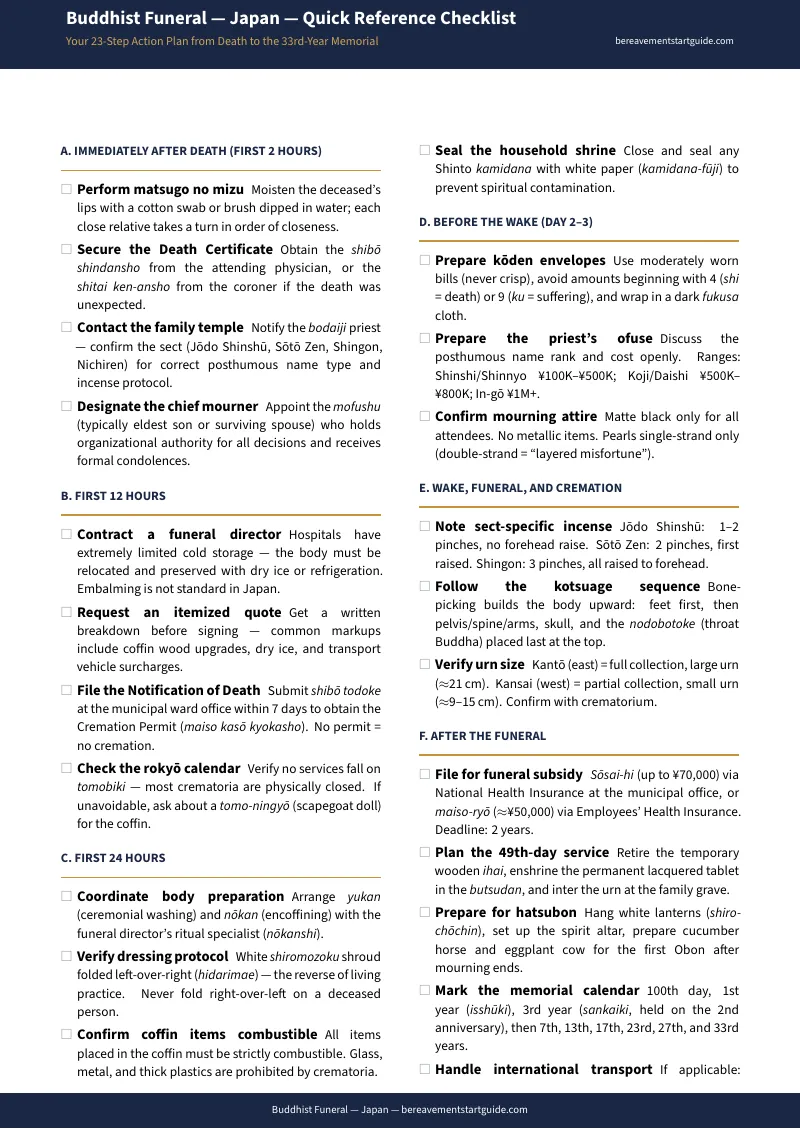
- Quick-reference checklist — 23 action items in chronological order for the first week
- First 48-hour action checklist — timeline-based task sheet with space to assign responsibilities across family members
- Funeral director comparison worksheet — side-by-side form for evaluating itemized quotes
- Kōden registry and thank-you tracker — log for every condolence contribution with return-gift tracking
- Memorial service calendar — pre-formatted calendar from the 7th-day service through the 33rd-year tōiage
- Agency communication log — record every call, email, and office visit with reference numbers for follow-up
Satisfaction Guarantee
If the guide does not help you plan the funeral with more clarity and less unnecessary cost, email us and we will refund your purchase — no questions, no forms, no waiting period.
Start Planning With Confidence
Download the free checklist to see the task sequence at a glance. When you are ready for the full guide — with the kaimyō negotiation framework, the worked cost examples, the kotsuage preparation chapter, and the complete memorial calendar — get the complete toolkit from your landing page.