New Mexico Is a Community Property State. Most DIY Estate Plans Treat It Like a Common-Law One.
Every asset acquired during your marriage belongs equally to both spouses — regardless of whose name is on the title. Your separate property follows different rules entirely. And when these two categories get confused in a will, the result isn't a minor oversight. It's a probate dispute that drags your family through court for months.
This is the kind of mistake that generic online templates create. They don't know that New Mexico is one of only nine community property states. They don't know about the homestead affidavit that lets a surviving spouse transfer a home under $500,000 without probate. They don't know that the state's "probate-only" Medicaid recovery rule means a recorded Transfer on Death Deed can protect your family home from the Health Care Authority entirely.
Each of these rules has a specific document that activates it. The problem is knowing which ones apply to your situation and getting them executed correctly under New Mexico law.
The New Mexico Estate Protection System
The New Mexico Basic Estate Planning Kit is a structured walkthrough of every document and decision that determines whether your family handles your estate in a weekend or fights through it for a year.
This isn't a stack of blank court forms. It's a complete system: which documents to prepare, in what order, how they interact, and the New Mexico-specific execution rules that make or break each one. Your will coordinates with your beneficiary designations. Your power of attorney works alongside your advance directive. Your Transfer on Death Deed gets recorded correctly on the first filing with the county clerk. And every chapter explains the community property implications that generic templates miss.
What You Get — 11 PDFs
- Complete Estate Planning Guide (13 chapters + 2 appendices) — covers community property rules, will execution under NMSA 45-2-502, probate avoidance strategies (TODDs, POD/TOD accounts, joint tenancy, homestead affidavit), revocable trusts, powers of attorney, healthcare directives with Elizabeth Whitefield End-of-Life Options Act coverage, RUFADAA digital asset framework, Medicaid estate recovery protection, property tax valuation caps, disposition of remains, probate administration, Native American land considerations, and a step-by-step action plan.
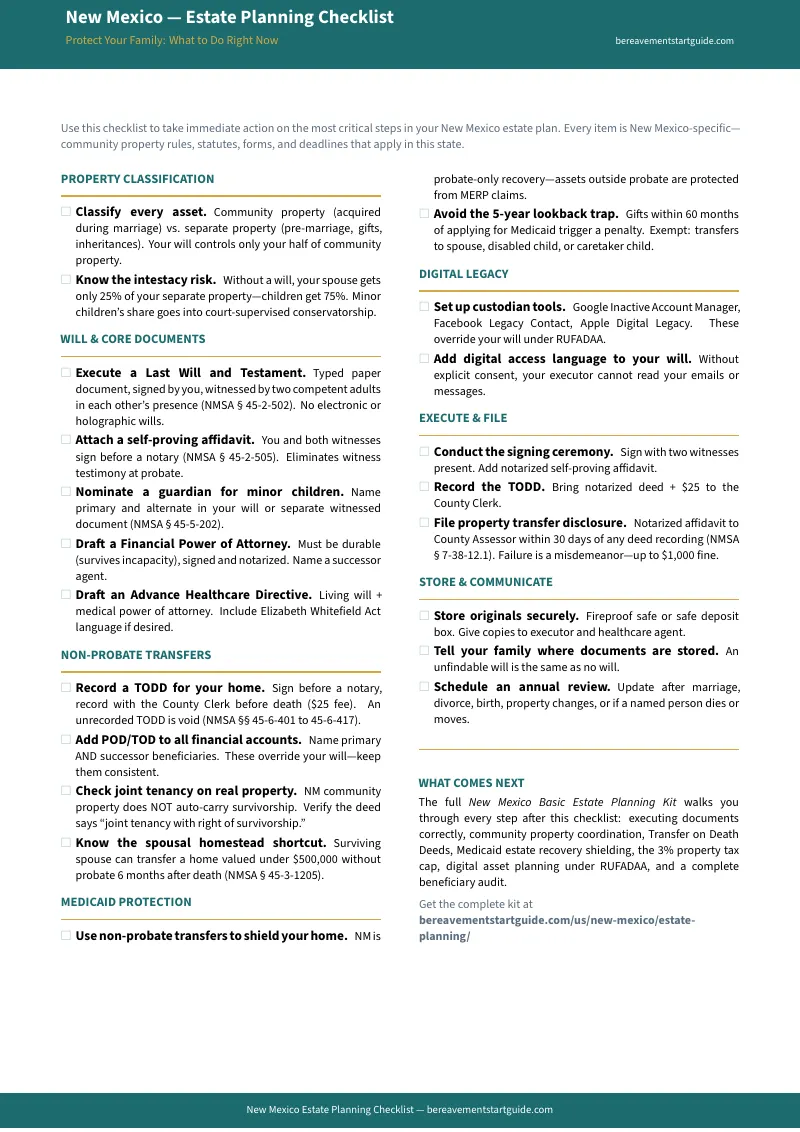
- Quick-Start Checklist — every document and deadline in priority order with New Mexico-specific thresholds that determine which steps apply to your situation. Print it, work through it, check things off.
- 9 standalone printable worksheets and reference cards:
- Asset Inventory Worksheet — classify every asset as community or separate property
- Community Property Worksheet — identify what you can leave in your will and what you cannot
- Probate Avoidance Decision Tree — which bypass tool to use for each asset type
- Transfer on Death Deed Recording Guide — step-by-step TODD filing with county clerk instructions
- Document Execution Checklist — signing requirements for every document, designed for your notary appointment
- Medicaid Estate Recovery Protection Reference — the probate-only rule, exempt transfers, and key thresholds
- Digital Asset Inventory — catalog your online accounts for your executor under RUFADAA
- Statutory Thresholds Reference — every dollar amount, deadline, and filing fee on one page
- Official Forms Reference — where to find every NM court and agency form you need
New Mexico-Specific Coverage You Won't Find Elsewhere
- Community property classification — how to identify which assets are community property and which are separate, how the distinction affects your will, and why blended families need extra care under New Mexico's intestacy rules
- Transfer on Death Deed filing — NMSA 45-6-416 requirements, county clerk recording procedures, the 120-hour survival rule, and the one-year creditor claim period that can delay a sale
- The Medicaid protection strategy — New Mexico's "probate-only" estate recovery definition means properly recorded TODDs and POD accounts shield assets from Health Care Authority claims, unlike most other states
- Self-proving affidavit execution — NMSA 45-2-504 requirements, when and where to get the notarized affidavit that keeps your family from tracking down witnesses during probate
- The homestead affidavit shortcut — how a surviving spouse can transfer a primary residence valued under $500,000 without probate under NMSA 45-3-1205, with the six-month waiting period explained
- Small estate threshold — when your remaining probate assets are under $50,000 in personal property, your heirs can skip probate entirely using an Affidavit of Successor in Interest under NMSA 45-3-1201
- Elizabeth Whitefield Act coverage — how New Mexico's 2021 medical aid-in-dying law interacts with advance healthcare directives, and what patients and families need to document
- Native American land chapter — clear guidance on AIPRA-compliant wills for trust and restricted lands, the BIA/OHA probate process, anti-fractionation planning, and which kit documents apply to fee-simple versus trust-held property
- RUFADAA digital assets — the three-tier consent hierarchy for digital accounts, how to authorize executor access without violating federal privacy law, and the electronic communications trap
Who This Is Built For
- Homeowners in Albuquerque, Las Cruces, Santa Fe, and Rio Rancho who want to keep their property out of probate using a Transfer on Death Deed — and need the county recording instructions that work on the first filing
- Married couples navigating community property rules who need to know exactly how their estate splits between the surviving spouse and children — especially blended families where intestacy creates unintended distributions
- Adult children helping aging parents get powers of attorney signed while they still have mental capacity — because once capacity is lost, the path leads through conservatorship court
- Families approaching Medicaid eligibility who need to understand how non-probate transfers protect the family home from Centennial Care estate recovery claims
- Native American residents who need clear guidance on which estate planning tools apply to personal property and fee-simple land versus trust-held or restricted tribal lands
- Parents who need to name guardians for minor children and set up basic protections before the next life milestone
- Out-of-state transplants who moved to New Mexico and need to know which parts of their existing estate plan still work under community property rules
Why Not Just Use the Free Court Forms?
New Mexico's judiciary website offers raw probate administration forms and a Guide & File system. The State Bar publishes free pamphlets. The Senior Citizens Law Office provides reduced-fee wills for residents over 60.
Here's the problem: the court provides post-death probate forms, not pre-death planning documents. The free pamphlets are informational — no fillable templates, no step-by-step execution guidance. And when you call the court clerk's office and ask how to fill out a form, you'll hear the same answer: "We're legally prohibited from giving legal advice."
The free resources don't explain how community property rules affect your will. They don't warn you about the one-year creditor claim period on Transfer on Death Deeds. They don't cover the Medicaid estate recovery gap. And they definitely don't tell you when your estate is simple enough to skip probate entirely.
The state provides the pieces. The kit shows you how they fit together — and which ones you can skip.
Why Not Hire a Local Attorney?
For straightforward estates, there's a real question of whether $1,000 to $4,500 in attorney fees is worth it. Local firms charge $300 to $750 for a simple will. Walk-In Wills in Albuquerque charges $595 for an individual will, $199 for a Transfer on Death Deed, and $250 for a mobile visit. The Senior Citizens Law Office charges $350 for wills — but only for residents aged 60 and over.
The kit doesn't replace an attorney for complex situations — and it tells you exactly when you need one (multi-state real estate, business succession, taxable estates, contested family dynamics, or irrevocable trust planning for Medicaid asset protection). But for the vast majority of New Mexico families with a home, some retirement accounts, and minor children, the kit covers every document and decision point.
And if you do hire an attorney later, the completed worksheets become your intake package — saving hours of billable time.
— Less Than One Consultation Fee
Walk-In Wills charges $595 for a simple will. Hernandez Law starts at $1,000 for a trust package. National DIY platforms like Trust & Will charge $199 for a will, then $19 to $49 per year in subscription fees to keep access to your own documents.
One-time purchase. No subscriptions, no annual renewal fees, no paywall between you and your own estate plan.
30-Day Money-Back Guarantee
Download the kit, review the guide and checklists. If the plain-English instructions don't clarify the exact steps needed to protect your family under New Mexico law, email us within 30 days for an immediate, full refund. No questions asked.
Important notice: Bereavement Start Guide is a publisher of educational resources. This kit assists individuals in organizing their estate affairs and completing standard statutory forms. It does not provide personalized legal, financial, or tax advice, does not act as a law firm, and does not establish an attorney-client relationship. For complex assets, multi-state property, or custom trust structures, consultation with a licensed New Mexico attorney is recommended.