Your Mother Was Diagnosed with Dementia Last Month. The Bank Just Told You That You Cannot Access Her Accounts. You Are One Missing Document Away from a Courtroom.
You watched it happen gradually — the forgotten appointments, the repeated questions, the bills piling up unopened on the counter. Then the diagnosis came, and suddenly you are the one everyone is looking at. Her checking account needs to pay the mortgage. Her insurance company needs someone to authorize treatment. The assisted living facility needs financial documentation you cannot produce because the bank says you have no legal authority to access her accounts — even though you are her daughter, even though you live in the same city, even though she asked you to handle this months ago.
Without a valid power of attorney, that conversation means nothing. New Mexico law does not recognize verbal agreements, family relationships, or good intentions as legal authority over another person's finances or medical decisions. The only path left is conservatorship — filing a petition in District Court, paying for a court-appointed visitor, a Guardian ad Litem, medical testimony, and a judge's supervision over every financial decision you make on her behalf. The filing fee alone is $117. Attorney fees for conservatorship in New Mexico typically run $2,000 to $4,500. And the process takes months while her bills go unpaid.
But here is what most families do not realize until it is too late: a power of attorney can only be signed while the principal is still mentally competent. Once your mother, your father, or your spouse can no longer understand the nature and consequences of the document, the window has closed permanently. There is no retroactive fix. There is no emergency POA. There is only the courtroom.
The New Mexico Power of Attorney Kit is a Legal Authority Blueprint — a complete, step-by-step system for creating, executing, and enforcing both financial and healthcare powers of attorney under New Mexico's specific statutes. Not a blank form you found on a government website. Not a generic national template that does not know the difference between a community property state and a common law state. A New Mexico-specific kit that covers the rules, deadlines, and procedures that make this state different from every other state in the country.
What's Inside the Legal Authority Blueprint
A 14-chapter guide, the POA Quick-Start Checklist, and 11 standalone printable worksheets — covering every stage from choosing your agent through bank presentation, county recording, and Medicaid planning, built specifically for New Mexico statutes and the unique legal features that make planning here different:
Why New Mexico Is Different — and Why National Templates Get It Wrong
New Mexico is a community property state. It is also one of the few states where all financial powers of attorney are durable by default — meaning they automatically survive your incapacity unless you explicitly state otherwise. And it is one of only eleven states with a medical aid-in-dying law, the Elizabeth Whitefield End-of-Life Options Act, which creates a legal boundary between what your healthcare agent can and cannot do. National document builders like LegalZoom skip all three of these features. The guide opens by explaining exactly what makes New Mexico different and why those differences matter for your family.
Choosing Your Agent — The Most Important Decision
Your agent will have legal authority to access your bank accounts, sell your home, pay your bills, and manage your investments. Under NMSA 1978 § 45-5B-114, they are bound by strict fiduciary duties — including maintaining separate property records, avoiding conflicts of interest, and acting in your best interest at all times. The guide includes a structured agent selection worksheet that evaluates trustworthiness, financial literacy, geographic proximity, and willingness to serve, plus instructions for naming successor agents so your plan does not collapse if your primary agent is unable to act.
Financial Powers — What to Grant and What to Restrict
New Mexico's statutory form (NMSA 1978 § 45-5B-301) lists 16 categories of financial powers. You must initial each one you want to grant. Signing "all preceding subjects" without understanding what each category includes is the single most common estate planning mistake — it can give your agent unchecked authority to gift your property, change your beneficiaries, or create trusts. The guide walks through every category with plain-language explanations, real-world examples of when each power matters, and specific warnings about the powers most frequently involved in financial exploitation cases.
Healthcare Directives — Living Wills and the End-of-Life Options Act
New Mexico does not have a standalone "medical power of attorney." Instead, healthcare decisions are governed by the Uniform Health-Care Decisions Act (NMSA 1978 § 24-7A-1 et seq.), which combines the appointment of a healthcare agent with living will instructions in a single Advance Health-Care Directive. The guide covers what your healthcare agent can decide — including surgery, treatment withdrawal, hospice care, and organ donation — and what they cannot. Specifically, a healthcare agent cannot request or consent to medical aid in dying under the Elizabeth Whitefield Act. The patient must retain mental capacity and self-administer the medication.
Community Property Protection — Why Marriage Is Not Enough
If you and your spouse own a home together in New Mexico, you might assume that marriage gives either spouse the authority to manage it. It does not. Under NMSA 1978 § 40-3-13, both spouses must sign all deeds, mortgages, and contracts affecting community real property. If your spouse becomes incapacitated without a durable POA, you cannot sell the house, refinance the mortgage, or even modify the insurance policy. The guide explains exactly how a durable financial POA protects community property assets and prevents forced conservatorship.
Bank Presentation Strategy — Because Banks Refuse Valid POAs Every Day
Financial institutions routinely reject valid powers of attorney — sometimes because the document looks "unofficial," sometimes because the teller has never seen one, sometimes because the branch prefers its own in-house form. New Mexico law is on your side. Under NMSA 1978 § 45-5B-120, banks must accept a properly notarized statutory POA within seven business days. They cannot demand their own form. They cannot arbitrarily reject your agent. If they refuse, they face court-ordered acceptance and liability for attorney's fees. The kit includes a step-by-step bank presentation checklist and the statutory language your agent needs to assert their rights.
County Clerk Recording — The Step Most People Skip
If your POA will be used to manage real estate — selling a home, refinancing a mortgage, signing a lease — it must be recorded with the county clerk in the county where the property is located before the transaction occurs (NMSA 1978 § 47-1-7). An unrecorded POA will be rejected at closing. This is the step that free templates and national document builders never mention. The guide includes recording instructions, estimated fees, and contact details.
Medicaid Lookback Protection
New Mexico enforces a five-year lookback period for Medicaid long-term care eligibility. If your POA agent transfers property or gifts assets during that 60-month window for less than fair market value, the state applies a penalty period during which Medicaid will not pay for nursing home care. The guide explains the narrow exceptions — transfers to a spouse, a disabled child, or a caretaker child — and shows you how to draft POA powers that prevent your agent from accidentally triggering a Medicaid penalty.
Tribal Land Advisory — Jurisdictional Limits That Free Forms Never Explain
New Mexico is home to 23 federally recognized sovereign tribal communities. A standard New Mexico financial POA can manage off-reservation bank accounts, vehicles, and personal property. But it cannot convey, transfer, or encumber trust land on a reservation — those transactions must comply with tribal codes and federal trust regulations. The guide explains these jurisdictional boundaries, directs tribal members to specialized resources, and prevents families from creating false expectations about what a state POA can accomplish on sovereign lands.
Springing vs. Immediate — Choosing When Your POA Takes Effect
An immediate POA takes effect the moment you sign it. A springing POA activates only when two qualified healthcare professionals certify your incapacity in writing. Springing POAs offer more control, but they can cause dangerous delays in emergencies while your family waits for medical evaluations. The guide covers both options with decision frameworks so you can choose the right activation structure for your situation.
Revocation, Termination, and What Happens After Death
A power of attorney terminates automatically the moment the principal dies. Any transactions after death are void and can create legal liability. The guide covers how to revoke a POA properly — in writing, notarized, recorded with the county clerk if the original was — and what estate settlement tools replace the POA after death, including New Mexico's Transfer-on-Death Deeds and the $50,000 small estates threshold.
Who This Kit Is For
- The adult child whose parent was just diagnosed with dementia — who needs to get POA documents signed while their parent still has the mental capacity to execute them, before the only option left is a $2,000+ conservatorship proceeding in District Court
- The married couple who owns a home together — who assume community property means either spouse can manage everything, and who will discover the hard way that one spouse's incapacity freezes the other's ability to sell, refinance, or modify their family home without a durable POA
- The family caregiver managing an aging parent's bills — who has been paying the electric bill and handling insurance claims informally, but whose informal authority means nothing the moment a bank, a title company, or a government agency asks for legal documentation
- The self-directed planner who cannot justify attorney fees — who looked up local estate planning prices ($2,000–$4,500 for a full package, $225–$350 for a standalone POA) and needs a legally valid alternative that covers New Mexico's specific rules at a fraction of the cost
- The agent whose POA was refused at the bank — who was turned away by a teller who demanded the bank's own form, and who needs the statutory authority and step-by-step strategy to assert their rights under NMSA 1978 § 45-5B-120
- The family concerned about Medicaid planning — who needs to understand how POA powers interact with the five-year lookback period, how to avoid gifting penalties that disqualify their parent from nursing home coverage, and how to structure agent authority that protects rather than jeopardizes eligibility
Why Free Templates Will Not Protect Your Family
The blank statutory form is free on nmcourts.gov. You can download it right now. Here is what you get: a PDF with empty fields, no instructions, and no context. Here is what you do not get:
- No explanation of which powers to initial and which to restrict. The statutory form lists 16 categories of financial powers. Checking "all preceding subjects" without understanding each category opens the door to financial exploitation. The free form does not explain the difference between granting banking powers and granting gifting powers — or why that distinction can cost your family hundreds of thousands of dollars.
- No county recording instructions. If your POA will be used for real estate, it must be recorded with the county clerk before the transaction. The free form does not mention this requirement, does not list fees, and does not explain what happens when an unrecorded POA is rejected at a real estate closing.
- No bank presentation strategy. The free form does not include the statutory language that compels banks to accept your POA, does not explain the seven-day acceptance window, and does not give your agent a procedure for handling refusal. You get a form. You do not get a plan.
- No Medicaid lookback warnings. The free form does not explain how an overly broad financial POA can trigger asset transfer penalties that disqualify your parent from Medicaid coverage during the lookback period.
- No community property guidance. The free form does not explain that marriage alone does not authorize one spouse to manage the other's community property interests — or that a missing POA can force a family into conservatorship to manage their own home.
Free templates give you a blank form from a government website that cannot provide legal advice. The Legal Authority Blueprint puts every New Mexico-specific statute, procedure, deadline, and risk into one document, in the order you actually need them.
Satisfaction Guarantee
If the kit does not give you the clarity and confidence to create legally valid New Mexico powers of attorney, email us for a full refund. No time limit. No questions.
— Less Than a Single Hour of Attorney Time
A standalone power of attorney from a New Mexico estate planning attorney costs $225 to $350. A full estate planning package runs $2,000 to $4,500. The Legal Authority Blueprint covers both financial and healthcare powers of attorney, community property protections, bank presentation strategies, county recording procedures, Medicaid lookback guidance, and tribal land advisory — at a fraction of what a single attorney consultation would cost.
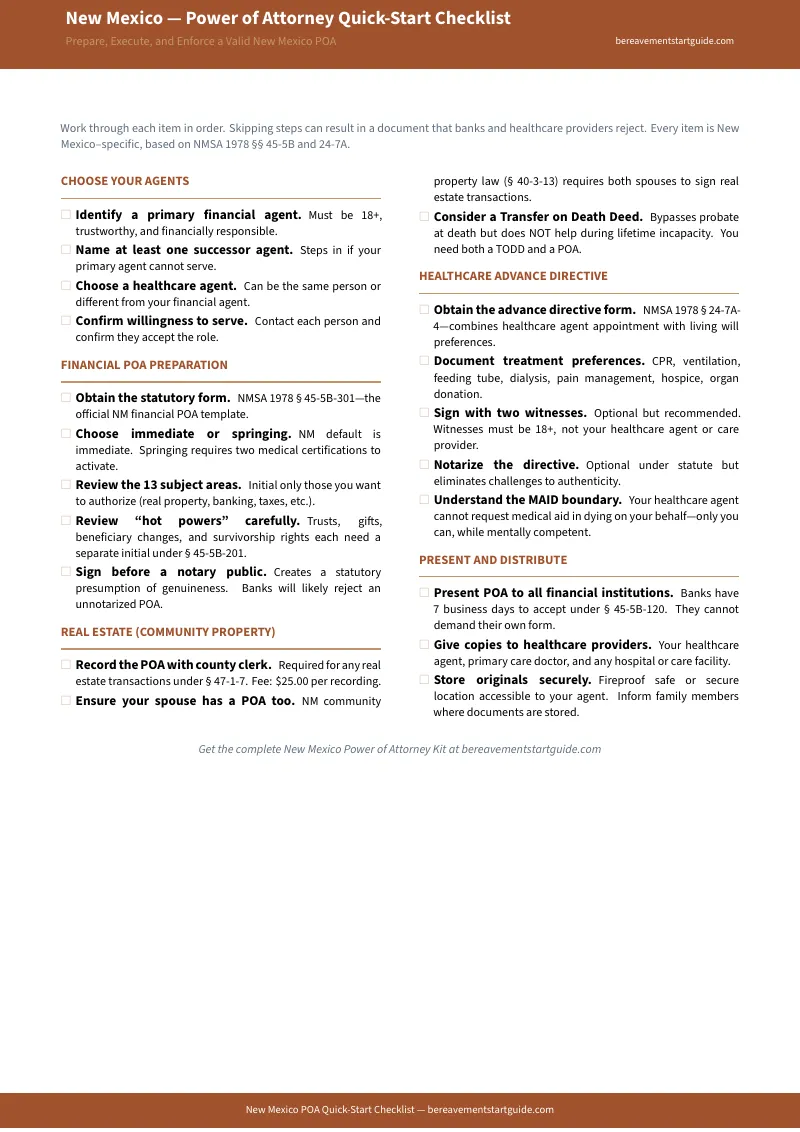
Download the free POA Quick-Start Checklist to see what is covered. When you are ready for the complete system, the full kit is waiting.