Your Family Can't Act Until the Document Works
Right now, somewhere in North Carolina, an adult child is standing at a bank counter being told their parent's power of attorney "doesn't meet our requirements." The teller can't explain what's wrong. The branch manager is unavailable. And the mortgage payment — or the nursing home deposit, or the property tax bill — is already past due.
The document was signed. It was notarized. It looked official. But something in the execution was wrong — the wrong witness category for a healthcare POA, a financial POA that wasn't recorded with the Register of Deeds before a real estate closing, or a springing clause that requires two physician certifications no bank will wait for.
North Carolina splits authority across two entirely separate statutory frameworks: Chapter 32C for financial decisions and Chapter 32A for healthcare decisions. Different statutes. Different witness rules. Different execution requirements. Get them confused — or worse, combine them into a single document like many national form providers suggest — and the resulting paperwork can fail at the exact moment your family needs it most.
The NC Compliance System — Built for Institutional Acceptance
The North Carolina Power of Attorney Kit is an execution system, not a form download. It walks you through both financial and healthcare authority as separate, properly executed documents — each with its own signing protocol, witness requirements, and institutional compliance tools — so that when your agent presents the paperwork to a bank, hospital, or Register of Deeds, it works the first time.
Every component is grounded in the specific North Carolina statutes that institutions actually check: Chapter 32C for financial powers, Chapter 32A for healthcare authority, § 47-28 for real estate recording, and § 32C-1-120 for bank acceptance enforcement. National form providers skip these details. Local attorneys charge $300–$2,500 to address them. This kit gives you the same statutory framework — without the billable hours.
What's Inside
Chapter 32C Durable Financial POA
A complete financial power of attorney built on North Carolina's Uniform Power of Attorney Act. "Hot powers" — gifting, trust creation, beneficiary changes, survivorship modifications — are disabled by default and only activated when you explicitly grant them. This prevents agent abuse while still allowing Medicaid planning, trust funding, and asset protection when needed.
Agent's Certification Form (§ 32C-1-119)
The statutory instrument your agent presents to a bank when they need to act on your behalf. This form triggers the mandatory 7-business-day acceptance window under § 32C-1-120 — and puts the institution on notice that refusing a compliant POA carries liability for your attorney's fees and court costs.
Healthcare POA + Living Will (Separate Documents)
North Carolina's Healthcare Power of Attorney (Chapter 32A) and Living Will (§ 90-321 Declaration of a Desire for a Natural Death) are kept as distinct documents — not combined. This prevents the clinical confusion that arises when a hospital has to determine whether the agent's real-time judgment or the document's static written directives take precedence in a crisis.
MOST Form Preparation Guide
Step-by-step instructions for working with your physician to complete the Medical Orders for Scope of Treatment — North Carolina's portable emergency medical order that EMS must follow on scene. Includes guidance on pink-paper printing for immediate visibility and how the MOST coordinates with (and can override) your existing healthcare POA and Living Will.
Register of Deeds Recording Guide
When your agent handles a real estate transaction, the POA must be recorded with the Register of Deeds in the property's county under § 47-28. This guide covers exact margin specifications (3-inch top margin on page one, ½-inch elsewhere), ink and font requirements, the $26 base filing fee, the $25 nonconforming document penalty, and multi-county filing procedures — so the document isn't bounced for a formatting technicality.
Bank Acceptance Toolkit
Pre-drafted demand language citing § 32C-1-120 and the Agent's Certification form. If a financial institution refuses or delays, your agent has the statutory tools to compel a response within seven business days — and to recover fees if the matter goes to court.
Agent Duties and Safeguards
Fiduciary obligations under Chapter 32C translated into plain-language guidance: record-keeping requirements, asset separation rules, co-agent and successor agent structures, and accounting frameworks that keep agent authority transparent and accountable.
Revocation Forms and Notification Templates
Clean termination of agent authority with delivery tracking — because a new POA doesn't automatically revoke an old one under North Carolina law unless you explicitly say so.
Medicaid Planning Overview
North Carolina uses probate-only estate recovery — assets that bypass probate are protected from NCDHHS recovery. This section explains how a properly authorized financial POA enables protective transfers (life estates, joint tenancy, trust funding) within the five-year look-back window, and when these strategies make sense for your family.
Who This Kit Is For
- Adult children setting up POA for aging parents before cognitive decline closes the window — and before a public incompetency hearing under Chapter 35A becomes the only option
- Pre-retirees and retirees who want financial and healthcare authority handled properly at a fraction of what a Charlotte or Raleigh estate planning firm charges
- Homeowners and real estate investors who need a recordable financial POA for property closings, especially when a co-owner cannot attend
- Couples planning for incapacity who want the surviving spouse protected against Year's Allowance and elective share complications
- Military families and anyone deploying out of state who need durable authority that survives distance
- Anyone facing surgery or a health crisis who wants healthcare directives and a MOST form conversation with their physician before the procedure
Why Not the Free nccourts.gov Forms?
The state provides blank PDF templates — no signing protocol, no witness disqualification guidance, no instructions for bank disputes, no recording specifications for the Register of Deeds. They don't tell you that financial POAs require notarization but not witnesses, while healthcare POAs require both. They don't explain that springing POAs are technically allowed but routinely rejected by banks. And they don't provide the Agent's Certification form that North Carolina law specifically created for resolving institutional pushback.
The forms themselves are free. The execution mistakes cost $300–$2,500 in emergency attorney fees when an institution refuses the document — or $5,000+ in guardianship proceedings when a family discovers too late that the paperwork doesn't work.
100% Satisfaction Guarantee
If the kit doesn't give you what you need, email [email protected] for a full refund. No forms, no waiting period, no questions.
— Less Than a Single Hour of Attorney Time
North Carolina estate planning attorneys charge $250–$400 for a single power of attorney document. A comprehensive package runs $1,500–$4,500. This kit covers both financial and healthcare authority — with the institutional compliance tools most attorney packages don't include — for a fraction of one billable hour.
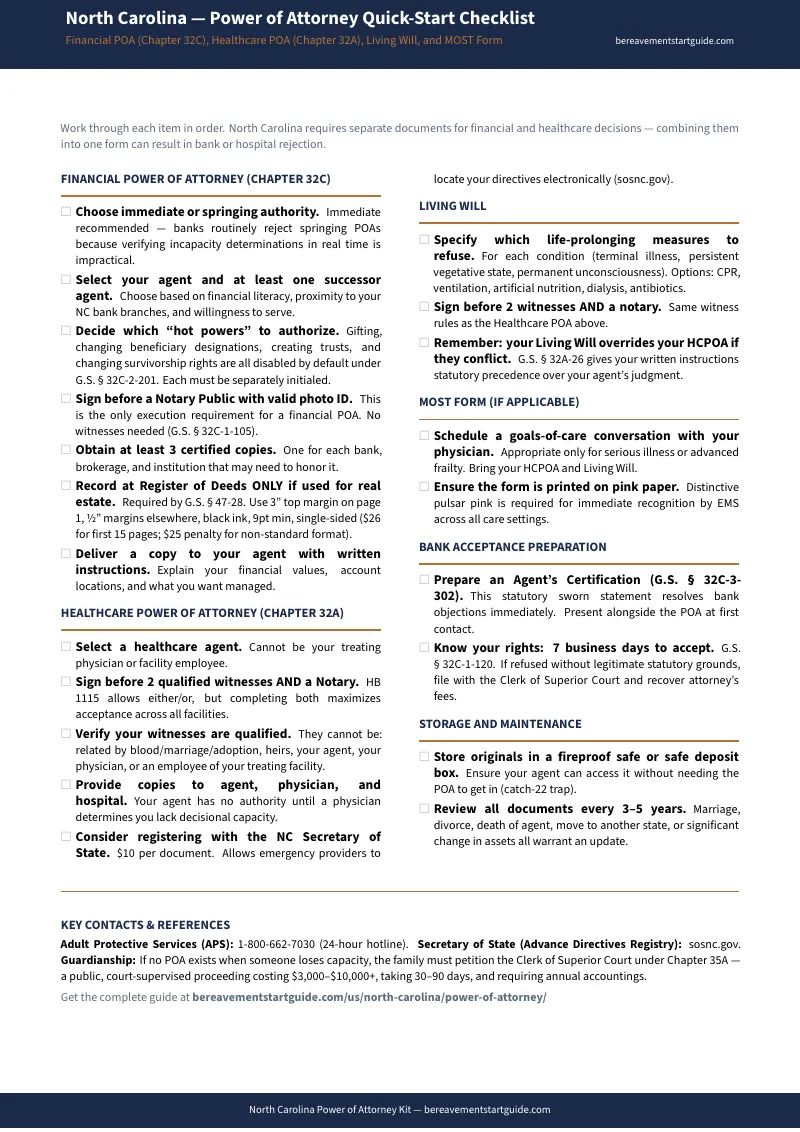
Download the free North Carolina POA Quick-Start Checklist to see the execution requirements at a glance. When you're ready for the complete system — every document, every signing protocol, every compliance tool — the full kit is waiting.