Your family shouldn't have to fight a probate court to honor your wishes
Every year in Ohio, families who thought they had "enough" planning in place discover the hard way that they didn't. A Living Will tucked in a desk drawer. A verbal promise to a spouse. A vague assumption that "the hospital will figure it out."
Then comes the crisis — a stroke, a fall, a surgical complication — and suddenly nobody has legal authority to make decisions. Ohio's default surrogate law (O.R.C. § 2133.08) kicks in: your adult children need majority consensus to act. Two children who disagree? The law deadlocks. The probate court appoints a guardian. Your family loses privacy, time, and thousands of dollars — while you lie in a hospital bed with no voice.
This is what happens when advance directives are treated as a single form instead of a complete planning system.
The Ohio End-of-Life Planning System
The Ohio Advance Directive & Living Will Kit isn't a stack of blank forms you download and hope you filled out correctly. It's a structured, step-by-step system that walks you through every document Ohio law requires — with execution instructions, witness qualification checklists, and county-specific filing guidance that prevents the most common rejection mistakes.
Most free resources give you a Living Will form and leave you on your own. They don't explain that Ohio has five distinct advance planning documents, each with different activation triggers, different signing requirements, and different legal authority. They don't mention that your witnesses can't be related to you by blood, marriage, or adoption — or that a Financial Power of Attorney requires notarization while a Living Will accepts either witnesses or a notary. They don't cover the Transfer on Death affidavit that keeps your house out of probate, or the Medicaid Estate Recovery rules that can claw back your home's value even after you've passed it to a beneficiary.
This kit covers all of it — in one organized, readable guide.
What's inside
- Living Will Declaration walkthrough — line-by-line instructions for Ohio's statutory form, with explanations of the two physician certification requirement and the specific triggers (terminal condition, permanent unconsciousness) that activate it
- Health Care Power of Attorney (HCPOA) guide — how to appoint your healthcare agent correctly, including the critical bold-print nutrition and hydration section that most people skip (skipping it means your agent cannot refuse tube feeding on your behalf)
- DNR Order process — how to obtain a State of Ohio DNR Comfort Care or DNR Comfort Care–Arrest order, the difference between them, and the four acceptable ID formats (printed form, bracelet, necklace, wallet card) that EMS will recognize
- MOLST explanation — when Medical Orders for Life-Sustaining Treatment apply, how they translate your values into actionable medical orders for hospitalization, intubation, and feeding tubes
- Declaration for Mental Health Treatment — how to document psychiatric care preferences (medications, ECT, facility admissions) before cognitive decline makes it too late, valid for three years under Ohio law
- Transfer on Death (TOD) Affidavit for real estate — step-by-step filing instructions under O.R.C. § 5302.22 to bypass probate entirely, including the spousal dower acknowledgment that's required if you're married
- Vehicle TOD designation — BMV Form 3811 walkthrough for naming a beneficiary on your vehicle title, plus the surviving spouse transfer rules for up to $65,000 in vehicles without probate
- Medicaid Estate Recovery protection strategies — how Ohio's broad recovery rules work under O.R.C. § 5162.21 (they reach TOD property, joint tenancies, and life estates), who qualifies for deferral, and how to apply for a hardship waiver
- Witness and notary checklists — document-by-document signing requirements so you never mix up which forms need witnesses, which need notarization, and which accept either
- County recorder filing guide — fees, procedures, and which counties offer Living Will registration with wallet-card locator numbers
- 6 printable standalone worksheets — action plan (23-step phased checklist), witness screening form, TOD filing checklist, Medicaid recovery reference card, forms quick-reference, and document distribution tracker
Who this is for
- Adults over 50 who want to lock in their healthcare wishes before a diagnosis forces rushed, emotional decisions
- Adult children helping aging parents plan — especially if siblings disagree on care preferences and you need clear, documented authority
- Ohio homeowners who want to keep their house, vehicles, and bank accounts out of probate (full administration costs 4% on the first $100,000 in fiduciary fees alone)
- Anyone preparing for surgery who needs to ensure their HCPOA is properly executed and immediately active
- Surviving spouses who went through a costly probate process once and refuse to put their children through the same thing
Why free forms aren't enough
Ohio's official advance directive forms are free. So are the PDFs from hospital associations and senior legal aid groups. Here's what they don't include:
- No execution instructions — You get a blank form with legal language but no explanation of what each clause means, who qualifies as a witness, or where to file it. County clerks are legally prohibited from helping you fill out forms.
- No asset protection — Free forms cover medical directives. They don't cover the Transfer on Death affidavit, vehicle TOD designation, or Medicaid estate recovery strategies that prevent your family from losing the house.
- No coordination across documents — A Living Will, HCPOA, DNR, MOLST, and Mental Health Declaration each have different signing rules, different activation triggers, and different legal authority. Free forms don't explain how they interact — or which one takes precedence when they conflict.
- No county-specific guidance — Recording fees vary by county. Filing procedures differ. Some counties offer wallet-card registration; most don't. Free forms assume one-size-fits-all.
Attorney-drafted estate plans solve these problems — at $1,000 to $5,000 per engagement. This kit delivers the same structured approach at a fraction of the cost.
Your peace of mind, protected
If the kit doesn't give you a clear, actionable path through Ohio's advance directive requirements, email [email protected] and we'll make it right.
— Less Than One Hour of Legal Consultation
Ohio attorneys charge $150 to $400 per hour for estate planning. A full advance directive package runs $1,000 to $5,000. This kit gives you the same document coverage and filing guidance — organized, step-by-step, and ready to use today.
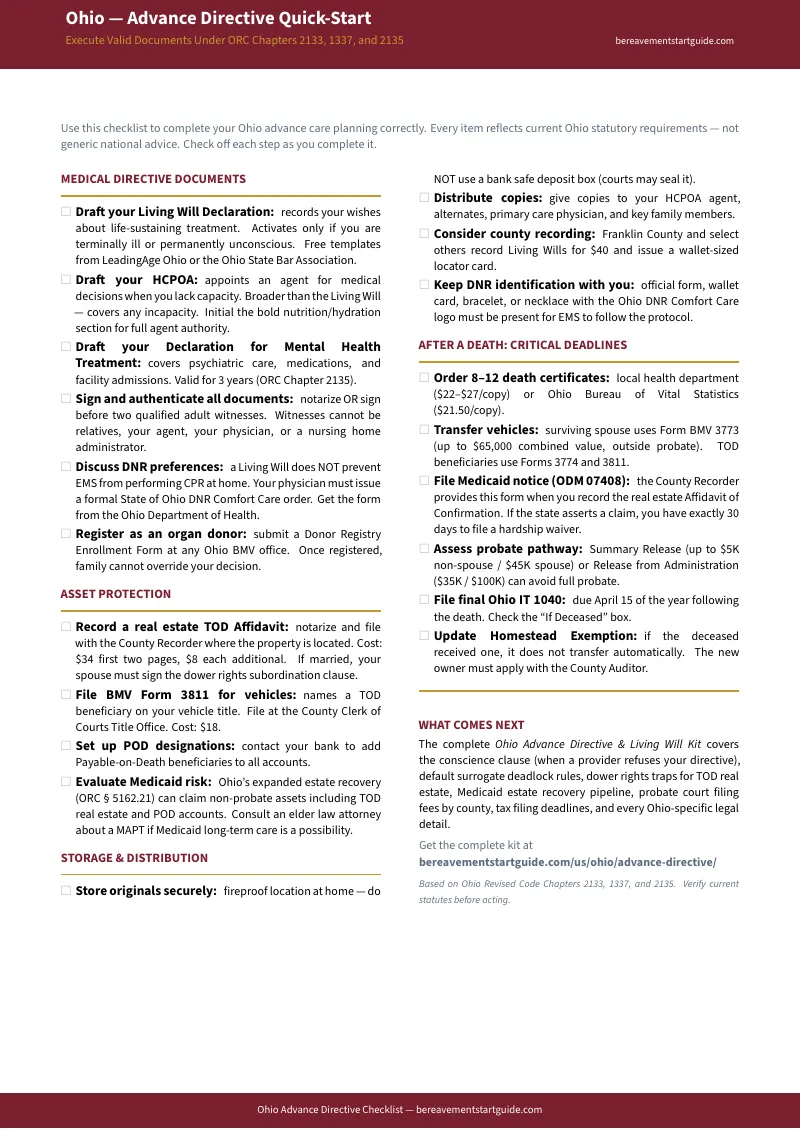
Start with the free checklist to see the planning framework. When you're ready for the complete system — with every form, every filing instruction, and every protection strategy — upgrade to the full kit.